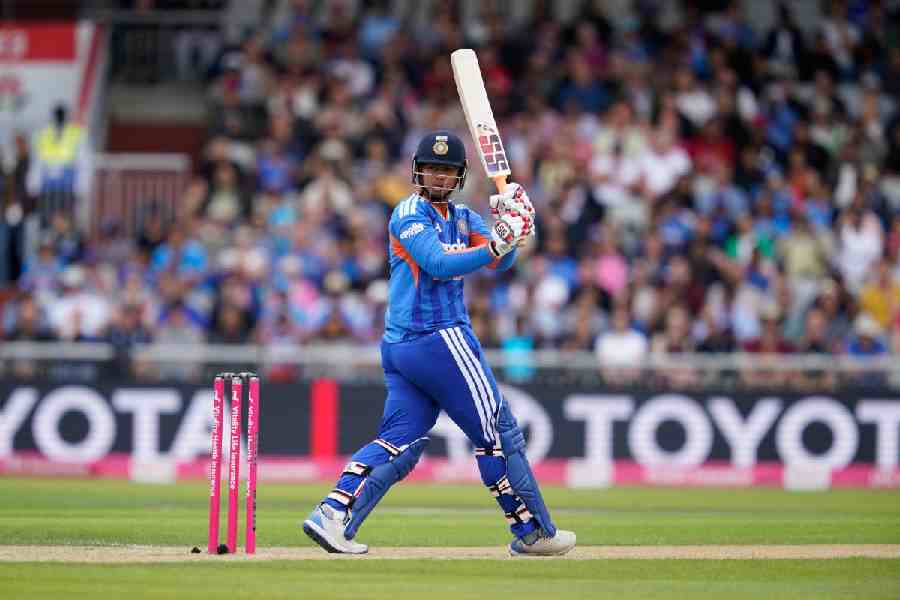
Vaibhav Sooryavanshi, the 15-year-old boy wonder from Bihar's Samastipur district, on Saturday became India's youngest debutant in international cricket, surpassing the legendary Sachin Tendulkar, who had held the record for nearly 37 years.
The left-hander was presented his India cap by teammate Tilak Varma before the start of the second T20 International against England at Old Trafford in Manchester, becoming India's 122nd men's T20 international and its youngest international cricketer at 15 years and 99 days.
The contrast in eras and personalities could not be starker.
At 16 years and 205 days, Tendulkar walked into the nation's collective consciousness with a game built on solid defence and artistic offence, defined by Mumbai's school of 'Khadoos' batsmanship.
However, Sooryavanshi seems unfamiliar with the concept of defence; his style is tailor-made for the demands of cricket's slam-bang T20 version. Fittingly, he made his India debut in the format that has fuelled his meteoric rise.
While Tendulkar's maiden international appearance reached Indian audiences through grainy Pakistan Television footage during the 1989 Test against Pakistan in Karachi, Sooryavanshi has entered the international arena with 4K cameras tracking his every move since landing in the UK.
While Vaibhav Sooryavanshi smashed a fearless 14 off 10 balls with two sixes on debut, Sachin Tendulkar’s iconic 1989 international debut yielded just 15 runs off 24 balls against Pakistan's fierce bowling attack
Widely regarded as one of India's brightest prospects, Sooryavanshi earned his first senior call-up after a meteoric rise that began with a blistering 35-ball century for Rajasthan Royals in the Indian Premier League (IPL) last year.
The teenager further enhanced his reputation in this year's IPL, finishing as the tournament's leading run-scorer with a strike rate of more than 237 and setting a competition record by hitting 72 sixes, breaking Chris Gayle's record for most sixes in a season.
He was named both the Most Valuable Player (MVP) and the Best Emerging Player in the competition, earning him a call-up to the T20I series against Ireland and England.
His performances prompted growing calls for a place in the national side, though selectors resisted fast-tracking him and waited until he turned 15 in March before naming him in India's squads for the T20 series against Ireland and England.
It's fair to say that Tendulkar was the cause. Sooryavanshi is the effect.
On that Wednesday of November 1989, Tendulkar stepped out at the National Stadium in Karachi to face an attack comprising Imran Khan, Wasim Akram, Waqar Younis and Abdul Qadir.
It was a time when the Berlin Wall was still standing and the Soviet Union was very much in existence. Rajiv Gandhi was still two-and-a-half weeks away from losing the Lok Sabha election and stepping down as India's Prime Minister. The era of economic liberalisation ushered in by Dr Manmohan Singh was still more than a year away.
Tendulkar belonged to the age of the floppy disk, while Sooryavanshi's generation is looking towards a future driven by artificial intelligence.
Not since Tendulkar's emergence has there been such anticipation around the debut of a young Indian cricketer. Sooryavanshi's meteoric rise has even caught the attention of international publications such as The Wall Street Journal and The Atlantic, despite cricket being a sport played in only a handful of countries.
Since arriving in England, fans have been making a beeline for selfies. Such is the craze that a fan was even seen taking a selfie with Sooryavanshi's Rajasthan Royals-appointed guardian, Romi Bhinder, happy to be clicked, even if it was with the teenager's manager.
Everyone wants a piece of Sooryavanshi, just as everyone once wanted a bit of Tendulkar. The difference is that Tendulkar emerged in pre-internet India, while today every fan armed with a smartphone is a digital reporter. The lines have blurred between 'public figure' and 'public property'.
Given Sooryavanshi's journey has only just begun, it is perhaps unfair to compare himi with Tendulkar. But the teenager had better get used to it. The comparisons are inevitable.