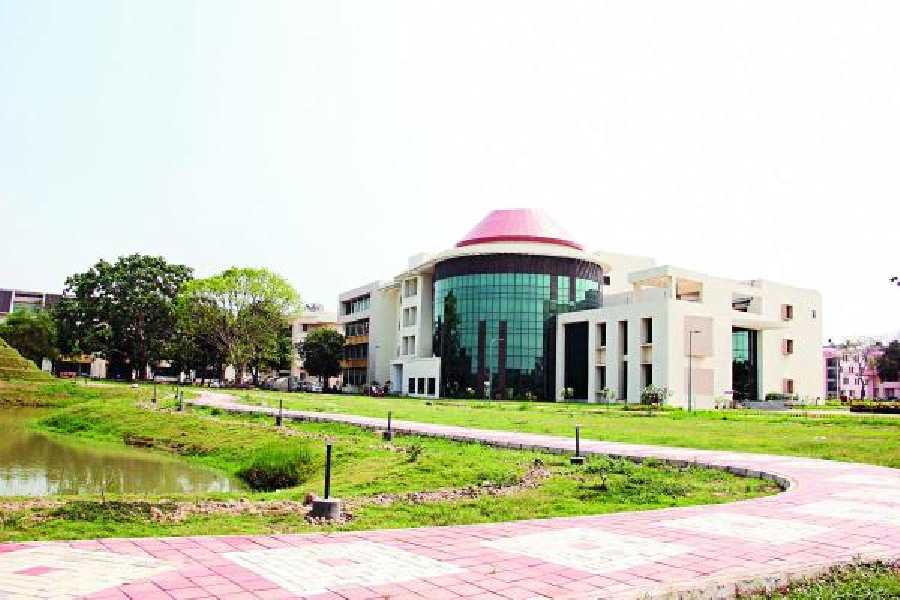
Scientists from the Indian Institute of Science Education and Research Kolkata (IISER-K), in collaboration with researchers from Jawaharlal Nehru University (JNU), New Delhi, have discovered an important mechanism that helps plants sense rising temperatures and adjust their growth accordingly.
The finding, which could help scientists develop crops that can better withstand climate change, has been published in the international research journal Science Advances.
The research explains how plants respond to warmer conditions by modifying their growth pattern. When temperatures rise, plants often grow taller by elongating their stems. This process, known as thermomorphogenesis, helps plants adapt to heat by improving their ability to capture light and maintain healthy growth.
The study was conducted using Arabidopsis thaliana, a small flowering plant widely used by scientists as a model to understand how plant biology works. The researchers discovered that a group of enzymes known as "LIGHT-RESPONSE BRIC-A-BRACK/TRAMTRACK/BROAD (LRB) E3-ubiquitin ligases" play a key role in controlling how plants react to increased temperatures.
According to the researchers, global warming poses a growing challenge to agriculture as higher temperatures can damage plant health and reduce crop yields. When temperatures rise from around 22 degrees Celsius to 27 degrees Celsius, plants begin to adjust their growth by producing more growth-promoting hormones such as auxin and brassinosteroids.
Understanding how this process works at the molecular level is important for developing crops that can continue to grow well under changing climate conditions.
The study shows that LRB enzymes act as important regulators by controlling two key proteins that influence plant growth. One of these proteins promotes plant growth under warm conditions.
The researchers found that LRB enzymes help maintain sufficient levels of this protein so that plants can activate the genes responsible for growth and hormone production.
At the same time, the protein normally slows down growth, and the enzymes allow plants to grow more efficiently when temperatures rise.
Chirag Singhal, the first author of the study, said the team used a combination of genetic, genomic and biochemical techniques to uncover how these enzymes control plant responses to temperature. He explained that this dual mechanism allows plants to finely adjust their growth depending on environmental conditions.
Lead researcher Sreeramaiah N. Gangappa, associate professor at the department of biological sciences of IISER-Kolkata, said the discovery highlights LRB enzymes as important regulators in the plant temperature-sensing system.
“The discovery identifies two enzymes, LRB1 and LRB2, which regulate proteins that determine whether plants respond positively or negatively to heat,” he said. “Rising global temperatures pose a serious threat to agriculture by affecting plant health and reducing crop productivity.”
He further explained that the researchers found LRB enzymes stabilise the protein considered the main driver for growth under warm conditions, enabling it to activate genes that promote hormone production and plant growth.
“Together, these actions allow plants to prioritise heat-adaptive growth when temperatures increase, even when light-related signals might otherwise restrict such growth,” he added.
The researchers say the findings are particularly significant because the LRB enzymes are present across many plant species, including major crops. This means the discovery could help scientists identify new ways to engineer or breed crops that are more resilient to rising temperatures.
The research was carried out at IISER Kolkata in collaboration with Prof Mukesh Jain from the School of Computational and Integrative Sciences at JNU, and was supported by the Anusandhan National Research Foundation and the department of biotechnology, government of India.
Scientists believe the discovery could eventually help farmers by enabling the development of crops that can maintain productivity even as global temperatures continue to rise.