
A small locality near present-day Budge Budge was the first Chinese settlement in Calcutta, much before Bowbazar and Tangra. The place is Achipur, named after Chinese trader Yang Dazhao (nicknamed Atchew) who arrived on the banks of the Hooghly in 1778 and has a temple worshipping him.
Park Street: A lecture on a Chinese migrant community on Wednesday took the audience at Indian Museum a couple of hundred years back.
Tansen Sen, the director of the Center for Global Asia in New York University, Shanghai, traced the history of Chinese migration in India. In a pictorial presentation, he showed how the migrant community carried its faith to the places it went to and localised it according to the existing culture.
Atchew arrived during the time of Warren Hastings. The trader had brought a huge quantity of tea and the governor general, a tea lover, offered him a piece of land to settle in, Sen said.
The Chinese trader set up a sugar mill on the banks of the Hooghly, south of Budge Budge. The tiny settlement around the mill - it drew several workers from mainland China - soon became a Chinese colony. The settlement was christened Achipur after the trader. The community grew and spread to Bowbazaar and, much later, to Tangra.
Unrest in south China forced many to seek livelihood in foreign lands. Cantonese migrants started coming in the mid-18th Century and those from the Sihui County near Guangzhao (Canton) migrated to Malaya and British India in the mid-19th century. Migrants from Siyi and Hakka also came to Calcutta in large numbers.
Sen's presentation showed how temples from Sihui County travelled thousands of miles to Calcutta. Ruan Ziyu and Liang Cineng - followers of the sixth Chan/Zen patriarch Huineng (638-713) - have separate temples in Sihui County but are found together in a temple off Blackburn Lane near Tiretta Bazaar. The Ruan-Liang temple, built in 1908, has two other deities - Lu Ban, the Chinese god of carpentry, and Atchew.
"The temples were not just places of worship, they played an important role in preserving the sub-dialect community's identity and in the mingling of Chinese and local ideas," Sen said.
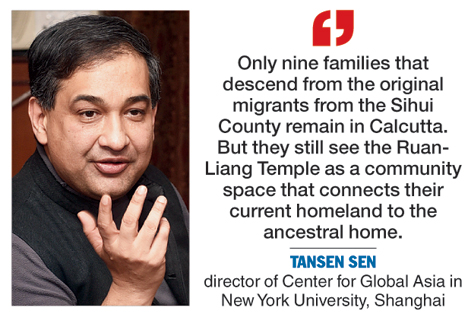
Only nine families that descend from the original migrants from the Sihui County remain in Calcutta. "But they still see the Ruan-Liang Temple as a community space that connects their current homeland to the ancestral home," the professor signed off.