Meghnad Mondal is in hospital with a bad liver. But he has had a new ailment since being admitted to Calcutta Medical College and Hospital on Saturday: he can’t sleep at night. Meghnad stays awake for the fear of the rats and roaches that rule the floors after dark. He can’t sleep during the day either, as the dirty feet shuffle past and the rotting rice makes him sick.
 |
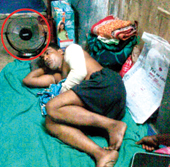
| On the floor at SSKM’s Curzon ward, medicines are not the only things being provided by the patient’s family. They have had to buy a fan (circled) for Rs 800 because there is none anywhere near Joypada Mondal, 45. “He would have died of the heat had we not bought it,” Bishnupada said about the plight of his younger brother, in hospital with a fractured skull and arm. A plastic bag to carry diagnostic reports, lying behind the patient’s back, says ‘Yes we care’. |
 |
| Chaitanya Oraon, 24, is comatose since a head injury in Balurghat, South Dinajpur, but one only hopes he is getting the oxygen he desperately needs. A critical care expert told Metro the oxygen supply could be severely hampered if a cylinder was placed flat on the ground like it was at SSKM. |
 |
| At Calcutta Medical College and Hospital’s male surgery ward, at least 15 patients are on the floor on both sides of the 30-feet corridor. Many of the relatives have squeezed themselves between the wall and the patients. Pictures by Amit Datta |
Hospitals have made it a habit to admit patients on the floor to overcome their scarcity of beds but it is a stop-gap arrangement fraught with life-threatening possibilities, warn doctors.
From the scare of secondary infection to the fear of not being heard by doctors who rarely bend their knees, dangers abound on the narrow hospital corridors cramped with critical patients.
At SSKM Hospital on Tuesday, Metro saw a comatose Chaitanya Oraon, his oxygen cylinder lying on the ground over his head. At Medical College and Hospital, Rauf Shah lay with his catheter next to him on the floor.
“If the catheter isn’t at a lower level, the flow of urine gets affected. The retention of urine in the bladder because of the catheter’s faulty position leads to serious infections,” admitted an associate professor of Medical College who would not be named.
A flat oxygen cylinder on the floor hampers supply, endangering a critically ill patient.
“A patient on the floor can never get proper treatment. If there is a heart attack, for example, it will be almost impossible to manage,” critical care expert Subrata Maitra told Metro.
“Even administering drip or blood is a problem. Critical patients should never be on the floor,” added another doctor.
But the number of people on the floor in Calcutta’s medical college hospitals has jumped over the past fortnight with Mamata Banerjee insisting no patient should be refused admission. On Monday, the chief minister signalled her approval of treatment on the floor, saying a hospital that could treat 10 patients could treat 10 more if it wanted.
At RG Kar Medical College and Hospital’s gynaecology department, there are 100 beds while another 100 patients — many of them mothers with newborns — are on the floor.
“It is a peculiar situation. We are blamed for turning patients away and then we are blamed for not providing them beds. No one seems to realise that we only have a certain number of beds,” a doctor said.
It may not always be the case that a patient is on the floor because all beds are full.
At SSKM, a tout had sought Rs 800 from Pulok Sardar to have his brother-in-law Khokon shifted to a bed. Khokon, 24, a day labourer from South 24-Parganas, suffered serious head injuries when he fell off a moving train on the way to work. At the New Casualty Block, he is at “F (floor bed) 12”.
“Doctors have not examined him once. They just stand and ask what has happened to him. They don’t even examine him,” said Pulok Sardar.
As hundreds of families spend their days with the consolation of having their kin “admitted” to a hospital and the concern about them getting worse, Metro found that treatment on the floor was often no treatment at all.
“A doctor needs 10 to 15 minutes to properly examine a critical patient. But it’s impossible for senior doctors to squat for so long. So they finish in three to four minutes and move on. The second visit is often given a miss,” said a senior doctor at Calcutta Medical College.
Flies and smelly remnants of lunch were the only companions for many of the patients. Meghnad’s wife threw away a new packet of biscuits that she had carefully kept to his right after he saw a rat nibble at it.
“These patients are most vulnerable to hospital-borne bacteria and viruses. The filth can easily lead to afflictions like sepsis and respiratory and urinary tract infections,” said a doctor.
Because of the filled-up floors, it is often difficult to clean them, increasing the chance of infection.
“Ideally, a hospital floor should be cleaned twice a day. But we sometimes can’t clean them at all for several days because of overcrowding,” said Siddhartha Mukherjee, superintendent of the Calcutta Medical College and Hospital. “But at the same time, we can’t refuse critical patients.”
The demand-supply ratio has to be corrected, said Maitra. The only way to do it is to improve the infrastructure at peripheral hospitals.