
Pictures by Sudeshna Banerjee
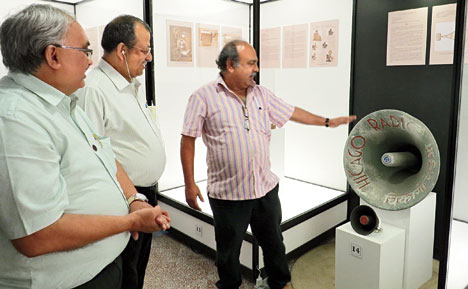
An exhibition is underway on the first floor at the National Council of Science Museums office in Sector V opposite Nalban which showcases some unique scientific artefacts which played an important role in history of our technological development.
The exhibition was inaugurated on International Museum Day last week. “The problem in India is that we do not have many scientific artefacts. These industrial artefacts are from the British Raj era and sourced from outside. Every object is an interesting story as they are objectified ideas. We have showcased inventions from mostly the 1920s and 30s,” said curator Manas Bagchi.
“We take technology for granted. When we make a call on the telephone or switch on the TV, we forget how many people stood on the shoulders of other giants to make these technological marvels possible,” said Jayanta Sengupta, secretary and curator of Victoria Memorial. He also lamented how science and humanities were taken to be separate cultures. “We do not read the history of science.”
The exhibition, on from 10.30am to 5pm till Saturday, showcases the development of artefacts as various and as familiar as gramophone, 16mm movie projector and microcomputer. Viewers can plug in a wifi-based audio narrator devised by scientific officer Satadal Ghosh to hear about the history of each object they stand in front of.
MADE IN CALCUTTA

The centrepiece of the exhibition is the semi-automatic ionospheric recorder manufactured in the radio physics department of Calcutta University. The founder of ionospheric science and radio technology in India was Professor Sisir Kumar Mitra (1890-1963) .
He was one of the few Indian physicists whose name was in contention for a Nobel Prize in physics and who earned the Fellowship of the Royal Society, London. In 1925-26, experimental evidence had been obtained in England and the US of the existence of ionization in high atmosphere. Mitra’s group could measure the heights of the different layers of the ionosphere by an instrument designed and built indigenously. The investigations carried out in Mitra’s laboratory not only provided the first general picture of the ionospheric condition in a sub-tropical region in low altitudes like in Calcutta but experimental results obtained by them also threw light on effects of thunderstorms, magnetic storms and meteoric showers on upper atmospheric ionization.

Musical box: This specimen from L’Epée, of Saint Suzanne, France, marketed in India by Seethaphone Co. of Bangalore, dates back to 1893. The idea of a self-playing musical box was developed from the carillon bell towers used in Europe where a rotating barrel pinned with cogs in certain positions would move hammers to strike tuned bells at the proper time to produce music. The invention is indebted to watch-makers as the first musical movement was made possible by a tuned steel comb played upon by pins or pegs set in a cylinder or disc contained in a watch. The musical box industry started in Switzerland and grew to employ over 100,000 workers in Europe and America.

Electric typewriter: Yes, IBM also made typewriters. Here’s a 1963 IBM Executive C model on display. The Executive model of electric typewriter was the most dramatic advance made in the typewriter industry. A quarter million Executive Cs were sold within the first 19 months after production started in 1959. IBM produced the first electric typewriter, the Model 01, in 1935 and continued producing typewriters till 1990.

Rotary duplicating machine: Manufactured by Roneo Ltd, London. The first Roneo was patented in 1906. This duplicator from the mid-teens is typical of the first single drum rotary duplicators but is a refinement, being equipped with a counter and replacing the centre crank handle and gearing to allow for turning in both directions. Such models were typically used in small offices or factories.


Smith premier typewriter: The Smith Premier Typewriter Company was named after the four brothers — Lyman, Hurlburt, Monroe and Wilber. Priot to entering the typewriter industry, they were gun manufacturers. In their employ was Alexander Timothy Brown (in poster), whom the brothers gave creative licence to create a new typewriter which was eventually patented in 1889.


Parcel balance
The Salter’s parcel balance has a cast iron frame on a circular base with three lobes, brass circular dial with engraved markings, and a weighing tray. Salter Housewares, a leading British manufacturer of domestic weighing scales, was born in late 1760 in the village of Bilston, England, when Richard Salter, a spring maker, began making pocket steelyards, a scale similar to the fisherman’s scale of today. By 1825, his nephew George had taken over and established a company that produced the UK’s first bathroom scale.

Mail box: Legend has it that sailors used to leave letters in caves on islands for downward ships to pick them up for delivery. That is how the idea of the letter box germinated. Letter boxes started getting used in India in the mid-19th century.

Mechanical calculators: These 1961 models were made in Sweden and weighed 6.75kg. When one of the setting levers is moved to a number then that number of pins are raised on the corresponding pin wheel (moving a lever to 6 raises six pins). The raised pins act as gear teeth and advance the individual accumulator wheels (with numbers at the bottom right) by the number of pins, thus adding the set number to the accumulator. Multiplication was done by turning the handle the required number of times to add the same number to the accumulator. The numbered wheels at the bottom left keep a record of the turning of the handles.

Telephone Magneto: Alexander Grahan Bell’s invention was not immediately popular. The biggest problem was to make the caller realise that he was being called. That problem was solved when Graham Bell’s assistant Thomas Watson devised a ringer. A hand crank was added to the device by turning which a coil was made to rotate in a magnetic field that generated electric current which was sent to the recipient’s end and rung an electric bell. The telephone then became a hit.