 |
 |
 |
 |
 |
 |
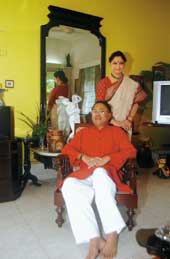
| From top • Amit and Sonali are the proud owners of various pieces of heirloom furniture including this Belgium glass mirror with Burma teak frame • The original thakurdalan where many plays written and enacted by Girish Ghosh have been staged • The baithakhana of the original house has a wall adorned with oil paintings of the Basu ancestors • The brown marble clock that ghori babu tunes every Saturday • The Basus have a huge collection of decorative items picked up from across the world. This includes an excellent range of China, ivory and crystals. Three almirahs in the drawing room of the new house store 200 such pieces • This grandfather clock is included in the collection of antique timepieces Pictures by Aranya Sen |
Heritage houses require time, effort and more than a little money to maintain. Fighting an uphill battle to preserve a piece of the city’s past are the Basus of Bagbazar.
Their home dates back to 1856 when the young engineer, Nilmoni Mitra designed the palatial residence. Spread over 80 bighas of land, the house had 100-odd rooms, five courtyards, a tennis court and swimming pool. Today, most of the structure has been sold off or taken over by the government, but solicitor Amit Basu, one of the heirs to the property, is still striving to maintain his portion.
Tucked away from the pollution and noise of the main road, the 30-foot facade still retains the grandeur of yesteryear. “It is difficult, if not impossible, to maintain such a huge property,” says Amit Basu, who grew up in the home. Till a few years ago, he continued to live in the mansion before moving to a modern dwelling he constructed next to the original house.
Basu has, however, with the help of his wife, actress Sonali Gupta (daughter of Kajol and Dwijen Gupta), managed to hold on to a collection of paintings in the baithakhana (outer drawing room) along with a grandfather clock that still gives perfect time. Most of the other heirloom furniture and an excellent collection of decorative pieces, from China to crystal to ivory carvings, find place in Sonali and Amit’s new residence.
The effort is also on to keep as much of the original home intact as possible. “To maintain a house like this, funds are the main concern. I am trying to get organisations interested in preserving at least the thakurdalan, but so far, nothing has come of it,” complains Amit.
The residence has witnessed a number of historic events. “Our ancestors Nandalal Basu and Pasupati Nath Basu were involved with the freedom movement. Many freedom fighters — Subhas Chandra Bose, Chittaranjan Das, Jawaharlal Nehru, Sarojini Naidu — were some of the frequent visitors here,” revealed Basu. Swami Vivekananda apparently received his first civil reception after coming back from the Chicago conference at the Basu home. Rabindranath Tagore, too, has used the mansion as a platform to call for strengthening of amity between Hindus and Muslims.
At the new address, modern exteriors do not take away from the old-world charm. “Maintaining antiques requires patience, but I enjoy the effort,” smiles Sonali. The Basus take pride in their collection of half-a-dozen clocks, some several decades old. “We have a ghori babu (clock man) who comes every Saturday to tune and time the clocks,” says Sonali. The grandfather clock still remains in the old house, while a marine clock and a timepiece of brown marble adorn the new house.
A keen collector of souvenirs from across the world, Sonali takes great joy in the impressive collection of handcrafted artefacts — including an extensive collection of old China and ivory — inherited from her in-laws. Three almirahs in the drawing room store around 200 such delicate pieces. Marble statuettes, a marble-topped settee, a six-foot-tall Belgium glass mirror in a Burma teak frame with ancient carvings add grace to the Basu abode.
Do and don’t
The monsoon is the worst enemy of old houses. We find it especially difficult to maintain oil paintings as old canvases are vulnerable to the damp. Occasionally they must be re-framed.
Small plants with strong roots can bring even the toughest building down. De-rooting them is critical.
Keep the artefacts in glass cabinets and clean them once in a while with a brush or a soft cloth.