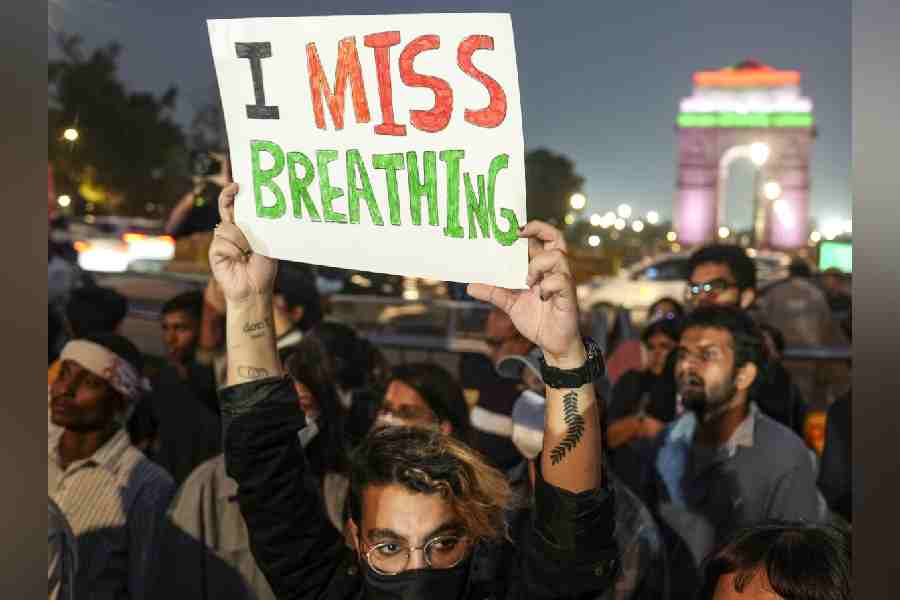
Pakistan is the world’s most polluted country when it comes to levels of fine particulate matter, followed by Bangladesh, Tajikistan, Chad and Congo, with India at the sixth spot according to the World Air Quality Report 2025, the eighth edition of the report published by Swiss air quality technology company IQAir.
India does not have much to cheer about in the report, which analysed data from monitoring stations across 9,446 cities in 143 countries, regions and territories; Loni in Uttar Pradesh is the world’s most polluted city and Delhi is at fourth spot.
In fact, five of the 10 most polluted cities across the globe are in India. Byrnihat on the Assam-Meghalaya border, UP’s Ghaziabad and Ula – better known as Birnagar in Bengal – are also in the top 10.
"The world's 25 most polluted cities were all located in India, Pakistan and China, with India home to three of the four most polluted,” the report said. “Loni, India, was the most polluted city, recording an annual average PM2.5 concentration of 112.5 µg/m³-a nearly 23 per cent increase from 2024 and more than 22 times the WHO guideline."
Year on year, 54 countries experienced a rise in the annual average of PM2.5, a total of 75 saw a drop, two remained unchanged and 12 were newly represented in this year's dataset.
"Only 14 per cent of global cities met the WHO annual PM2.5 guideline of 5 µg/m³, down from 17 per cent the previous year,” the report said, “Only thirteen countries/territories met the WHO annual average PM2.5 guideline-French Polynesia, Puerto Rico, US Virgin Islands, Barbados, New Caledonia, Iceland, Bermuda, Réunion, Andorra, Australia, Grenada, Panama, Estonia.”
What causes most pollution
Wildfires, intensified by climate change, played a major role in degrading global air quality in 2025. Record biomass emissions from Europe and Canada contributed to approximately 1,380 megatonnes of carbon.
Canada was the most polluted country in Northern America for just the second time in the report's eight-year history, as its second-worst wildfire season on record affected air quality across Canada, the US and parts of Europe.
"In the United States, annual average PM2.5 levels increased to 7.3 µg/m³. Smoke from wildfires in both Canada and the US raised averages across parts of the Great Lakes states in the summer and in the Pacific Northwest in the fall. El Paso was the most polluted major city in the United States. Historic dust storms triggered a 46 per cent increase in PM2.5 levels to 11.4 µg/m³ as the city recorded the highest number of major pre-summer dust storms since the 1930s,” the report said.
"The Southeast Los Angeles region (Cudahy, East Los Angeles, Huntington Park), heavily impacted by wildland-urban interface fires, ranked as the most polluted area in the country. Seattle remained the cleanest major US city for the second consecutive year, with an annual average of 4.5 µg/m³," it added.
Pollution rises in Europe too
Across Europe, 23 countries recorded a rise in annual average PM2.5 concentrations, 18 recorded a drop, and one was newly added.
Switzerland and Greece experienced increases exceeding 30 per cent due to transboundary wildfire smoke from Northern America and Saharan dust from Africa. Malta recorded the largest decrease at nearly 24 per cent.
The end of the US State Department's global air quality monitoring programme at embassies and consulates in March 2025 caused millions to lose access to air quality data. Centre for Research on Energy and Clean Air (CREA) reported that monitoring efforts in 44 countries were weakened and six were left without any monitoring.
"Air quality is a fragile asset that requires active stewardship to protect public health,” said IQAir global CEO Frank Hammes. “The 2025 World Air Quality Report makes clear that without monitoring, we cannot fully understand what's in the air we breathe. Expanding access to real-time data empowers communities to act. By reducing emissions and addressing climate change, we can drive meaningful, lasting improvements in global air quality."
The report underscored the importance of expanding air quality monitoring networks, particularly through low-cost sensors that empower communities, researchers and policymakers with actionable data.
"The World Air Quality Report reveals two competing realities: an air pollution crisis and the rise of communities, scientists and data working to meet the challenge. In 2025, familiar culprits like industrial agriculture, wildfires and fossil fuels left their mark in the data collated by IQAir worldwide," said Aidan Farrow, senior scientist, Greenpeace International.
"This open, transparent data is an essential tool for holding polluters accountable and securing a healthy environment for everyone," he said.