 |
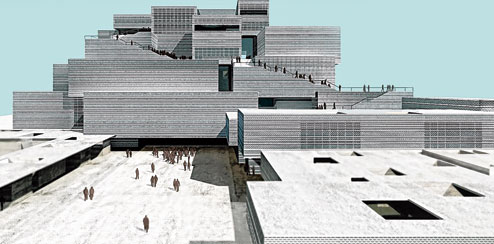
| An artist’s impression of the museum |
The brand new Kolkata coming up in the green pastures of Rajarhat over the relics of colonial Calcutta, will, in about three years’ time, be able to boast its very own landmark. This landmark will be quite as iconic as the ones of old Calcutta like the Indian Museum, General Post Office, and Writers’ Buildings, and will be the first of its kind in India. After years of wait, at 1pm on Thursday, Mamata Banerjee will lay the foundation of the Kolkata Museum of Modern Art (KMOMA) which is designed by Herzog & de Meuron based in Basel, Switzerland, the acclaimed architects who created the Bird’s Nest Olympic stadium in Beijing and the Tate Modern in London.
It will be the first building in India to be designed by Herzog & de Meuron and will celebrate “art sensibility” through as much the exhibitions and activities it will be involved in as its multi-layered structure that collapses time and space, recalling at the same time a ziggurat or a stupa and a futuristic urban structure. The G+9 KMOMA building, 48.75 metres high, will come up on 10 acres gifted by the state government in the Rajarhat area close to the Ecotourism Park. It is a 10-minute drive from the airport and the East-West Metro is coming up close to it. The building itself will cover 550,000sqft, and the space will be divided into two zones — apart from a museum containing 44 galleries, art restoration, education, research facilities, photographic facilities, offices and theatre, it will have a “Culture City” containing a plaza, an amphitheatre for 1,500 people, artist’s studios, a 500-seat auditorium, art education facilities, and 14,330sqft retail space where textiles, books and artefacts will be sold. KMOMA is a tripartite venture involving the Bengal government, the Centre and the private sector.
According to the Herzog & de Meuron website, “the concept envisions a collection of simple rectilinear volumes of urban and monumental scale, arranged to express the complexity and diversity of the programme. It draws on traditional Indian construction principles of stacking individual elements, producing a coherent and legible whole through the collection and compression of diverse, unique elements. These elements appear as strata in the façade of the volumes and reflect the simplicity with which they will be built. At the east and south entrances to the site, volumes and voids create courtyards, streets, alleyways and market-like experiences which lead the visitor into a central plaza, a place for gathering and orientation. At the west end of the plaza, the museum rises in a vertical stack of volumes asserting a presence within the complex and the greater urban context. Punctuated throughout the complex are a series of public spaces connected by a network of generous staircases carving out the exterior and interior of the building. The assembly of different programmes, scales and qualities throughout the site gives the proposal a city-like quality. The new KMOMA recognises the importance of public space in India and offers visitors many opportunities for discovery and interaction within a diversity of spaces.” The structure will be eco-friendly, taking into account Calcutta’s muggy summers and high levels of humidity. It will use “passive methods” of climate control to protect visitors from the heat and rain. It will be constructed with “unique cast masonry blocks” and “specific volumes are shifted relative to one another to protect facades below from direct exposure to the sun, or to create shaded exterior spaces”. Elegant jali-like screens will provide shade and control the light within. The spaces where visitors are meant to congregate are shaded and enjoy natural cross-ventilation. Considerable thought has been given to the selection of building material. Landscaping “plays an important role in bringing together the diverse building programme, public space and quality of the cultural and natural landscape”. The lush greenery around the peripheries of the building, the trees planted in the pedestrian pathways and the many courtyards will provide shifting vistas. The rise and fall of the water level in a water basin in the central plaza will indicate the change in seasons. Christine Binswanger, partner, Herzog & de Meuron, will oversee the project to be executed by Abin Chaudhuri, executive architect, Abin Design Studio based in Calcutta.
Rakhi Sarkar, director, CIMA gallery, who is the managing trustee of KMOMA, told Metro that the design of the building will be “very contextual to our conditions, aesthetics and way of life. It will be a serious piece of architecture. The design was evolved though 14 to 15 intensive workshops where all stakeholders from artists, actors and urban planners participated. It is a very holistic and inclusive project.”
Sarkar sounded upbeat. “We are very hopeful. There is excellent response from all over. The corporate sector is always looking for good projects for sponsorship. We do not fear funding will be any problem. The funds will start coming in once construction begins,” she stressed. In the past few years, about three small auctions have been held to raise funds. At an auction conducted by Sotheby’s in New York in 2007, Rs 4 crore was raised, and some donors have already made commitments. The Bengal government will bear one-third of the project cost, and dialogue has been initiated with the Centre. “The private sector will drive the whole organisation,” she said.
The activities of the museum have already started. Renowned curators will soon organise small exhibitions, and a conference on urban planning has been slated for next February. Charles Correa is expected to attend it.
Sarkar emphasised the academic role played by KMOMA, and 25,000sqft has been allotted for this. International art academies will offer post-graduate courses in art history, art management, and restoration. It is meant to encourage research and will have a large archive. KMOMA will off and on work with the Courtauld Institute of Art in the UK. On its academic advisory board will be Prof. Jean-Francois Chevrier, former professor of École nationale supérieure des Beaux-Arts, Paris, Dr Kwok Kian Chow, director of the Singapore Art Museum, Singapore, Dr Partha Mitter, London, Dr Deborah Swallow, professor and director of the Courtauld Institute of Art.
KMOMA has been planned as a multidisciplinary project and every year, three to four projects in the fields of visual arts, designing and performance arts will be held. “Work will full-fledgedly take off from next year,” said Sarkar. International agencies and personalities will be involved. On the programme committee are Dr Sabyasachi Bhattacharya, Prof. Swapan Chakravorty, Jogen Chowdhury and Suman Mukhopadhyay. This is in keeping with KMOMA’s mission statement by Prof. Frank J. Korom: The Kolkata Museum of Modern Art’s mission is to acquire and display modern Indian art in its local global cultural contexts in the city that inspired Indian modernism. It is further committed to interdisciplinary research and the dissemination of knowledge about Indian art and culture through scholarly publications, innovative teaching curricula, and public outreach programmes. KMOMA strives to become a distinct centre of expertise on art where visitors can experience and learn about trans-Asian connections with India and the world at large.
KMOMA will have a collection of art works as a nucleus, and artists and collectors have made commitments. Besides there will be long-term and short-term loans from private collectors and Indian private holdings. But the emphasis, Sarkar said, is on the museum becoming a “living space, turning it into a vital centre with a lot of activity and not just a dead repository”.
A Staff Reporter