 |
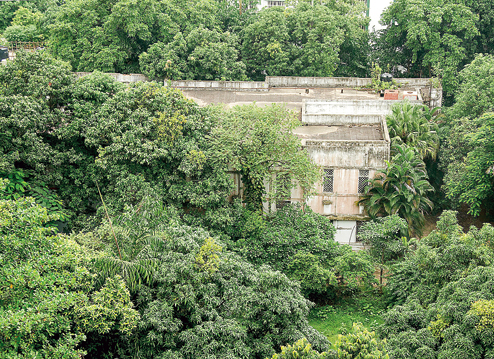
| The building at 3/1 Sunny Park before a realty firm started demolishing it |
The high court on Thursday issued an interim order restraining a real estate company from demolishing a house at 3/1 Sunny Park, a 72-cottah plot where a 27-storey building has been planned.
Justice I.P. Mukherjee issued the order on a petition moved by Siddhartha Mitra, counsel for residents of the area, claiming that the property has all the attributes to be declared a heritage structure.
“The building is in German design and meets all the criteria to be declared a heritage structure. Many eminent personalities of the city, through a joint petition on August 9, requested the municipal commissioner to declare the house a heritage building,” Mitra submitted while moving the petition.
The plea, Mitra later said, is pending.
“In the meantime, a group of people reached the spot with bulldozers and electric cutters and started demolishing the building. I moved the court and Justice Mukherjee issued a day’s stay on the demolition and gave me liberty to file a proper application seeking a stay,” Mitra said.
The property is now owned by the PS Group, a real estate firm. “The building is not a heritage structure as of today and it was bought in 2011. The high court has issued a stay… let’s see what happens next,” a source in the developers’ camp said.
“The plot is spread over 72 cottahs. The building is expected to come up on 12 cottahs and the rest will be vacant. Residents of the area will not face any obstruction. They need not worry,” he added.
The petitioners said the house was built in Bauhaus design in 1940. “We had in August approached the Calcutta Municipal Corporation to declare the building a heritage structure. But the authorities are sitting over it,” said Swaroop Mukerji, who lives in a housing complex opposite 3/1.
The two-storey house at 3/1 initially belonged to Janakinath Ghosal and Rabindranath Tagore’s eldest sister Swarnakumari Devi.
Ghosal’s granddaughter Ramala Bhattacharya sold the property to the PS Group. The developers removed the tenants and started demolishing the structure early this year.
Author Amit Chaudhuri, among the protesting neighbours, said: “I used to notice this building from my flat. It was interesting because of its clean lines. But we discovered its historical significance only when we started researching its past and learnt that it was built not in the 1960s or ’70s — as we had originally assumed — but in 1946. That immediately made it unusual. A Bauhaus structure of the 1940s would be unusual anywhere, even more so in Calcutta. With its clean lines and lack of ornamentation, it was a radical architectural style for that time, it was an architectural statement.”
Mukerji said: “Tagore had stayed at this house for a few days and mentioned it in Chhinnapatrabali, the collection of letters.”
“Our locality is infested with commercial establishments and the 40ft road remains packed with cars parked on both sides. If another 27-storey structure is built in this area, it will lead to trouble for all residents,” said Mukerji.