 |
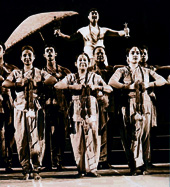
nCome July, a theatre group from town will get to rub shoulders with performers worldwide at a theatre gala in Germany. Rangakarmee, steered by Usha Ganguly, has been invited to stage Kashinama at the International Theatre Festival ? Theatre der Welt 2005 ? in Stuttgart, from July 3 to 12. The troupe will fly with its original cast of 40 members, comprising actors from age six to 70.
Based on Kashinath Singh?s Pande Kaun Kumati Tohe Lagi, Kashinama rips off the fa?ade of economic progress that masks the dishonesty of religious emissaries in the holy city of Varanasi. It also harps on the threat that tradition and culture face in the sweep of globalisation and is the only production to have been invited from Asia.
The festival will have participants from the Netherlands, South Africa, Sweden, Turkey and the US, among others.
?The artistic director of the festival had seen Kashinama in Delhi last year when we staged it at the month-long NSD festival. She chose our play from among performances at Prithvi Theatre and Chennai festivals. I feel Kashinama is very relevant today and is in sync with the theme of this year?s festival, the effects of globalisation on contemporary theatre,? said Ganguly on Thursday. Under her direction, Rangakarmee has established itself as one of the city?s foremost theatre groups with 27 productions over a span of 29 years.
?Though we have performed abroad before, those were on invitation from Indian communities. This is the first time we will be part of world theatre,? added Ganguly.
After debuting in January 2003, Kashinama has already held 70 shows at several venues across India. The one-hour-50-minute production will have surtitles for the German audience at all the three shows. The set for the production is partly being manufactured in Germany.
This apart, Rangakarmee has also been asked to perform indigenous theatre songs at a programme as part of the event.
nIt was just the other day that we covered a new production of Waiting for Godot. Hard on its well-worn heels comes another one, staged by Theatrecian on June 19. Actually, there is a Bengali version as well, Dream Theatre?s Godor Pratikshay, still running, which had a repeat show on June 17 ? but it dates back several years, though it newly features a Bangladeshi actor in the role of Estragon. The fact that the metro can support so many interpretations at one time suggests that Calcuttans sympathise enormously with the existential predicament of Beckett?s tramps.
Debutant director Tathagata Singha certainly makes a splash in his first attempt; he has even partially read my mind in his reading of the play. The easiest thing to do is follow the author?s instructions with respect to casting.
However, with any dramatic classic, too much respect undermines the theatrical surprise element because almost everyone knows beforehand what happens, varying degrees of predictability set in during the act of watching. The director?s duty is to apply an individual artistic and imaginative vision to such a text so as to explode that know-it-all sense in the spectator.
Since Didi and Gogo (to a large extent) and Pozzo and Lucky (to a lesser extent) represent all humanity, it seems logical not to necessarily confine their parts to the same actors. Thus, Tathagata does a neat reversal after the interval: the men playing Didi and Gogo switch over to Pozzo and Lucky, and vice versa.
In principle I approve of the decision, though I would not have used this particular changeover myself. Practically speaking, it leads to problematic dilemmas in the rehearsal process. Do the new performers act as if they are the old characters, or do they act as a different set altogether? Tathagata and the cast did not appear to have reconciled this satisfactorily, because both methods were in evidence.
With a relatively stylised, po-faced Didi (Ronaan Roy) and a more natural, carefree Gogo (Sumeet Thakur), Act I got a flying start and maintained its pace when a time (read stopclock)-obsessed Pozzo (Deborshi Barat) entered with a decidedly gloomy Lucky (Tanaji Dasgupta), who danced a fantastically catatonic caper.
In spite of Tathagata?s claim to use vaudeville, Roy underplayed the fun, perhaps out of nerves. And Lucky?s speech fell flat not only because Dasgupta delivered it flat, but because no scuffle ensued to muzzle him until it was too late.
When things turned around in Act II, however, the humour declined markedly. Only Thakur kept us guessing by never letting on if Pozzo really was blind, and Tathagata staged quite an unexpected coup by bringing both pairs of Didi-Gogo back to share Didi?s mournful final utterances.
Tathagata?s other innovation in the play, of inserting a placard-bearer with four captions from the text at key moments proved an intelligent one by recalling the silent movies that inspired Beckett. He also designed subtle lighting schemes for the end of each Act.