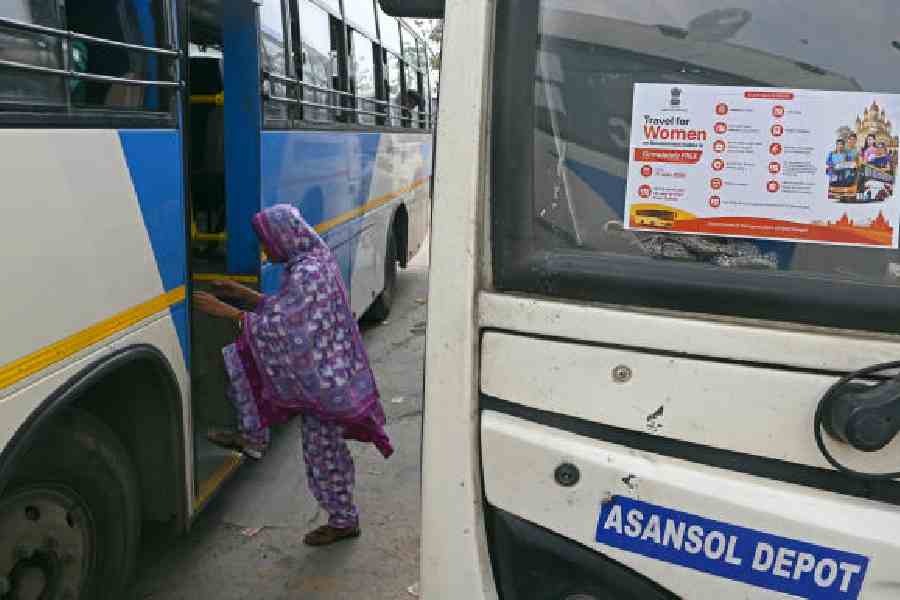
Bengal's decision to offer free bus travel to women on state-run services has provided significant relief to commuters, but private bus operators claim the policy is hurting their business, prompting them to seek government intervention to offset mounting losses.
Private bus operators say women passengers are increasingly opting for government-run buses, leading to a decline in ridership and revenue. Coupled with rising fuel costs and stagnant official fares, the industry is now pushing for the implementation of a "kilometre scheme" that would bring private buses under the state transport system.
The proposed model would allow privately owned buses to operate as part of the government fleet, with owners responsible for vehicle maintenance and drivers, while receiving a fixed payment based on the distance covered.
The secretary of the Joint Council of Bus Syndicates, Tapan Banerjee, said private bus owners are witnessing daily revenue losses ranging between Rs 500 and Rs 700 since the launch of free travel for women on state-run buses.
"Women passengers are availing government-run buses wherever available, resulting in a decrease in passengers for private buses," he told PTI.
According to Banerjee, private buses remain the backbone of public transport in Bengal, carrying more than 85 per cent of passengers across the state.
Explaining the impact on earnings, he said that a mother travelling with her daughter to and from school would typically account for four ticket purchases a day, revenue that private operators now lose when those commuters switch to free government services.
"Women passengers are opting for state-run buses wherever available to save expenditure on conveyance," he said.
Echoing the demand for government support, All Bengal Bus Minibus Coordination Committee general secretary Rahul Chatterjee said private operators would benefit if the state expanded the kilometre scheme and brought private buses under its transport network.
"It will help both the passengers as well as private operators as we won't have to worry about operating losses," he told PTI.
Under the kilometre scheme, already operational in some states, private operators purchase and maintain buses and provide drivers, while the transport department integrates the vehicles into its fleet. Government conductors manage fare collection, and private owners receive a fixed payment for every kilometre operated.
Both Banerjee and Chatterjee refrained from criticising the government's free travel initiative, saying policy decisions are entirely within the government's domain.
The BJP government introduced free bus travel for women on services operated by the West Bengal Transport Corporation, South Bengal State Transport Corporation and North Bengal State Transport Corporation after promising the measure during the recently concluded Assembly elections.
Chatterjee said the impact on private operators is particularly visible on routes where government buses operate frequently.
"In routes like Siliguri-Cooch Behar, there are ample state-run buses, and there is a loss of passengers for private buses," Chatterjee said.
He added that similar trends are visible on several routes connecting Howrah railway station with different parts of Kolkata.
Apart from declining passenger numbers, operators are also grappling with fare-related concerns. Chatterjee noted that official bus fares have not been revised for nearly a decade.
"Bus fares were last increased in 2018 when the present chief minister held the charge of the transport department (in the then TMC government)," he said.
He claimed that several other states have periodically revised fares in line with rising fuel prices, but Bengal has not followed suit.
Although official bus and taxi fares have remained unchanged since 2018, private operators have informally charged higher rates in some cases following fuel price hikes after the COVID-19 pandemic.
"Diesel prices have increased by about Rs 10 per litre in just about a month in May this year, but the fares have remained unchanged," Chatterjee said.
The impact, however, is not uniform across all routes. Mohammed Jubair, a conductor on Route 73 in Howrah, said his bus service has not experienced any decline in passengers because state-run buses do not operate on that route.
Meanwhile, Subho Das, a conductor on a north-south Kolkata route, said passenger numbers have dropped since women began travelling free on government buses.