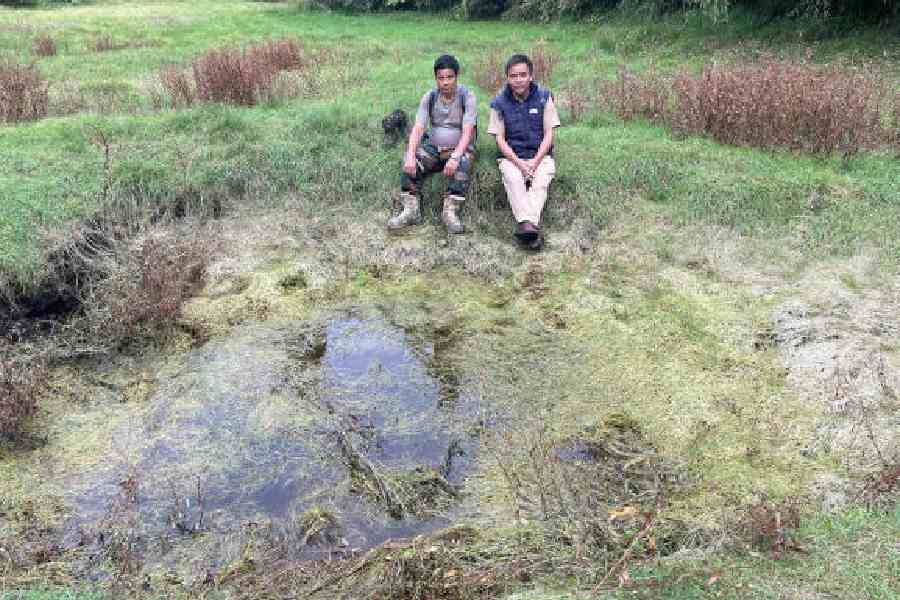
The state forest department has initiated a proposal to declare Panchpokhri, a hilly wetland in Kurseong, a sanctuary for salamanders.
The frequent sightings and a healthy population of the rare Himalayan amphibians in the area prompted the move. The proposal has been forwarded to the Union ministry of environment, forest and climate change.
“We have sent a proposal to the Union ministry to designate Panchpokhri, a forest wetland under the Kurseong forest division, as a salamander habitat sanctuary. The proposal has been initiated through the chief conservator of forests (wildlife, north),” said Devesh Pandey, the divisional forest officer of the Kurseong forest division.
There is a water body in the Bagora range of the division, around 15km from Kurseong town, at an elevation of approximately 5,000 feet above sea level.
Spanning around five hectares, the moist terrain surrounding it provides ideal breeding conditions for the Himalayan salamander, a species native to the Darjeeling Himalayan region that is listed as a vulnerable species by the International Union for Conservation of Nature (IUCN).
Foresters noted that the species typically inhabits small bodies of water surrounded by foliage. Through conservation efforts, the department has identified around 12 such habitats across the forest division where the species has been sighted. However, Panchpokhri stands out as the largest site, with frequent sightings being reported, especially during the monsoon season.
“We are yet to begin a formal enumeration of the salamanders at the Bagora wetland, as their presence is usually more visible during the monsoon. However, early sightings this year, that is, well before the monsoon, are significant,” a forester added.
A forest department source said that the species is also found in neighbouring countries of Nepal and Bhutan.
The Himalayan salamander can grow up to 17cm long and has a lifespan of up to 11 years.
In 1985, the state had launched a similar initiative to develop the Jorepokhri salamander sanctuary at Sukhiapokhri in Darjeeling, designating a 10-acre area for the project. However, the effort failed due to the construction of concrete structures over the water reservoir.