
Calcutta: When three first-time directors set out on a search for a one-time woman footballer who lost her place in the Indian team after a failed sex test, little did they know that they were embarking on an award-winning project.
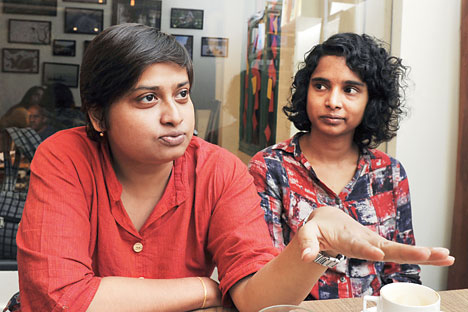
Farha Khatun from West Midnapore, Satarupa Santra from Birati in North Dum Dum and Sourabh Kanti Dutta from Salt Lake have documented the story of Bandana Pal and how she became Bonnie in I am Bonnie. The film has fetched them the National Award for Best Film on Social Issue.
The making of the film was no smooth journey. It was first conceptualised in 2006 but work began only six years later.
"I first heard about (then) Bandana in 2006. Satarupa and I met him and expressed our desire to make a film on the footballer. But we had no funding then," said Sourabh, who has worked as assistant director and cinematographer.
It was in 2012 that the duo, joined by Farha, began working on the film. They had a tough time locating the subject as Bandana by then had a new identity.
"Bandana had undergone a sex change surgery and become Bonnie. He had also left his hometown in Gaighata, North 24-Parganas, settled down in Matigara as an idol-maker and got married," Sourabh said.
Bandana's career as a striker in the Indian women's football team was cut short after a sex test right before the Bangkok Asian Games in 1998.
.jpg)
.jpg)
The film was first conceived as fiction but the developments in Bonnie's life made the directors change their mind.
"As we were shooting, his life took several turns. His family still hadn't accepted him, it was becoming increasingly difficult for him to make ends meet with idol-making and odd jobs. He was dejected and hurt," said Farha, an alumnus of Roopkala Kendro who now works for the Film Division of India.
The adversities took their toll on Bonnie as well as the film as he snapped ties with the crew mid-way. "We were very tensed, more because Bonnie had by then become a friend and we were concerned about his whereabouts. It took six months to touch base with him again. We would call from different numbers everyday. We were hopeful throughout that we would resume and complete the film," said Satarupa who teaches journalism and mass communication in a Birati college.
Finally, Bonnie - who has been coaching kids in football at Barasat Kishalaya Home for the past year - was convinced as well. "I wanted to tell people that I have been wronged for no fault of mine. I wanted to tell them that it is possible to live with dignity if you are true to yourself. Whether I am Bandana or Bonnie doesn't matter."
The directors can't agree more. "He wanted to be heard. He kept on fighting all his life. He is a hero. In fact the film is made by not three but four people and Bonnie is the fourth pillar," said Farha, who graduated with a degree in English literature from Belda College.