 |
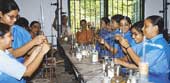
| The scene today: Students at work in the chemistry laboratory |
Imagine a science laboratory in school that requires almost no maintenance. Think virtual — a lab that promises the experiment experience, minus the hazards and the hassles.
Too good to be true? Well, it’s almost here. The Birla Industrial and Technological Museum (BITM), under the auspices of the National Council of Science Museums (NCSM), is set to launch its first such initiative.
After one year and 2,000 hours of work by a team of four, the virtual lab software is ready for release. Initially, it’s chemistry that’s the focus, with work on a bio-sciences CD already underway. The final instalment will be for physics. The subject matter is school syllabus-based and the images are 3-D.
The aim, explains BITM director Samaresh Goswami, is to make science more interesting for students, without the huge cost of laboratories, which many schools can’t afford.
“Apart from a few schools and colleges in Calcutta, most find it very difficult financially to have proper laboratories, with all the facilities. Children are losing interest in science, since the real feel of the subject comes from experimentation. This is an effort to revive that,” says Goswami.
The computer is the medium because of availability and low cost, feels the BITM director. “The state government’s priority at the moment is computers in schools. By my calculations, in the next three or four years, about 80 per cent of schools will have them. So, the software will reach more people, rather than real labs,” he adds.
The data input in the programme developed by BITM covers the salts, acids, chemicals etc, in the Madhyamik, Higher Secondary, ICSE and CBSE syllabi. Theoretical knowledge will be imparted first and then the user can conduct experiments, from lighting the burner to measuring and mixing the chemicals and then writing the reports based on the virtual results. If the student gets the wrong results, then the programme gives the right answer, with the error indicated and the explanation.
“This is not a replacement of the real thing, since you can’t actually feel or smell the stuff. But there are certain advantages. For instance, there is no mess to clean up, neither are there any hazards in dangerous or explosive combinations, which cannot be done in real labs. Also, for slow learners, the same experiment can be repeated over and over again,” says Goswami.
Next month, the CDs will be sent out to a few schools in Calcutta, Purulia and Siliguri, to test it on students. March is the launch date at BITM, with the final aim of uploading the software on the BITM and NCSM websites, to make it more accessible, so that the software is eventually available free of cost, initially in English, but later in Bengali.