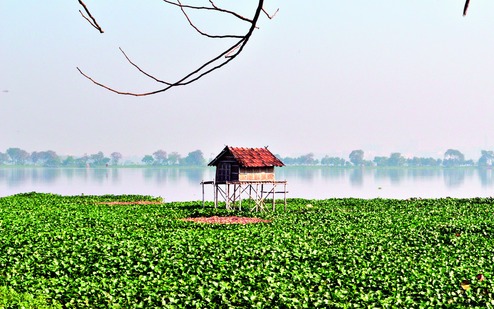

Calcutta: The Bengal government is apparently going ahead with its plans to build a flyover and widen a road through the core of the ecologically fragile East Calcutta Wetlands despite environmentalists warning of a disaster looming in the garb of development.
The Calcutta Metropolitan Development Authority has already invited bids from consulting firms to do an environmental impact assessment for both projects - a road meant to connect Sector V with Bantala on the Basanti highway and a flyover between Metropolitan on the EM Bypass and New Town.
The time frame fixed for the exercise is 16 weeks, during which the contracted consultant would need to speak to all stakeholders and make an assessment of the potential impact of the twin projects on air, water, noise, soil and biodiversity during and after construction.
The detailed project report for the flyover had been done by Hidco before the CMDA was made the implementing agency.
An engineer pointed to the word "widening" in the tender for the environmental impact assessment contract as a red flag in terms of the potential for encroachment on the wetlands. He said the pillars of the proposed 5.7km flyover could also be a threat to several water bodies along the route.
Dhrubajyoti Ghosh, the internationally acclaimed ecologist who died last Friday, had resigned from the East Calcutta Wetlands Authority's governing committee after his opposition to the flyover project was bulldozed at a meeting.
Environmentalists fear that Ghosh's passing has made the movement to save the 12,500-hectare sprawl of wetlands weaker.
The East Calcutta Wetlands naturally treat about 750 million litres of waste generated by Calcutta every day, besides sustaining agriculture and fisheries. According to environment experts, the wetlands also act as a drainage basin and climate sink. "If the wetlands perish, Calcutta would be required to set up a waste water treatment plant costing more than Rs 1,000 crore. Now we are getting the same volume of waste treated free," an expert said.
Urban planning consultant Tapas Ghatak, formerly with the CMDA, said meddling with the ecology of the wetlands carries the potential for irreversible damage. "A World Bank report pointed out sometime back how the wards around the EM Bypass stand vulnerable to prolonged waterlogging. This threat will increase manifold if the wetlands are filled."
Metro had reported earlier that widening the road linking Sector V with Bantala would mean going through several bheris (fisheries). An engineer involved in the planning for the project said the road was currently 4-4.5 metres wide. "It is a dirt track that few vehicles use. The idea is to widen it and make it motorable."
Calcutta High Court has banned construction in the wetlands belt but transgressions continue to happen. The added protection of Ramsar status hasn't helped either, although the rule-book states that approval from the Ramsar Bureau is mandatory for any construction there.
A Ramsar official had sometime back made it clear that the organisation, headquartered in Switzerland, would not give its nod to any project with implications for the wetlands unless a comprehensive management plan was submitted and approved.
According to the East Calcutta Wetlands Authority, the quasi-governmental organisation now headed by environment minister and mayor Sovan Chatterjee, the flyover and road projects would need to go through multiple clearances and that process itself would take more than a year. "Moreover, any such development plan needs to be vetted by the ministry of environment, forest and climate change," a senior official said.
But environment experts aren't convinced about the urban development department's intentions. " How can the government possibly float a tender for an environmental impact assessment when it has already intimated the high court that it won't go ahead with the flyover project without all necessary permissions, which it still has not received?" said wetland activist Santanu Chakrabarty.
Additional reporting by Jayanta Basu