 |
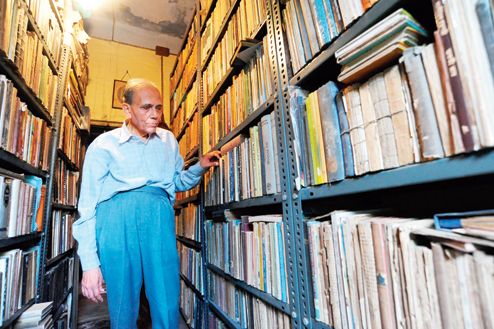
| Ashoke Kumar Roy among his beloved books at the library in his Sinthee home. |
He once built special houses to preserve the natives in the biting cold of a Norwegian island but can’t find a patch of land in his hometown Calcutta to preserve his most prized possessions.
Ashoke Kumar Roy, a 74-year-old retired engineer, runs a private library of over 40,000 titles in his home on Kalicharan Ghosh Road near the Sinthee crossing. He calls it Manmatha Nath Ghosh Institute of Nineteenth and Twentieth Century Studies after his maternal grandfather, who himself had a well-stocked library in his Shyambazar home.
Among the titles are rare books in English and Bengali, full sets of periodicals dating back to the 1800s, poetry, souvenirs, catalogues, children’s magazines and much more. The library is free for all, open round the year, sometimes 7am to 11pm. Roy even provides meals and lodging for outstation researchers. His only request: “Please make an appointment before you come.”
Over 250 students have worked for their PhD in his library on subjects ranging from literature to music. Currently, 31 researchers are using the library. Debarati Banerjee is working on the Bengali periodical, Bharatbarsha, for her PhD at Calcutta University. She says she prefers Roy’s library because he has the complete set of Bharatbarsha, something even the Sahitya Parishad or the National Library don’t. And then there’s Ray’s guidance, which is invaluable.
“What Sir has done is, he has compiled the contents of 63 years of the publication of Bharatbarsha. It has reduced my work by a year,” smiled the young scholar as she scribbled notes in a ground-floor room of Roy’s house. Debarati heard about the library from her PhD guide and other teachers who had done their research there.
But what of a time when Debarati wants to send her students to this library?
Roy’s son tells him not to worry about the future but the fate of his books is a perennial concern. Spread over seven rooms in various stages of disrepair on the first floor, most of the volumes are stacked on large steel shelves. Some have found a home on wooden shelves, a few lucky ones live inside glass cabinets. Books cover every available surface — tables, chairs, cabinets, even his bed.
“I buy books because I love to read. As the collection grew, I decided to make a library in my home in the 1960s,” said the Jadavpur University alumnus, who was in the 1961 civil engineering batch.
After graduating from JU, Roy had studied structural engineering at Roorkee (now IIT Roorkee) and then earthquake engineering at Glasgow University.
While engineering was his profession, the printed word remains Roy’s abiding passion. He has written some 30 books of stories and essays and contributes regularly to various publications.
In his library are gems like William Carey’s Bengali dictionary of 1865 and Peary Chand Mitter’s work on David Hare, dated 1877. This was recently reprinted from his copy by Radiance publishers.
“I don’t charge anything for it. I am happy that these books are being reprinted because that means they will be preserved. With just one copy in my library, I worry that some priceless book will get damaged by pests or natural elements like rain or dampness,” said Roy, who has read his entire collection.
He owns complete sets of iconic Bengali periodicals. Like Bichitra, where Bibhutibhushan Bandopadhyay’s Pather Panchali was published. Or Tattobodhini, where Michael Madhusudan Dutt’s death was announced in 1873. There are full sets of Vishwa Bharati, Probashi, Bharatbarsha, Basumati, Sonibarer Chithi, Bani and Pancha Pushpa.
The state central library has shown interest in taking over Roy’s collection after him but he wants to make a permanent arrangement for his books while he is alive. He is sceptical because many government libraries shut down for no apparent reason. Also, students have to work around innumerable government holidays and truncated working hours.
“All I want is a two-cottah plot somewhere near the city connected by train or bus so that students can access it easily. The responsibility of building the structure is mine,” Roy said.
His dream is to build a low-cost, two-storey house on the plot. The ground floor will have a reading room-cum- seminar space while the second floor will house his books. Ground floors are not good for storing books, he says.
Roy knows all about building houses, having worked for companies like L&T across the world, from Nigeria to Venezuela, and even for the United Nations. That’s how he found himself in the bitterly cold climes of Hammerfest, Norway, building special houses that trap heat.
Apart from trying to find a permanent space for his collection, Roy is desperate to update his library catalogue. He used to employ a librarian until recently but can no longer afford one. “If I could get a grant of around Rs 50,000 to pay someone for six to 12 months, I would get my collection catalogued,” he said.
Roy’s eyes still light up while talking about cantilever bridges and foundation strength but he is happy immersing himself in his beloved books. He would be happier if he found a safe home for them.
Do you know anyone like Ashoke Kumar Roy? Tell ttmetro@abpmail.com