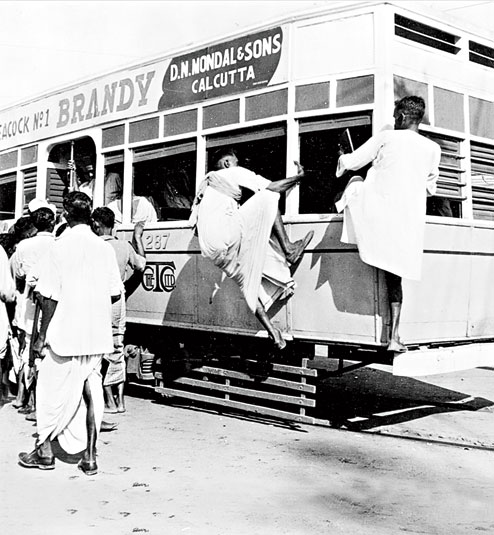


(Clockwise from top) Clyde Waddell’s photograph of a man clambering
into a tram through a window; Pablo Bartholomew’s image of a little Chinese girl; and Rathin Mitra’s high court
Three exhibitions on Calcutta - two of photographs and one of drawings of heritage buildings - are happening around the same time in galleries here by sheer happy coincidence.
The Calcutta Diaries: Pablo Bartholomew, an exhibition of black-and-white photographs taken in the 1970s and 1980s at Akar Prakar, continues till December 13, and Calcutta, The City I Love: Rathin Mitra, a show of the veteran artist's sketches of old buildings done in the 1980s, ended at Galerie 88 last Saturday. The third at Aakriti Art Gallery titled A Yank's Memories of Calcutta comprises photographs of Calcutta taken in all likelihood between 1945 and 1946 by Clyde Waddell, a GI, whose identity was initially unknown. This opens on Monday and is on till January 24.
Incidentally, all three bodies of work have been circulating on the Internet and on Facebook for quite some time. But seeing the actual prints and drawings is a different experience altogether for all the details, which even high-resolution digital images cannot reveal, stand out in all their singularity. The photographs of Waddell and Bartholomew are studies in contrast for the GI shot them 30 years before the latter did. Both shot trams. Waddell's are overcrowded but the paint on them is fresh. Bartholmew's are jalopies.
Waddell was chief photographer for the Huston Press before joining the army, and he went around Calcutta armed with a camera when he was granted a dearly earned leave. He had to oblige friends who requested him to shoot around the city and they later bought his prints. A couple of albums of these photographs exist and these prints are from them. Waddell's annotations are witty, pithy and informative. He did not confine himself to 'White' Calcutta but made forays into the hinterland.
Clyde's images are very upbeat and exude a typical American spirit. We see buffaloes in a snazzy Old Court House Street lined with splendid buildings and shops, snake charmers, pavement dwellers, even Tollywood, GIs being accosted by beggars of all description, GIs making purchases at New Market, GIs in brothels and a rare view of an opium den in Chinatown. Clyde strayed into Nimtala burning ghat, slums and ghettoes and Kalighat. Although we catch glimpses of extreme poverty Clyde's spirit is always buoyant. The exhibition includes some artefacts of that era such as radios, binoculars and other odds and ends.
Bartholomew's images present a decaying Calcutta of the marginalised Chinese people and the underclasses. During the Chinese aggression in 1962, many unfortunate members of this community which had made Calcutta its home in 18th century were bundled off to an internment camp in Rajasthan.
When Bartholomew shot them in Tangra the feeling of alienation is tangible in their wary glances.
Rathin Mitra's drawings of important buildings are familiar to most newspaper readers as he would be featured regularly in dailies. Mitra, who is 88 now, did these drawings in the 1980s. They are invaluable documents of a city in a state of flux.