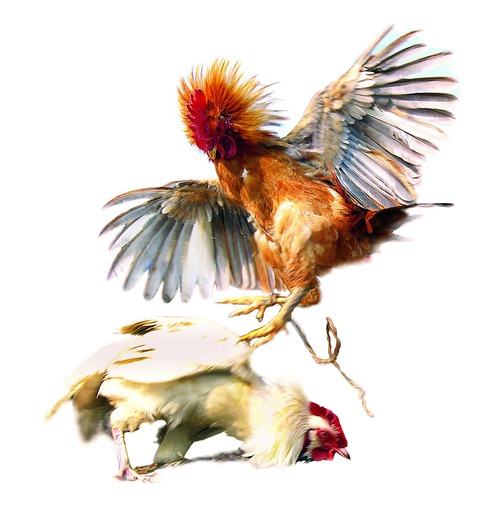

Rocky has fought many bloody battles. He is lean, fair and tall, his aggression obvious in the way he jerks his glistening muscular neck to look you in the eye. He is no ordinary alpha, but of a certain Tamil lineage that is famed for male prowess. So much so that if two such fellas cross paths, they are sure to fly at each other's throat, almost out of compulsion.
Most roosters are like that - they have an innate belligerence that, with grooming and training, renders them akin to professional performers of the arena. That perhaps explains why cockfighting is the world's oldest spectator sport.
The history of raising fowl for fighting goes back thousands of years and despite regulations, cockfighting continues to entertain the masses in many parts of the world, including India. Many archaeologists claim that chickens were first domesticated not for eating but for cockfighting.
Rocky's owner, Dilip Pal, is proud of his protege's record. "He will fly at you even," he says, half-jokingly. Pal is a construction worker in Calcutta, where he lives with his family of five, but his 13 roosters seem to be the real focus of his time and energy.
Pointing to a brown one named Shah Rukh, he says, "He was injured in the leg by his opponent's knife... but wouldn't let go until the latter fell."
True enough, the beautiful bird has a bandaged left leg, and his difficulty in walking is obvious. But that doesn't stop him from turning warrior, instantly, hackles and all, as Pal leads Rocky into his presence. "He simply cannot tolerate any other male around him," Pal chuckles.

Fallacious physiological and cultural explanations, cry some. But, come winter, when the birds seem to don a stately glow, the perfectly waxed look so to speak, there is a rise in the incidence of this blood sport.
"Makar Sankranti is of particular significance in rural Bengal, and village folk source entertainment in rooster fights. Melas and haats abound, and that is where the fights are staged," observes Jagannath Ghosh, who is like an encyclopaedia of people and customs in the forests and hinterlands of Jharkhand, Chhattisgarh, Bengal, Bhutan and Sikkim.
Ghosh notes how enthusiasts start to buy and rear roosters much earlier, as a certain period of time is required to assess the bird's strength, training, grooming and so on. Only after that is the " shnaada" or male pheasant ready to be in the ring. "Uddam, rokto, mrityu, ullas, akrosh... It is about vigour, blood thirst, thrill of the kill, exuberance and anger," is how he deconstructs the whole gamut.
Wildlife conservationist Subhrojyoti Chatterjee, whose main area of study is hunting practices in the north and south Bengal regions, says that until five or six years ago, cockfighting was regularly held in the open in many places. "Perhaps people have become more conscious now, both in terms of morality and litigation, but often this may not be the case in the districts or rural areas."
Local NGOs too have become vigilant, which in turn pushes police to conduct raids.
Roosters have a bony leg spur, which humans supplement with an arsenal of metal spurs and small knives. "The length of the knife is in proportion to the size of the leg," says Pradip Sardar, a pro since his teens.
Pairing up takes place between two roosters of similar size, weight and height.
"First, we try to get a measure of the bird's jeyd - doggedness or determination to grapple - by observing its kicking or how it beats its wings mid-air," says Sardar. Of all the gamecock varieties he has dealt with, Sardar's best bet is the shona-jhinjra - a bird with a cover of brown feathers and golden spots. But the one such bird he owned recently lost a fight, and he hasn't been able to buy another yet. He is also quite fond of his mala morog, the black one with light spots.
What's colour got to do with it? "Probably nothing, but I have noticed that the black ones tend to be more self-effacing," laughs Ghosh. He too gives the shona-jhinjra a high rating, for this bird is apparently able to learn the ropes of "rana kaushal" or warfare most efficiently. The Australian variety, weighing a good five kilos or more, and the Aseel - noted for its pugnacity - are other favourite players.
Unlike the chicken we buy for consumption, these roosters cost a bomb. Ghosh says he has seen such birds being sold for as much as Rs 30,000 to Rs 40,000. And that's nothing, compared to the prices in some districts down South, where cockfighting reportedly is a much-frenzied affair.
Apart from the training, these birds are famously pampered. They need to be fed well - with corn, wheat, fish, rice and meat. Some keepers even indulge them with cashew, almonds and eggs for more strength.
Vaccines, antibiotics, vitamins and supplements, Sardar knows it all - mox for colds, tetracycline for stomach infections, ampilox, terramycin and so on. "If a bird suffers a gash, I sew it up with needle and thread. I am able to sense exactly what he needs, and within two or three weeks he is fit to fight again."
"It can be a terrible addiction, this rearing of fowl for fight," muses Ghosh. He recounts the story of a man who was left shattered after his shona-jhinjra fell dead. This, after months of preparation, during which time he was oblivious even to the needs of his wife and children.
With punters and organisers keeping the stakes high, big money changing hands has become quite the norm. Wealthy enthusiasts betting cars and houses on roosters is also not unheard of. "People are willing to bet upto Rs 1 lakh," says Pal, whose son has taken his best birds to the village to make the most of the festive season. "These people are usually small-time businessmen, real estate promoters and their kin." Money, however, is not always the objective - in many tribal areas, haandiya or country liquor is the prize for patrons.
The spectators, of course all men, can be seen standing and shouting, gesturing and leaping - "no place for a woman", as they all say. The noise is deafening, and brawls common. In a bizarre incident a few years ago, a cock killed his master reportedly because the latter was forcing him into the ring immediately after his previous bout.
The actual fight may last anything from less than a minute to over 30 minutes, until one of the two dies or is unable to fight any more. The knives are so sharp and dangerous that cockfighters themselves have been badly injured or killed when accidentally slashed by their own birds.
And so it continues, this ancient blood sport, in the fringes of this great big city, at a distance enough for no one to lose so much of that humanity to be called savage, at a distance so safe that even the lawmakers can see and unsee.