 |
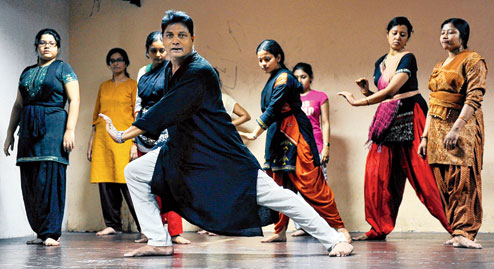
| Shashadhar Acharya shows a step to participants at the workshop held in EZCC, Salt Lake. Pictures by Sanjoy Ghosh |
In the city for a seven-day workshop to train members of theatre group Bratyajan in body movement, Chhau exponent and Sangeet Natak Akademi award winner Shashadhar Acharya took time out for a chat with Metro. Excerpts:
From Seraikela to the world stage, how did this journey begin?
Twenty years ago, Chhau was limited to a handful of villages and communities. As a fifth-generation Chhau performer in Seraikela, I felt I should try to promote the dance outside my state, Jharkhand. I have seen people come to Seraikela to research Chhau. My father and other teachers helped outsiders complete doctorates in the subject. I thought if outsiders are coming for research, then why shouldn’t we take the dance to a larger audience outside the state? That’s when I left home for Delhi.
How did you get noticed?
In 1988, I started working under Ratan Thiyam at the National School of Drama in Delhi. I used to do theatre from childhood but dance was my profession. I went to the NSD to take admission there. But when Ratan Thiyam found that I come from a family of traditional Chhau dancers, he asked me to teach my art form to the second-year students. I have been teaching at NSD since then. The institution later introduced a six-month course on Chhau. Now I also teach at FTII Pune, Punjab University in Chandigarh, BNA, Whistling Woods International School run by Subhash Ghai and Actor Prepares of Anupam Kher.
What’s it like to teach dance to actors?
I primarily teach Angik Abhinay. In the ancient Indian tradition, there are four types of abhinay or acting — Vachik, Angik, Ahari and Satvik. My work is to teach the Angik part of acting, which is called physical theatre in the modern world.
The language of physical theatre is universal. Whether in Pakistan or in the US, people understand body language. The barrier of spoken language in realistic theatre, which depends more on dialogues, can be broken by physical theatre. If we apply Angik Abhinay techniques to recreate some folk texts, it will be easy for the international audience to appreciate.
How do you incorporate Chhau movements in a contemporary international play?
When I joined the NSD, physical theatre was not much in vogue there. I tried to make people realise its significance. In 1988, the NSD syllabus had a course on Parsi theatre, one on Natya Shastra and the rest were on modern western theatre. Even now in the three-year syllabus, there is only a three-month course on Sanskrit theatre and a similar one on local theatre. The rest of the courses are on western theatre.
Today, I do the choreography for most directors who come to the NSD from abroad. I apply Chhau movements in my choreography and these directors find the movements “completely contemporary”, though for me, they are very very traditional. This implies that Chhau is as much traditional and classical as it is contemporary. It depends on your approach to the body.
What’s your role in this workshop with Bratyajan?
Bratyada knows me for a long time. When he said “why don’t you work with my group?”, I told him that I was ready to work with any group. He called me to conduct this workshop. The aim is to give actors knowledge about their own bodies and make them realise what they can express with the help of the body. Keval actors se hi hum pahar, jharne, nadi, sab kuch dikha sakte hain (we can depict mountains, waterfalls, rivers and many other things using only actors).
After the training, we intend to produce a play where Chhau movements could be incorporated.
Are you now more involved with theatre than Chhau?
My profession and passion is Chhau. Besides Chhau I also do theatre as I have been enjoying theatre since childhood. And I teach at the NSD and universities because these institutions often fund Chhau productions for my troupe.
Who are your troupe members?
The best students at our family-run institutions in Seraikela join my group. My brothers are also established Chhau dancers and they help in running the organisation.
Is there enough scope for students of Chhau in India?
Compared with 20 years ago, the scene has changed for the better. The art form is respected across the world and we are invited to perform both in the country and abroad. But I intensely feel the need for education for the Chhau students. It is a must for artistes to develop in today’s world.