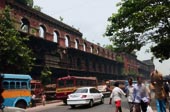
As with the seasonal outbreak of dengue and malaria and broken tram tracks that have turned into death traps, the Calcutta Municipal Corporation (CMC) is not prepared to meet the growing problem of buildings that are falling to pieces all over the city. Some of these buildings are spectacular, yet have turned into slums because of disputes between landlords and tenants. Sections of Karnani Mansion on Park Street, for instance, have turned into a squatters? colony as a fall-out of a long-standing wrangle that shows no signs of resolving. Some buildings have witnessed history, yet have been abandoned because they are white elephants. They often pose a threat to human life when parapets, balconies, shutters and other building parts cannot resist the gravitational pull any longer and hurtle down or collapse on passersby or residents.
Yet, housing is such a persistent problem that such buildings are the only roof on offer not only for the poor and the destitute, but also for the stolid middle class. Burrabazar and Chitpore have many such landmark buildings, some of which mysteriously go up in flames and are reduced to rubble overnight. Even that does not deter Calcuttans from using them. Witness the reborn Firpo?s Market, gutted a few years ago.
The CMC had identified 63 such unsafe buildings in the last financial year. In the current year, 13 such structures have been identified. But a complete list is unavailable. The director-general (building) of the CMC, Pranabendra Nath Basu, said on Thursday that a complete list of such structures is not yet ready. Perhaps CMC would be well advised to earmark a portion of the Rs 1,860 crore it has received from the Asian Development Bank for the uplift of entire neighbourhoods that boast such buildings. That is the only way the Calcutta Improvement Programme can become effective.
Photographer Pabitra Das was spoilt for choice when he had to select a dozen landmark buildings in north and central Calcutta crying out for care. He presents six of the most visible ones this week, some of which are mini-cities, heavily populated as they are. The rest will be presented next week.
 | Strand Warehouse close to Howrah bridge has been in the news of late as efforts are on to recycle these vast but dilapidated structures. Though several fires have consumed the top floors, transport agencies still use it to store goods. The space outside is used as a dump for soiled plastic bags, and the circular rail overbridge is home to immigrants. |
| Jatindramohan Tagore had built Tagore Castle in Pathuriaghata where battlements and towers are married to brackets from Rajasthan. It was leased out to the Mundhras. Now this freaky castle has turned into a gigantic concrete box with windows, chock-a-block with tenants. The clocktower is a pigeons’ nest. The tiles of the grand staircase are splattered with paan spittle.tPasupati and Nandalal Bose’s residence in Bagbazar of late 19th century vintage was built by engineer Nilmani Mitra. Now the thakurdalan is crumbling but on October 16, 1905, Rabindranath and leaders of the swadeshi movement had started the National Fund, watched by a huge crowd that had gathered in the vast space in front of the house. New buildings have eaten up all the open space. |  |
 | It used to be Duff College. Then it was Rajabagan thana on Nimtala Ghat Street. Abandoned thereafter, it has turned into a hothouse for parasites. The building has huge vacant rooms but even derelicts will not dare to venture inside |
| Ganesh Garh opposite Jorasanko Thakurbari once belonged to the Cossimbazar royal family. Now about 250 families of tenants live there. It has been declared an unsafe building by the Calcutta Municipal Corporation yet tenants and others who live there will never leave their tiny flats even as it becomes progressively difficult to prop up the ceilings. The current landlord wants to build a highrise there but tenants, who have lived there for generations, will not budge unless compensated. |  |
 | Pasupati and Nandalal Bose’s residence in Bagbazar of late 19th century vintage was built by engineer Nilmani Mitra. Now the thakurdalan is crumbling but on October 16, 1905, Rabindranath and leaders of the swadeshi movement had started the National Fund, watched by a huge crowd that had gathered in the vast space in front of the house. New buildings have eaten up all the open space. |
| House No 243 on CR Avenue is a heritage building fronting the Rambagan slum. A notice facing the road declares it an unsafe building. A chunk has fallen off the broken pediment. It has a small courtyard and the verandahs have beautiful grilles. All the rooms are occupied. But a bamboo structure has been constructed inside to prevent parts of the building from collapsing. Of late, several other ornate buildings on this avenue have disappeared. Their landlords allowed them to rot and once tenants vacated them, demolition men wiped them out. New constructions came up overnight. |  |
 |