 |
Around 35 per cent of the project cost of Rs 18 crore will be borne by the state and the rest by the Centre. A source said a “high-powered committee” of urban planners had cleared the project at a meeting on October 26.
“The ramp and the slip road form part of our holistic approach to managing traffic in and around Dunlop. We are also constructing a flyover which will connect PWD Road at the Dakshineswar end with BT Road near the ISI campus. Traffic at and around the Dunlop crossing will be reduced significantly once all three roads — the ramp, the tunnelled slip road and the flyover — are unveiled,” said Dibyendu Pal, an executive engineer of the PWD’s north suburban division.
An expert in surface transport, however, expressed doubts whether the projects would serve their purpose of taking some load off BT Road. To prove his point, he cited a recommendation of the Indian Road Congress that BT Road should have at least eight lanes by 2020.
“This could turn out to be yet another instance of myopic plan, just like the Bypass that is now having to be widened and the AJC Bose Road flyover that must have a few more ramps,” he added.
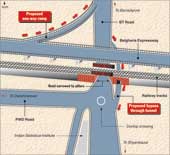
The 360-metre ramp, which will descend from a point on the expressway between Dakshineswar and Dunlop, will meet BT Road near the state transport corporation depot.
An official in the public works department said the one-way ramp, comprising two lanes, would be taken by vehicles bound for Barrackpore, Kalyani or other areas on the northern fringes from Nivedita Setu (new Bally bridge).
This will be the first ramp of the highroad which was built to connect Barasat to Delhi and Mumbai roads.
Now, north-bound vehicles from Nivedita Setu access BT Road via PWD Road, adding to the chaos at the congested Dunlop crossing. “The ramp will allow north-bound commuters from across the river to skirt the perennially-clogged Dunlop intersection,” said a PWD officer.
Also as part of the project, there will be a 100-metre road of two lanes branching off BT Road to the east near the L9 bus-stop and meeting the artery again close to the Indian Statistical Institute campus.
Under the Expressway and the adjacent railway bridge, the road will pass through a tunnel.
“Like the ramp, the road too will enable vehicles, south-bound ones in this case, to avoid the Dunlop crossing and also the part of BT Road right under the railway bridge where two concrete pillars on the flanks have narrowed the carriageway considerably,” said Arup Dey, a senior PWD engineer.
The tunnel will be bored through one of the pillars of the bridge using “cutting-edge technology and pre-fabricated box structures”. The government has estimated that around Rs 4 crore will be required to lay the road, excluding a “small amount” to procure three acres of railway land.