 |
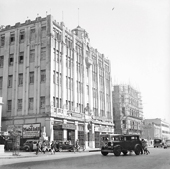
| The Esplanade end of Central Avenue, renamed Chittaranjan Avenue, in its early days in the 1940s. Picture by Parimal Goswami |
This is the seventh year that Sutanuti Boimela is being held in the tiny courtyard of Girish Mancha in Bagbazar where the focus is on small publishers in Bengali struggling for survival. An interesting feature of the book fair, which ends today, is the series of lectures and cultural programmes organised on the occasion. This year being the 250th birth anniversary of William Carey, Asish Khastagir’s lecture was on the Bengali printers of 19th century, and pioneering printing and publishing organisations like P.M. Bagchi & Company and Calcutta Art Studio, which have survived all these years, were felicitated. The drizzle notwithstanding, the mela attracted a good number of people every day.
Of the lectures, the one by Debasis Bose, expert in Calcutta history and old families, on the urbanisation of Calcutta and the lessons of history was of relevance to today’s town planners. Bose’s lecture was dedicated to Purnachandra De Udbhatsagar (1857-1946), who, as archaeologist and litterateur, Arun Nag, explained in his introduction, is an almost forgotten figure. De, who taught Bengali and Sanskrit in Asutosh College, had collected 42,000 Sanskrit slokas of unknown origin, otherwise Udbhat slokas. He had an “antiquarian’s mind”, who used to do field work and researched archival material as well. His numerous articles were sprinkled with anecdotes of old Calcutta.
Debasis Bose’s lecture stepped back in time to the origins of the city, and covered a wide range of topics from the waterways and roads and lanes of Calcutta to its folk arts such as the cane artistes of Rambagan, Kumartuli clay models and the famous sweets of the Shimla area in north Calcutta. He traced the evolution of native architecture from the riverine colonies of north Indian Vaishnavites in Burdwan to the first palaces built by a Nabakrishna (later Deb Bahadur) munsi of East India Company in Sovabazar. These heavily protected buildings were the precursors of our gated communities, said Bose.
As the city spread out, Circular Road was built by filling up the Maratha Ditch in the 18th century. Living conditions were far from ideal here (the only exception was Garpar, the Brahmo stronghold), and people at first resisted shifting to this area.
Thereafter, professionals like doctors, teachers and lawyers settled down in Kalighat and Bhowanipore and subsequently Ballygunge. Bose mentioned how Satyendranath Tagore’s son, Surendranth, planned the development of Ballygunge and Hindustan Road and Hindustan Park, where the roads had corner projections, as in Harappa and Mohenjodaro of yore. The lesson of history was well learnt.
However, in our times history is largely ignored. Bose said with a touch of regret that the plan for Southern Expressway, which would have improved the city’s connectivity, will never be executed, thanks to the housing colonies mushrooming south of the city. In the 19 th century, the Lottery Committee facilitated the building of Town Hall, Creek Row, Beleghata canal and the Cornwallis-College-Wellington-Wellesley Street axis. But one big mistake the committee committed was to build the axis — Bidhan Sarani and Chittaranjan Avenue — along the trough which becomes waterlogged in the monsoon. This historic mistake, Bose asserted, will be repeated when, it is said, a road will be constructed from Garia to Baruipur along Adiganga route.
Bose pointed out the blunder in connecting Saraswati river with the Hooghly and the excavation of Tolly’s Nullah, although the plans were well-intentioned. Bose went into the legal minutiae of chicanery in land sale in recent times, drawing parallels with some past cases. Human nature hardly changes.