 |
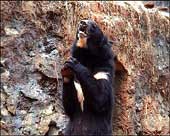
| A begging bear at the Guwahati zoo. Courtesy: PETA |
Last week a news channel carried a story done by PETA, India, volunteers on the zoos of eastern India. It was shocking to say the least. Visitors in the Shillong zoo were seen drinking and then assaulting animals. One even gave a lit cigarette to a fox. No zoo-keeper was around to stop them.
In the Guwahati zoo, a bear infested with ticks was seen crying and begging for food from the visitors. In the same zoo, a one-horned rhino has been living alone in his enclosure for 36 years. He has developed a wound above his horn from banging his head on the wall of the enclosure in frustration.
Such is the deplorable state of zoos not just in eastern India but throughout the country. According to the reports by PETA volunteers, there is a slaughterhouse on the premises of the Jodhpur zoo. In the Veermata Jijabai Udyan zoo in Mumbai, a male elephant has been chained for over six months without being released even once to roam his enclosure.
Zoos claim that they exist for education and conservation but what, pray, is to be learned by watching tigers, monkeys and other intelligent animals walk in endless circles in pitifully tiny cells?
A worldwide study of zoos conducted by the Born Free Foundation revealed that zoochosis, a psychological disease caused by stress is rampant in confined animals.
Zoo animals are known to display zoochosis by engaging in abnormal behaviours such as head bobbing, biting cage bars, pacing and severely mutilating themselves. Many of these animals die prematurely as a result.
Such bizarre behaviour has nothing to do with how animals live and behave naturally in the wild. Torn from their families and often alone, many of these sensitive animals are in a constant state of grief and misery.
Zoo staff, zoo vets and other relevant officials are often ill-trained and ignorant of animal psychology and insensitive to the condition of the very animals they are supposed to be caring for. The little solace that the animals can hope for is also taken away from them when unruly visitors torment them by pelting stones and plastic bottles at them.
According to Anuradha Sawhney, chief functionary, PETA, the Central Zoo Authority has de-recognised some of the zoos, like the one in Bikaner. Therefore the onus is on the state governments to take timely action and ensure that these animals are relocated. Every day that is postponed, it?s the animals that suffer.
In a country that prides itself on being ahimsa vaadi, I believe we are on the borderline of humanity. We need to figure out who the real beasts are: them or us?
PS: Special thanks to PETA for their extensive research in the zoos of India.