 |
Several students turned up at the high court on Wednesday to attend the hearing of a case filed by a Presidency College student, asking to see his answer script under the Right to Information Act.
Pritam Rooz, the third-year mathematics honours student, had requested the Calcutta University authorities to show him his honours paper V answer script. He had appeared for the paper last year during B.Sc Part II.
The university authorities had turned down the request. Rooz then moved the high court, stating that the university had violated the Right to Information Act by not allowing him to see his answer script.
On Wednesday, Justice Indira Banerjee fixed the matter for hearing on March 7.
Rooz had obtained 28 marks out of 100 in his honours paper V. He applied to the university authorities for review of his answer script. Four marks were added following the process.
Not satisfied with the increase, Rooz had asked to see his answer script. The university authorities informed him that the norms did not permit handing over of the answer scripts to the examinees.
Rooz then wrote to the university authorities that the Right to Information Act empowered him to see his answer script. But the authorities again turned down the request, stating that the university rules did not come under the purview of the act.
“I want to know from the court whether students have the right to see their answer scripts. A student should have the right to know whether his answer script was properly evaluated or not,” said Pritam, who filed the case in the high court in January.
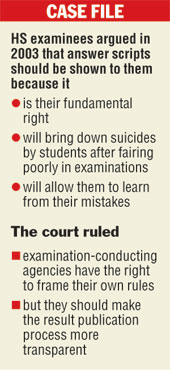
Viewing of answer scripts is a long-standing demand of students. In 2003, at least 300 Higher Secondary examinees had moved a PIL in the high court, calling for photocopies of answer scripts to be supplied with results.
“The court had turned down the plea but said the agencies that conduct examinations should make the result publication process more transparent. The students are now relying on the Right to Information Act,” said advocate Supradip Roy, who had appeared for the examinees.