IBIS DOCKS IN HOME TOWN

AMITAV GHOSH is in Calcutta this weekend with the third title in his sweeping Ibis trilogy. Published by Penguin Random House India, Flood of Fire, which takes the story of Deeti-Neel-Zachary-Bahram-Paulette right into the First Opium War between the British Raj and China in the 1840s, was launched at the Indian Museum on Saturday evening. Earlier in the day, the author met up with some friends over coffee and coconut water at Taj Bengal. One of his closest friends in Calcutta, PRADEEP KAKKAR,
former professor at Wharton School and founder-member of PUBLIC, interviewed Amitav Ghosh for Metro. Edited excerpts:
Pradeep Kakkar: This book is dedicated to Debbie "for our 25th". I remember when you got married (to writer Deborah Baker), in Calcutta, and quite coincidentally, one of the celebrations was in Tangra for a nice Chinese meal!
Amitav Ghosh: Yes... yes, I remember... you were there. ( Laughs)
You have been writing this trilogy for 10 years. Is there a sense of relief and triumph that it is done? Or is there a worry about 'God, what am I going to do tomorrow?'
The 10 years that I was working on this, I didn't do anything else really. I put everything aside for later... and now there are so many things I have to do! Things are just bursting out of my head... ( laughs).
You've lived with these characters for a decade now. You've talked about Deeti being an overwhelming presence... of the characters taking over your life. What's going to happen to them now?
They'll be like the attiyo-shojon (relatives) that you forget to visit (laughs). I don't have any immediate plans to head in that direction, but who can tell, it is possible that I might... some day.
On the question of process of writing, one of the remarkable things about your work is the very detailed and scrupulous research that you do. And yet there's completely fascinating storytelling. How do you handle that? Is there a tussle between being disciplined, focused, research-oriented and then letting your imagination take off?
( Smiles) I don't believe in those sorts of distinctions really. I mean I find that it's in the process of doing research that I get my ideas, you know. I'll be looking at some paper... some letter or some very boring thing, like a list of things and suddenly from that you get an idea. So I could never imagine separating my imagination from my research work. I could never imagine hiring someone to do my research. I don't find research difficult, frankly. I find it easy, I find it quite enjoyable....
This goes back to your academic training....
Yeah, I guess it's because I've had that training, research doesn't intimidate me ( laughs). I enjoy being in archives, I enjoy being in libraries. So that part is fun!
But research is also a mechanical thing. You are going through pages after pages after pages.... Also, for me, especially since I'm working on historical materials, actually having that relationship to the material is very important. Say you are looking at a logbook. That log itself evokes a certain time, it evokes a certain place...
Plus, for you travel is an important part of research...
Very much. For me travel is very, very important. Say travelling in China was very important for these books. Being in Mauritius was very important... so yeah, travel is a fundamental part of my research.
So, taking location, or physicals as one important force that works on your writing, I'm thinking of your three-city base - Calcutta, Brooklyn (in New York) and Goa. And as you've said, Goa is the place where your writing comes easiest. Are we losing you? Has Calcutta lost you a bit over these last 10 years?
Look, I mean, I have a very deep connection with Calcutta. It is my birthplace and being a Bengali, Calcutta has an irreplaceable place in my life. But yeah, I find being in Goa very congenial. Most of all... I find city life very difficult now. Not just Calcutta but also Delhi, Bangalore, Mumbai... I would find all these places very difficult.... I like being in a rural area, where I can grow things, where there's a different pace, where you have a different relationship with your surroundings... those things are very attractive to me, you know. So yes, I do find being in Goa is really helpful in my work.
PK: So you are a writer and a gentleman farmer.
AG: ( Smiles) I guess you could put it like that...
Metro: What do you grow?
AG: I grow a lot of spices...
Metro: Do you cook as well?
AG: Yes, yes...
PK: Oh he's a fabulous cook. That's one of his dark secrets!

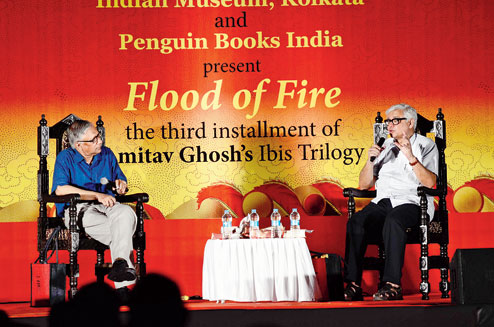
on Saturday. Picture by B. Halder
PK: Speaking of Goa, I remember hearing you talk to a class of students there. You were talking about writing as a career. You've also spoken about writing being a risky business, and of a writer, in some ways, being like a small-scale entrepreneur...
AG: ( Laughs) You know, I make that analogy half as a joke. Because actually writing is very different from being a small entrepreneur. But what I would say is I do think writing is about risk... It is about artistic risk, if you like, because you are constantly having to take risks in your work. And it's about material risks. Certainly if you make your living from writing, it's a very precarious existence. You have to like that precariousness, you have to like that sense of risk. Actually very few writers make their living from writing. Very, very few. Most writers either have jobs in teaching, or jobs in journalism.... They have what's called the 'day job', you know. Some are financial analysts, bankers and so on.
But if you are a writer who wants to make a living from writing itself, it's a very different kettle of fish... I remember talking about this with V.S. Naipaul once and he said something very interesting, that to be a writer you have to be able to write travel pieces, you have to be able to write for newspapers....
So it's not something that you would strongly recommend to budding writers?
Well, I would caution them but I think young people in India are highly entrepreneurial. There may be regional differences... but in Goa I see every other man has a business on the side, and every young woman too.
There are writers like Chetan Bhagat and Amish Tripathi, they both have business backgrounds and they bring the entrepreneurial spirit to their writing. And I think that's a good thing, I don't see anything to disapprove of in that.
Moving away from your writing, you've said you are glad you are not an environmental activist. But you have been very articulately speaking about and writing about climate change.... So, do you see yourself at some point becoming an activist or a spokesperson for climate change?
I think there's a difference between being an activist and being a writer who's writing about climate change ( smiles). I think Arundhati (Roy), for example, writes much more in an activist voice than I do. I think if I were 20 years younger maybe I would feel the urge to be an activist but at this point I just think it's something that I can observe and write about.
Someone was asking me what I see in the future... I don't see many good things. I think climate-change impacts are accelerating; especially in Bengal we're going to be very, very severely impacted. Calcutta being below sea level for most of its extent, it's just going to take one big cyclone....
Yes, and as you say, the response can't be at an individual level, it has to be at an institutional level...
Yes, it's too large a problem. So, what we see here is a catastrophic market failure. I mean it really explodes the whole idea of the efficiency of the market. The market can't solve this, it's not even begun to address it.
And while Calcutta is extremely vulnerable, you know what really worries me? Bombay. You see what Bombay is. It's a sliver of land... opposite it is this great fault in the ocean which is overdue for an earthquake, so there's a tsunami risk. But more than that, there's the heating of the oceans. The Arabian Sea has actually heated up much faster... in the Arabian Sea historically there were never cyclones, but in the last five years there have been four or five. Just imagine a major cyclone hitting Bombay! You can't evacuate... and I say this because we saw Hurricane Sandy in New York and what incredible damage it can do. No city should have been built there. And it's only the British who built it. The Portuguese built in Vasai, which is actually on the mainland.
Amitav Ghosh is my favourite author because...
Tell ttmetro@abpmail.com