Nobel laureate Gunter Grass, who passed away recently, had told his friend Subhoranjan Dasgupta, "I crave for the visual dimension." Indeed, Grass etched, sketched, drew and painted restlessly throughout his creative career. Dasgupta evaluates the artistic output of Grass.

Critic George Steiner had a special word of praise for Gunter Grass. While stressing the pathbreaking importance of Grass' classic The Danzig Trilogy - which begins with The Tin Drum and ends with Dog Years - he observed that Grass, more than any other postwar German writer, redeemed the German language poisoned by Hitler and Goebbels. This achievement, however, should not eclipse the fact that Grass began his creative odyssey as a sculptor and artist.
In 1947-48, he joined the Dusseldorf Art Academy as a student of sculpture and fared well in the examination. In fact, he needed only a year to prove his worth as sculptor and then he studied graphic art in real earnest. Recalling those hard days as a struggling, young artist, Grass wrote in a poem, "I was a stoneman / and good in making children's gravestones / What are left are loves / That handily cast a shadow." These words, almost confessional, sound all-too-modest because Grass remained an irrepressible artist without a pause. His oeuvre comprises 2,800 drawings and watercolours, 450 graphic prints and more than a hundred sculptures. These accompany his written words and create a multi-layered collage where the line and colour reinforce the word with remarkable exactitude.
This variegated collection created with the pencil, brush, colour, needle of the graphic, chisel and hammer was tastefully arranged and placed in the Gunter Grass Haus in Lubeck. In fact, the inauguration of this 'Haus' in October 2002 marked the highest point in the week-long celebration of Grass' 75th birthday. Scholars and art critics from Montreal to Breslau assembled in Lubeck to evaluate the worth of Grass the artist whose sketches and figures, prints and paintings evoke a world astoundingly close to reality, yet fantastic and surreal.
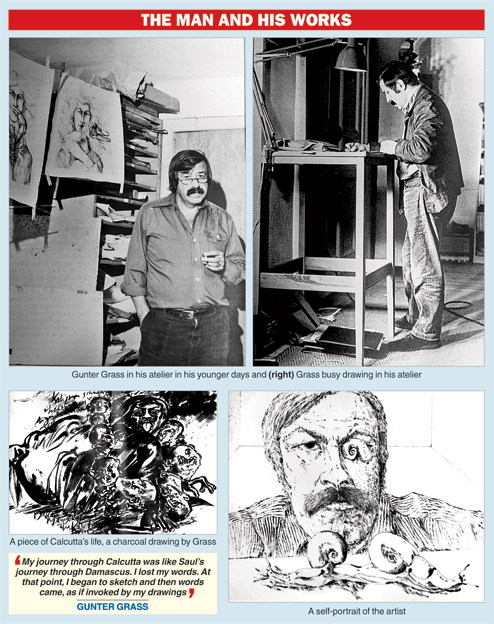
In his colour-washed album Found Objects For the Non-Reader (1997), Grass, the aquarellist and Grass the poet, are fused. When we examine the poster reproductions of these watercolours on display - for example, Oskar, the diminutive Tin Drummer with his red-white drum, blue circular eyes and glaring black spots of premonition all over his body and link him with the verse of the novel ("Now ahead of me too, facing me Black / Blackwords, blackcoat, blackmoney") - we realise that Grass fashioned an original idiom where the writer and the artist were indivisible. We pause in front of his bold etching Meeting in Telgte (1979) and discern how the writer with his quill is trying to reform a war-torn land. We see his fearful graphic Shark on Land (1973) and prefigure an Apocalypse which he described later in his novel The Rat (1986). We stare at his surreal self-portrait (1971) where a snail covers one of his eyes and think that, like Salvador Dali, he must have been in a jocular mood.
Is this creative quest autonomous or deeply related to his dedication to words, I asked Grass in Lubeck. He answered, "The artist and the writer in me coexist in the first phase. Later, the artist turns autonomous. You have seen my books of poems - how these are enriched by drawings and watercolours. I crave for this visual dimension even when I am immersed in words. But after a time, these very drawings free themselves from the pages and become sovereign. Like the sketches which I did while writing My Century and Novemberland."
The thematic as well as aesthetic bond between words and pictures charted the simultaneous progress of the artist and the writer - from the expressive cover of The Tin Drum to the fearful cluster of human figures accompanying his last epic A Wide Field.
But, at times, the artist Grass preceded the writer. For example, when the turbulent shock of Calcutta rendered him speechless, he depended solely on his charcoal drawings. While I examined these in Grass Haus recreating the mounds of garbage in Dhapa and people sleeping on the pavements, I recalled his confession: "My journey through Calcutta was like Saul's journey through Damascus. I lost my words. At that point, I began to sketch and then words came, as if invoked by my drawings."
His graphics and figures not only precede, accompany and follow his texts but also flower from a free, self-sustained soil, unattached to the progress of words. When you confront his Naked Woman in terracotta, you are struck by its sheer originality. The woman, perfectly shaped, lies on her back embodying the expression of pure, primeval fear.
Again, the lean and clasping dancing couples in bronze enacting varied movements with vacant looks remind us of Ernst Barlach's figures. They resemble none found in the novels and poems of Grass. The creator had such art-works in mind when he claimed, "I cross the transient confine of words when I create with stones and colours. A written metaphor shines, a figure in stone shines and defies time."