 |
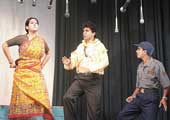
| Indrani Halder as Bangladesher Baghini at Mahajati Sadan on Day One of the jatra festival. Picture by Amit Datta |
“indrani halder will take a few more minutes to come on stage. She is almost through with her make-up,” a voice booms over the microphone. “So, we request our respected guests on the dais to say a few words. Let’s welcome minister…”
A deafening hoot from the packed Mahajati Sadan auditorium drowns the minister’s name. “Shuru korun, shuru korun,” the audience screams. After two truncated speeches amid more boos, the unwanted guests clear out of the stage, the concert chimes and the curtains rise on Trinayani Opera’s Bangladesher Baghini. The roar can be heard from Central Avenue to the Sunderbans.
The flavour of real jatra might have been a trifle amiss on the proscenium, but audiences at the inaugural show of Paschimbanga Jatra Utsav certainly didn’t seem to mind. Not as long as the pala had a larger-than-life feel — with generous doses of melodrama, high-pitched histrionics, tear-jerker dialogues, in-your-face comic relief, some glitz and some glitter.
One-hundred-and-twenty-years after jatra in the form we know it today — well, maybe not quite — took formal shape, this form of entertainment is still making its presence felt — and most definitely heard. So much has changed, and yet so much has remained the same.
The where
The comfort of the closed Mahajati Sadan in December 2003 is a far cry from the courtyard of Madhusudan Sanyal’s Jorasanko address in a December night of 1882. Having sold tickets for a pala for the first time, Bagbazar’s National Theatre had staged Dinabandhu Mitra’s Nildarpan, also paving the way for the establishment of jatra troupes in Chitpur.
Yet, suburbs have remained its real bastion. The windy open fields are where viewers pour in, even now, from far-flung areas and squat on the far-from cushioned ground for hours.
“Standing on a bare wooden stage open on all sides, the artistes would transport the audience to a make-belief world — a palace, a hut or a battlefield — with sheer acting prowess and vocal power. No props, no lights, no acoustics,” recounts Surojit Banerjee, a scriptwriter.
Now, most troupes enlist some technical support (hanging and lapel mikes, and a proper backdrop at the least), and eye-popping stunts. Bottomline: a bit of Bollywood and a lot of commercial theatre in the garb of jatra.
The what
“The standard of palas has dropped drastically. A lot of vulgarity has crept into the stories, costumes, dialogues and gestures. A gentleman recently told me that he has stopped coming to jatras with his family as some of the palas were very embarrassing to watch together... One has to keep in mind that rural Bengal is still very orthodox in such matters,” laments film actor-turned-jatra star Santu Mukherjee.
The form may have undergone mere cosmetic changes, but the content has invariably caught the drift of the contemporary and held its audiences despite the draw of the big and the small screens.
If mythologicals were the staple fare in the early 19th Century (when it all began with Chaitanya Mahaprabhu’s abhinay leela), the early 20th Century saw it veering towards historical plays. Biographical palas became the rage in the 1960s — with veteran Shantigopal setting the trend — and continuing well into the 1980s. With Utpal Dutt, the raw art form saw a definitive refinement in treatment. A parallel wave of reformist palas with a dominant Leftist ideology swept through the same period.
The 1970s heralded a never-seen-before era of glamour and stardom unleashed by Swapan Kumar, with whom stage adaptations of feature films entered the jatra melting pot. While Uttam Kumar churned out one box-office hit after another, Swapan Kumar picked up the cue and replicated the success on stage. Saptapadi, Nishipadma, Jibanmrityu, Sanyasi Raja, Amanush — some of the golden moments are still caught in frozen frames at the 72-year-old thespian’s Gariahat residence.
“This trend also foreboded the decadence of the form, which became pronounced by the mid-Eighties when film stars gained a foothold. The balance got tilted when they started demanding and getting fat pay packets just for that extra dash of glamour,” says Banerjee.
The who
If film actors trot the line that they brought big bucks and glamour into the palas, jatra artistes never let go a chance to say it’s quick cash that lured the Tollywood brigade to Chitpur.
And that’s where all the action is for 19 days now, as the Paschimbanga Jatra Utsav with 22 troupes rolls out an attractive line-up of Soumitra Chatterjee, Shatabdi Roy, Indrani Halder, Dipankar Dey and several middle-ranking actors.
Beyond the festival and far removed from Mahajati Sadan, the palas starring Chunky Pandey, Shakti Kapoor and Asrani are among the big draws this season.
“Mumbai artistes don’t work too long at a stretch. For instance, out of 10 shows a month with Chunky Pandey in the lead, he will act in five and some other actor will replace him in the rest. Most palas casting stars follow this module,” says Santu Mukherjee. “Their dialogues, mostly a hotchpotch of Hindi with a smattering of Bengali, are pre-recorded…”
Quality, clearly, is the quickest casualty. Cashing in on whatever is saleable is the sole mantra — from the Kargil conflict to the capture of Saddam Hussein. Fifteen days is all that it takes for Digbijoyi Opera to stitch together the battle for Baghdad and hit the Bankura fields with Dhora Porechhe Saddam.
The how
It’s all about the money, honey, but talk of sales figures and most jatra producers act far more coy than their skimpily-clad money-spinning women on stage.
“Modest returns” is all that is forthcoming. But given that most Tollywood stars do not mind taking the dusty trail to the remote pockets of Bengal, there’s little doubt about where the bait lies.
“A modestly successful pala can pull around 8,000 people while a hit can push that up to 25,000 to 30,000,” says Samir Sen, secretary of the jatra producers’ association. The booking rate for top draws climbs up to Rs 50,000 a show. One particular pala featuring a big Tollywood name has recorded Rs 70,000 a night.
On Tuesday evening, Day One of the festival hosted by three jatra associations and the information and cultural wing of the state government, there was the odd gaffe. But the buzz in the audience was indication enough that the organisers — battling a slump in business with the rains playing spoilsport earlier this season — would have the last guffaw by the time the jatra jamboree would end.