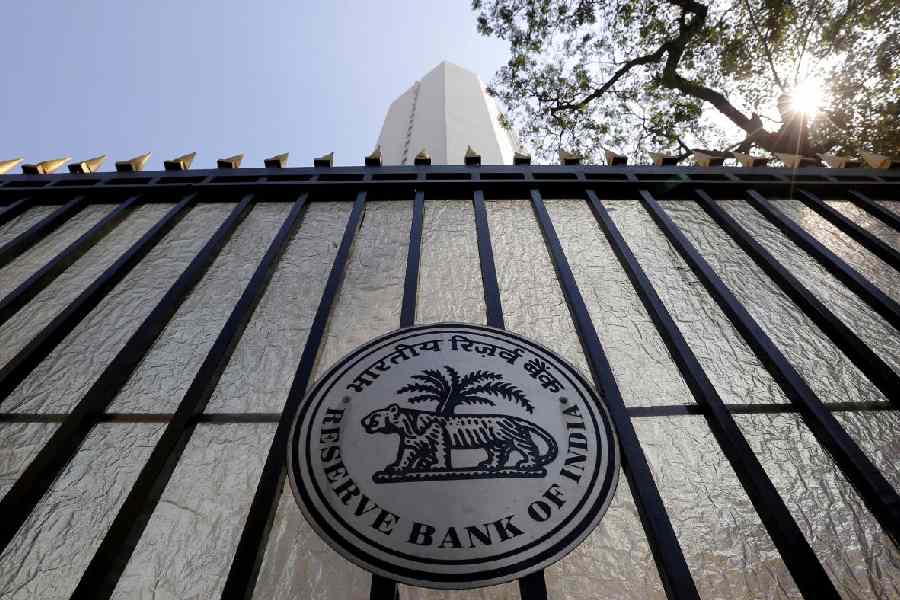
Consumer demand dynamics could play a role in the policy decision of the monetary policy committee of the Reserve Bank of India, scheduled to meet from April 6 to 8 to decide whether to hold the benchmark repo rate at 5.25 per cent or raise rates to contain inflationary pressures.
Chief economic adviser V. Anantha Nageswaran wrote in the preface to the March edition of the Department of Economic Affairs’ monthly economic review that if demand softens in response to rising costs, the current inflationary uptick could be treated as a transient supply-side shock.
However, if consumption remains firm, the risk of “second-round effects” — where higher import costs feed into broader price pressures — could compel a stronger monetary response.
“If demand moderates in response to higher prices, the central bank will be more inclined to treat the inflationary impact as a supply shock.
“Otherwise, it may be compelled to watch for second-round effects of higher import costs on inflation and respond accordingly. Higher interest rates burden the entire economy, whereas the pass-through of material prices falls on specific end-users,” Nageswaran said.
A similar observation was made by Christine Lagarde, president of the European Central Bank. “Small, one-off and short-lived supply shocks can be looked through. But as expected, deviations from our inflation target grow larger and more persistent, the case for action becomes stronger,” Lagarde had said at the ECB watcher’s conference at Frankfurt earlier this month.
Presenting scenario analysis earlier to a parliamentary panel, Nageswaran had said that if crude oil prices rise to $130 per barrel and remain elevated for two to three quarters, consumer price inflation — which stood at 3.2 per cent in February — could climb to around 5.5 per cent.
While this would mark a sharp increase, it would remain within the RBI’s tolerance band of 2–6 per cent.
Crude prices have already surged significantly, with the Indian basket rising from $62.2 per barrel in December to $115.75 per barrel as of March 26, amid the ongoing conflict in West Asia.
Globally, monetary policy signals remain mixed. In March, central banks in advanced economies, including the US, UK, Euro area, Japan, Switzerland, Sweden and Canada, kept rates unchanged, while Australia raised its policy rate by 25 basis points for the second consecutive month. Among major emerging markets, China, Malaysia and Indonesia held rates steady, whereas Brazil and Russia opted for rate cuts.
A Reuters poll of economists suggests that the RBI is likely to keep the repo rate unchanged at 5.25 per cent on April 8, with expectations of a prolonged pause extending at least until mid-2027.
“Inflation is already quite benign. So there is some space for oil price shocks to get absorbed into higher inflation without really rocking the boat of the economy ... but the risks are clearly to the upside for the policy rate,” said Dhiraj Nim, economist, FX strategist at ANZ Research.
Beyond energy prices, other external risks are also building. Investigations by the US Trade Representative into 16 economies, including India, over alleged excess manufacturing capacity and export practices, add another layer of uncertainty.
“The renewed conflict in West Asia and the US investigations into trade practices of key trading partners have brought uncertainties regarding global energy security, US import tariffs and global supply chains back to the centre stage.
“Prolonged period of war and high uncertainty would be detrimental to the broader global outlook, which was
already in a state of flux prior to the recent events,” the RBI said in its March bulletin,
adding that given India’s external dependence on crude oil, there is a need for proactive measures to limit adverse spillovers.