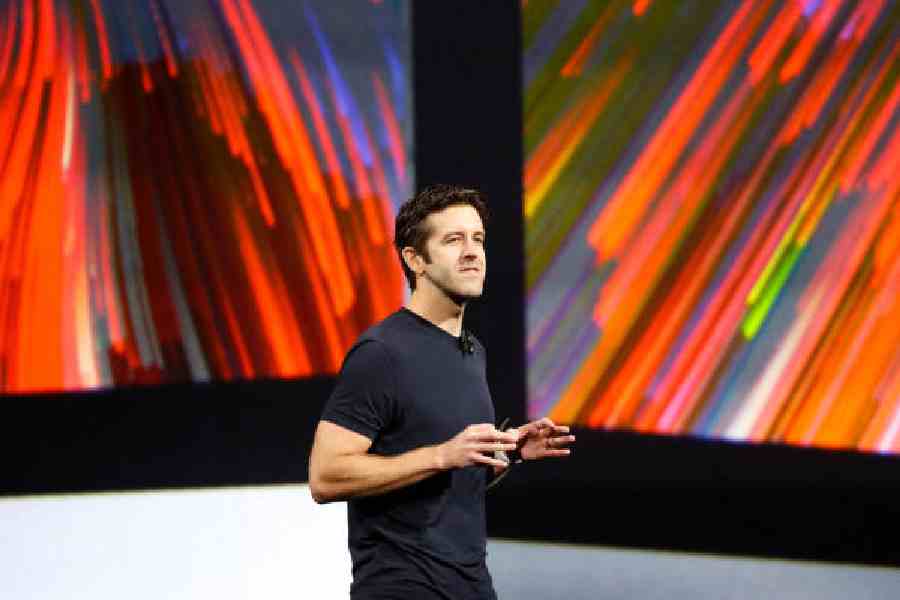
He has been a builder who has spent around 25 years quietly shaping the products that billions of people reach for every single day. When Tim Cook officially steps down as Apple’s chief executive on September 1, he will hand the keys of one of the most valuable companies in history to a 50-year-old mechanical engineer. That man is John Ternus. And if you have not heard much about him until now, that is rather the point.
In Silicon Valley, where chief executives often cultivate their personas as loudly as they do their products, Ternus has built his reputation the old-fashioned way — by getting things done.
During his career at Apple, he has left his fingerprints on virtually every major product the company makes: iPhone, iPad, Mac, Apple Watch, AirPods, and Vision Pro.
The making of an Apple man
Ternus studied mechanical engineering at the University of Pennsylvania, and his very first job out of university had him working (1997-2001) on virtual headsets at Virtual Research — a detail that now reads almost like destiny, given Apple’s deepening investment in spatial computing and the Vision Pro. That first role did not last long. Apple came calling, and it was his second position. He has never left.
He recalls that first day at Apple with a disarming honesty. In a 2024 commencement address at Penn’s engineering school, he described walking through Apple’s doors feeling equal parts exhilarated and intimidated. “To be honest, I wasn’t sure I belonged there,” he told the graduating class. “The people I met were so smart and so confident, and they knew so much more than me. But I’ll always be grateful that I wasn’t afraid to ask for help when I needed it.”
That willingness to remain curious and open — even in the face of self-doubt — tells you something important about who Ternus is. He worked under both Steve Jobs and Tim Cook, absorbing lessons in design obsession and operational excellence respectively.
He championed the creation of iPadOS to unlock the full potential of the iPad’s hardware. He pushed for the Apple Pencil and its magnetic charging. He was a vocal advocate for adding LiDAR to the iPhone. And perhaps most significantly, he was instrumental in Apple’s landmark shift from Intel processors to its own Apple Silicon chips — a transition he later described as one of “the most profound changes at Apple, certainly in our products over the last 20 years”.
As he put it himself: “I started in product design. I’m a mechanical engineer by background, and I’ve had the great fortune of working on pretty much every type of product that we make.”
More light has been shed on Ternus in a recent article published in The Daily Pennsylvanian. Paul Feehery, a 1997 Penn engineering graduate and Ternus’ friend, roommate, colleague, and senior project partner, said Ternus stood out for his consistent approach to work. The pair later shared an off-campus house near 39th Street and worked on their senior project together.
Ternus is also an accomplished swimmer. Katharine Gilbert, who coached Penn men’s and women’s swimming and diving from 1983 to 1999 at Penn, told The Daily Pennsylvanian she first got to know Ternus while recruiting high school athletes for the men’s swimming and diving team.
The newspaper reported that, as an engineering student, Ternus’ most “prominent undergraduate work took the form of his senior project” — the Head Actuated Nutritional Device Feeder, or H.A.N.D. Feeder. “The device aimed to help users feed themselves by translating head and neck movements into the motion of a spoon.”
A quiet rise to the top
Ternus was appointed senior vice-president of hardware engineering in April 2021, and in the years since, that role has only expanded. He became a familiar face at Apple’s major product events from 2017 onwards, presenting at the annual WWDC developers conference and introducing new product lines with his usual calmness. At WWDC 2022, he spoke about the success of Mac’s transition to Apple Silicon: “We couldn’t be more excited by how well the Mac transition to Apple Silicon is going…. The Mac business has never been stronger.” At the 2025 iPhone event, he unveiled the iPhone Air with characteristic understatement: “It’s the impossibly thin… iPhone Air.” Most recently, it was Ternus who introduced the world to the MacBook Neo at Apple’s New York City experience.
People who have worked closely with him describe a leader who is steady, trusted, and deeply product-focused. He is a builder — someone who understands how hardware actually comes together and who makes decisions with clarity and conviction.
At 50, Ternus was the youngest serious internal contender for the top job by roughly a decade. As it happens, that is exactly the age at which Tim Cook stepped into the role. If Ternus stays for a decade, Apple will be in capable hands well into the 2030s.
Cook will not disappear overnight. He steps down as CEO on September 1 — just ahead of the expected iPhone launch event — before assuming the role of chairman of the board. In that capacity, he will continue to advocate for Apple with global leaders and act as a senior adviser to the business. It gives Ternus a genuine safety net, and it gives Apple the benefit of continuity. Ternus, for his part, joins Apple’s board at the same time as he assumes the chief executive role.
Think of Apple’s leadership history as three distinct chapters. Steve Jobs was the design absolutist — a man who could agonise over the curve of a corner. Tim Cook is the supply-chain maestro who transformed Apple from a beloved brand into a profit-generating machine of almost unimaginable scale. Ternus is the engineer’s engineer. He knows the inside of Apple’s products as well as anyone alive, and he is poised to bring that technical intimacy to bear on every strategic decision.
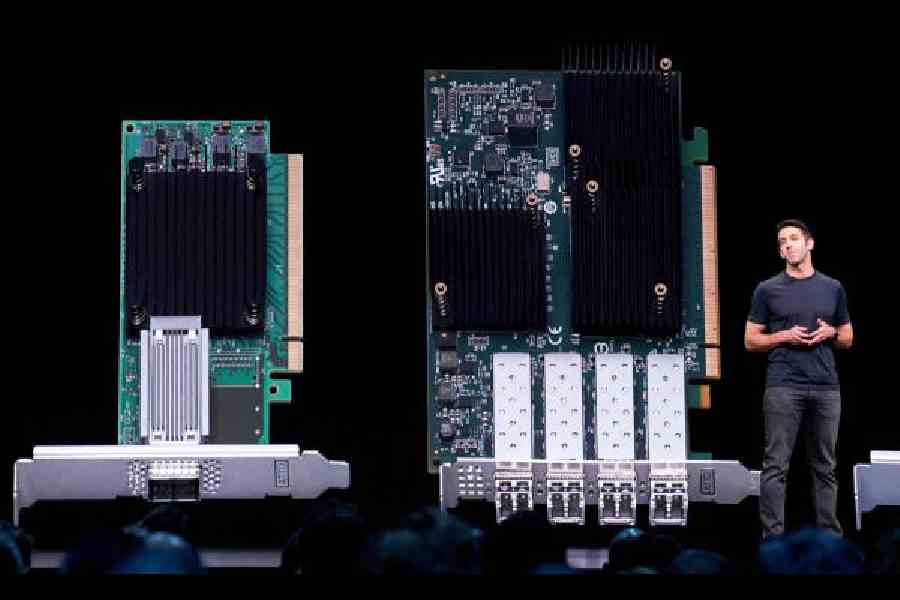
Ternus helped shift Apple from Intel chips to its own silicon for MacBooks. Picture: Reuters
Meanwhile, Johny Srouji — Apple’s long-serving chip chief and the architect of Apple Silicon — has been elevated to chief hardware officer, taking over from Ternus in that domain. Srouji’s expanded remit now spans hardware, engineering, silicon, advanced technologies, platform architecture, and project management. It is a formidable pairing.
Product roadmaps at Apple are drawn up years in advance, so do not expect any dramatic pivots in the short term. What you can expect is a CEO who is more deeply immersed in the product development process than his predecessor — someone who will want to understand the engineering trade-offs behind every decision, not just the commercial ones.
The AI question
The most pressing question that will follow Ternus into the office is also the most talked-about in the industry: can Apple win in artificial intelligence?
The received wisdom is that it has fallen behind. Alphabet, OpenAI, and Anthropic have raced ahead with consumer AI products, and critics have been quick to point out that Siri has lagged behind its rivals. So far, investors have been patient.
Ternus himself has been characteristically unbothered. In a 2023 CNBC interview, flanked by Srouji, he brushed off concerns about Apple’s AI standing with a simple: “Not too worried.” That confidence is not without foundation.
Apple has a bouquet of AI solutions in the form of Apple Intelligence. We are at an early phase when many people feel AI is helping them on a daily basis and then there are those who are sceptical.
“We always think about how we can leverage technology to ship amazing products and features and experiences for our users. And so that’s how we think about AI. You’ve already seen plenty of it happening in different places, live translation on AirPods and other things. It’s like we’re taking the technology and leveraging it into really meaningful experiences. And that’s how we think about approaching it,” Ternus recently said.
Apple has been doing machine learning for years. Features that predict which controls to surface in your Control Centre, or that suggest where you are likely heading when you plug your phone into your car, are all AI-driven. They just do not make headlines.
More importantly, Apple’s approach to AI reflects its values in a way that its rivals’ simply do not. Apple will not add a flock of hot-air balloons to the background of your family photo just because the sky looked grey that day. It will make your photograph look better — sharper, truer, more alive — whilst remaining faithful to the moment you actually captured. That commitment to authenticity and privacy is not a weakness. It is, arguably, Apple’s greatest competitive advantage.
The bigger bet Apple is placing is on running AI models locally on its devices, rather than relying on Cloud servers. This is precisely where Apple Silicon becomes genuinely exciting. The proprietary chips at the heart of Apple’s Macs and iPhones could give the company a significant edge — the ability to deliver powerful AI experiences entirely on-device, privately, without sending your data anywhere. And when Apple does need to take help of external servers, it does so in a privacy-preserving manner, a commitment that extends even to its partnerships with third-party companies.
The immediate test will be Apple’s Gemini-enhanced Siri, poised for release later this year. Getting Siri right — genuinely right, not just passably improved — may be the defining product moment of Ternus’s early tenure. Users have been waiting. Ternus may well be the person who finally delivers.
The hardware horizon
Beyond the AI debate, Apple’s hardware pipeline is arguably the most exciting it has been in years. Mixed-reality glasses and the company’s first folding iPhone are all reportedly in development. There is also a growing family of AI-enabled wearables built around Siri — smart glasses, AirPods fitted with cameras and more — hinting at a future where Apple’s ecosystem extends well beyond the devices we carry in our pockets. The smart home is another frontier ripe for the taking.
Then there is spatial computing — the category that may yet prove to be Apple’s most consequential long-term bet. The Vision Pro has attracted its share of sceptics, but Ternus is not among them. It is worth remembering that his very first job, long before Apple, had him working on virtual headsets. This is a category he has believed in for decades.
Speaking to Tom’s Guide, he was measured but unmistakably enthusiastic: “We’re still very much in the early innings of spatial computing. We are super excited about it. The Vision Pro is an extraordinary product. It’s like we reached into the future and pulled it into the present.” He pointed to compelling use cases already emerging in enterprise and medicine, and struck a note of genuine excitement about what lies ahead: “We’re at the beginning of the journey.”
It is a timely conviction. Meta is doing brisk business with its Ray-Ban smart glasses, and Google is reportedly collaborating with Samsung on its own entry into the category. The spatial computing race is very much on — and Apple, with visionOS already built and a hardware chief who has believed in the technology since before most people had heard of it, is better positioned than its critics tend to acknowledge.
But if you want a window into exactly how Ternus thinks about hardware more broadly, look no further than the MacBook Neo — the most affordable Mac Apple has ever made. In lesser hands, “affordable” can easily become a euphemism for “compromised”. Not under Ternus.
Speaking to Tom’s Guide, he was emphatic: “We never want to ship junk. We want to ship great products that have that Apple experience, have that Apple quality.” Delivering that at a lower price point, he explained, required building something entirely new from the ground up — rethinking the trackpad, reimagining the enclosure, and drawing on decades of accumulated expertise across every product Apple makes.
The result, he said, did not lower the bar: “We still made an amazing high-quality Mac at this incredible price point.” That is the Ternus doctrine in miniature: the relentless pursuit of getting it right — whatever “it” happens to be. It is a philosophy that has served Apple’s premium products well for decades. The real test now is whether it can scale across an ever-widening portfolio, at every price point, in an era when Apple is pushing into more categories than ever before.
Ternus is exceptionally well placed to oversee all of this. He has spent the better part of his career helping to bring complex hardware to life, and he carries the kind of deep product intuition that only comes from having been in the room when the difficult decisions were made. As he said in 2023: “I’m really excited about the products that we’re making and even more excited about the things that we’re going to be delivering in the future. There’s just so much opportunity here for us.”
Challenges ahead
None of this means the road ahead is straightforward. Ternus inherits a company facing a genuinely complex set of pressures — commercial, geopolitical, and cultural.
Manufacturing is perhaps the most urgent headache. Apple has spent years shifting production away from China towards India and Vietnam, but the Trump administration’s sweeping tariffs on Chinese goods have accelerated the pressure considerably. Apple has pledged significant investment in American manufacturing, but the long-term logistics of that shift will fall squarely on Ternus to resolve. Unlike Cook, who built his entire career around supply-chain mastery, Ternus will need to lean heavily on his predecessor’s counsel here.
Then there is the broader geopolitical climate. Apple is not merely a company; it is a symbol of American soft power. Operating at that scale means navigating political currents in every major market — and those currents have rarely been choppier than they are right now.
There is also the question of what comes after the iPhone. For more than a decade, the iPhone has been the gravitational centre of Apple’s business. But the market is maturing, and competitors are circling with devices designed to convince consumers that the smartphone is yesterday’s technology. Apple needs its next defining product. Whether that is the folding iPhone, smart glasses, or something nobody has thought of yet remains to be seen.
And then there is the app economy. If we are genuinely moving towards a post-app world — one in which AI agents handle tasks that once required individual applications — Apple will need to think carefully about how its App Store model evolves, and what that means for its services revenue.
Perhaps the most unexpected challenge on Ternus’s list is one that is quietly reshaping the entire consumer technology industry: screen time. Governments around the world are increasingly pressing for limits on how long people spend staring at their devices. That puts Apple in a peculiar position.
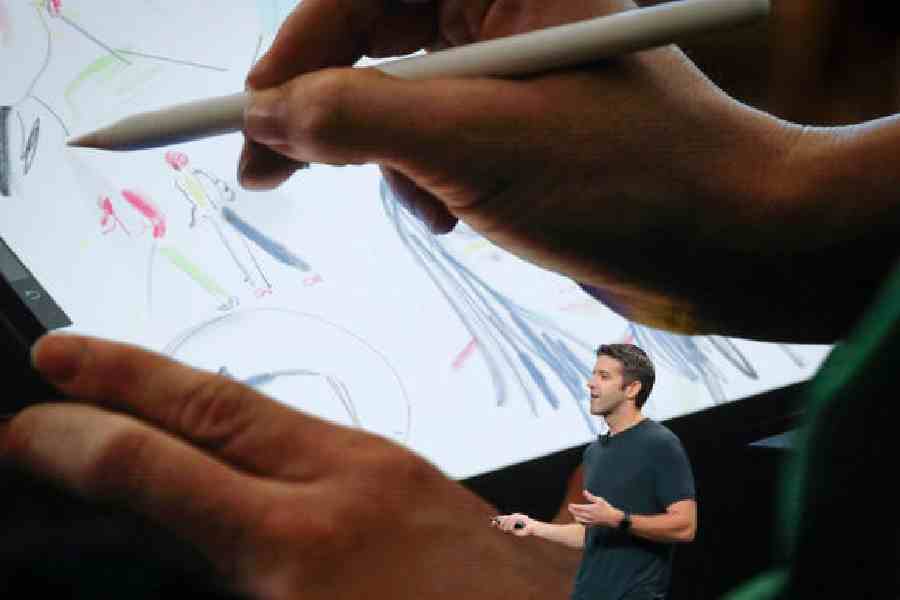
The incoming Apple CEO discusses the iPad Pro during an event in New York in 2018. Picture: Getty Images
Its entire ecosystem is built around products people love to use. Ternus will need to find a way to make those devices feel more meaningful and purposeful — not simply more compulsive. Will a premium folding iPhone rekindle the excitement that the original iPhone once sparked? Or will the next chapter of Apple require a more fundamental reimagining of the relationship between people and their technology?
Right person for the moment?
There is a version of this story in which John Ternus is the wrong choice for the AI age — a hardware man handed the keys to a company that needs a software visionary. That argument is not entirely without merit. But there is another version, and it may be the more persuasive one. Apple’s biggest bets in the years ahead — on-device AI, spatial computing, wearables, proprietary silicon — are fundamentally hardware problems. They require someone who understands how chips, sensors, and form factors actually work; who can make the trade-offs that only engineers fully appreciate; and who has the deep trust of the teams that will have to execute on those decisions.
Ternus has the loyalty, the longevity, and the craft. He carries Tim Cook’s management ethos — open, empowering, and genuinely attentive to Apple’s mission of enriching lives and protecting the planet — paired with a technical depth that his predecessor never quite possessed.
He walked through Apple’s doors all those years ago, a young engineer unsure he belonged. He stayed, he learned, and he built. Now the company he helped shape is his to lead.