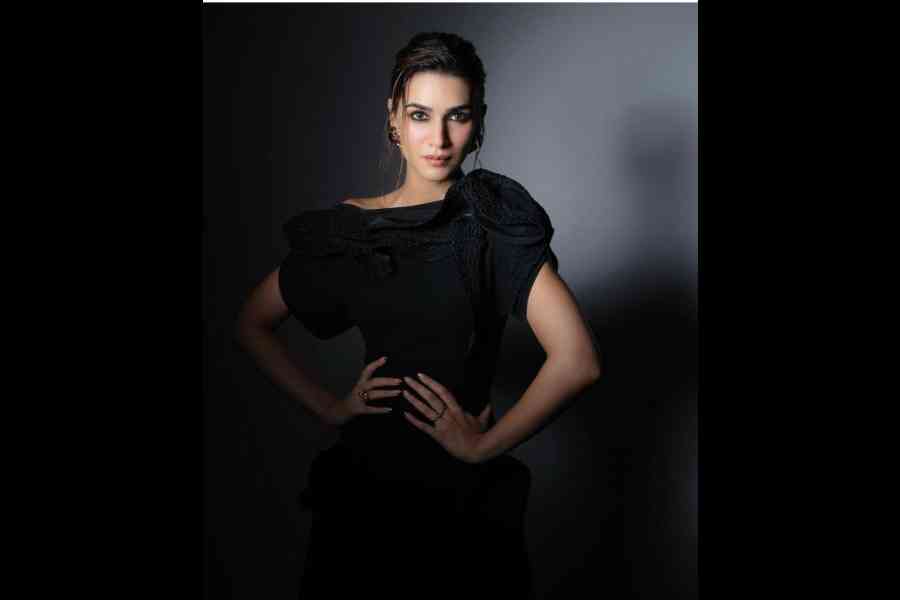
Her latest film Tere Ishk Mein is going great guns at the box office, giving Kriti Sanon a lot to smile about. Directed by Aanand L. Rai and co-starring Dhanush, the film that is set in the same universe as the duo’s 2013 hit Raanjhanaa, gives Kriti the opportunity to sink her teeth into a layered, complex character, which she aces with the kind of ease that we have now come to expect from the National Award-winning actor. A few days after its release, t2 caught up with Kriti for a chat.
Beyond the box-office numbers, what has the most special aspect of the reception to Tere Ishk Mein been?
I am overwhelmed with all the love that the film and my performance are getting. I am very attached to this film and this has been one of my most layered and possibly the trickiest character I have played so far. I finally got the opportunity to be directed by Aanand L. Rai in a passionate love story, which is a big tick mark on my list. The film is very intense and the audience is taking time to absorb and feel it. Almost all the messages I am getting say that it took them time to reach out to me because they were still processing the impact of the film.
I got a lot of love for Mimi (that earned Kriti the National Award for Best Actress), but I can safely say that the kind of appreciation that I am getting for Tere Ishk Mein is unprecedented. I was just talking to someone who said that it was refreshing to watch an imperfect female character like Mukti on screen. Female characters are no longer expected to just be Miss Goody Two Shoes... they are flawed and vulnerable and that is what is making people relate to Mukti.
Mukti is confused and ambiguous in many ways. Did you feel conflicted playing her at any point?
Mukti constantly fights a dilemma between her head and heart. On paper, she could have come across as a negative character, if not played a certain way. Aanand sir was clear about the fact that this may seem to be a one-sided love story, but there is no way that Mukti doesn’t have feelings for Shankar (Dhanush). He has beautifully explored a zone where you can feel a lot for a person without it falling into the standard definition of what the world thinks is love. As women, we often end up feeling conflicted because there are certain qualities that we seek in a life partner. We want someone we can feel safe with and who makes you feel that it is not a tough task to be with him. But here comes Shankar who Mukti feels for deeply in many ways, but he is so volatile that she just can’t be with him. That dilemma, I feel, has been explored in a very relatable manner.
Also, playing Mukti was tricky because not everything is expressed with dialogues in this film. There are a lot of emotions that are left unspoken. I had to convey a lot through the rawness and vulnerability in my eyes. Even when she talks, the dichotomy of feelings within her makes her say something, even though she may be experiencing something completely different. When he says “I love you” to her the first time, she knows that she doesn’t want to be with a guy like him. She hugs him but also turns her face away because she feels conflicted and emotional. That also happens in the scene where she shields him from the cops at first, but ultimately knows that he can cause harm. There is so much conflict I had to convey through my eyes. It is beautiful for any actor to be not given the crutches of dialogue, because it gives you so much more scope to play with.
Has this role pushed you the maximum as an actor in recent times?
Mimi (2021) pushed me a lot... as an actor, I grew in many ways with that film. Do Patti (2024) presented a different kind of challenge. In Tere Ishk Mein, I felt that emotionally and mentally, I had come to a place where I was ready to take up the challenge of playing such a layered character.
The problem with Mukti was that if she went a little off, the audience would perhaps not connect with her at all. You may even feel: “Oh, what a b**ch!”It was important to tap into the human side of her — her love, her denial of love, her pain, her guilt and her journey. She is a very different character in the end from what she started as at the beginning of the film.
It is interesting you mentioned that because when we spoke about your last film Do Patti, which had you in your first double role, you had underlined the challenges of playing two different characters in the same film. Was playing Mukti — who, as you said, changes so much during the course of the same film — even more difficult?
It was, in many ways. What was important for me was not to judge her and the kind of decisions that she makes at various points in her life. No matter what she said, did or reacted to, I, as Kriti, had to be internally convinced about it.
Mukti never wants to hurt anyone intentionally, especially Shankar. When she hurts someone, it really bothers her. She is not directly responsible for Shankar’s father’s (played by Prakash Raj) death, but that guilt affects her really badly. She feels that she inadvertently caused this man so much pain and almost destroyed his life. She gets into self-destruction mode and wants to go through the pain herself. That can only happen if someone is genuinely pure-hearted and empathetic. That was my core when I was playing Mukti.
Also, so much has happened in her life in the intervening years after Shankar has left — she is an emotional wreck, she has cirrhosis, she is pregnant — and we had to show the time that has passed on her without really saying it. Aanand sir told me: “I want to see your past in your eyes... I want to feel the intensity of the past that these two people have had.” These are the little instructions and directions that helped shape the film.
The film has fittingly been called out for its toxicity, misogyny and sense of male entitlement. How do you react to that?
I always love a good debate. Art is different for different people... if you have a painting in front of you, different people will perceive it differently. Yes, Tere Ishk Mein has toxicity, but what is refreshing is that the woman is not submitting to it; in fact, she actively calls it out whenever she can. The film has a very strong female perspective where Mukti is constantly countering Shankar’s sense of entitlement and his inability to hear ‘no’. This kind of love scares her. She rejects him multiple times... it is not that she goes along with what he says and demands. Yes, the guy is toxic but it is not that she is worshipping him.
Over the last few years, there has been a perceptible shift in the expectations from a Kriti Sanon film. Which film, do you think, made the audience see you in a new light?
It has been a combination of several parts, I feel. My journey has been about learning, growing and building. I am not from a film background, I never did theatre before getting into films. Everything that I have learned so far about acting has been on the job. After Mimi — whether it was the love from the audience or the National Award — I stopped feeling the need to prove myself because I knew that from now on, I will by default choose films that justify all those accolades. Now I am hungry to do better, to take risks. Honestly, it felt like a weight lifted off my chest. I was like: “Now people already know what I can do and that I can do more. So I just want to enjoy what I am doing.” I am not in a race, I am not looking to get ahead of anyone... I just want to be better than what I was in my last film. I get excited when I am shooting and I see that I am being able to push the envelope with every scene. That is the only thing that I try and focus on.
You have two big franchise films — Cocktail 2 and Don 3 — coming up. What can you tell us about them?
The idea is not to do ‘projects’... I need to connect with the film at some level. Not every character has to be intense or deeply performance-oriented. After Tere Ishk Mein, I didn’t have the capability to do another intense role immediately. I was craving something fun, which, at the same time, had to be challenging in its own way. Cocktail 2 (co-starring Shahid Kapoor and Rashmika Mandanna) came along at the right time. It has been great working in the film, we still have two months of shoot left. As for the other film (Don 3, opposite Ranveer Singh), I don’t know how much I should be saying, if at all, because the official announcement hasn’t been made. But again, that is also a film in a very different genre from Cocktail or Tere Ishk Mein. I am glad that I am not putting myself in a box.
My criterion in many ways to pick a film is that I look for a scene, or sometimes more than one, that I know will really scare me as an actor. Tere Ishk Mein, of course, has multiple scenes like that. It scared me as an actor, and that is what I am looking at in my films.
My favourite Kriti Sanon film is...
Tell t2@abp.in