Bang, boom, Boong!
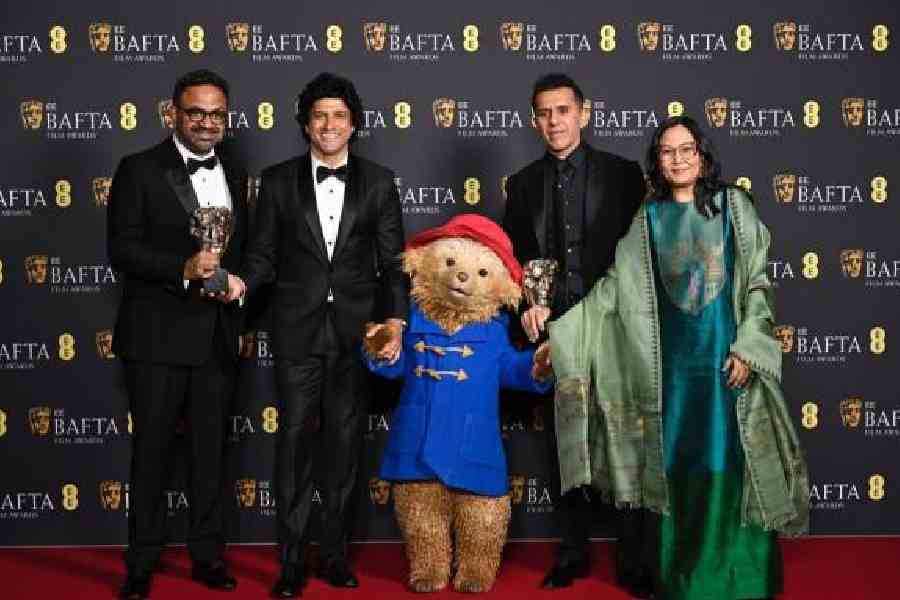
Boong created history, winning a BAFTA award for Best Children’s and Family Film. Made in the Manipuri language, the powerful and poignant film, directed by Lakshmipriya Devi and produced by Farhan Akhtar’s Excel Entertainment, has found resonance across the world — including the jury of the BAFTA awards — for its themes of displacement, political and racial tensions and the loss of innocence in a region that continues to battle unrest, as seen through the eyes of its nine-year-old eponymous protagonist.
An overwhelmed Lakshmipriya Devi, dressed in traditional Manipuri weaves, used the global platform to call for peace in Manipur. She was accompanied on stage by producers Farhan Akhtar, Ritesh Sidhwani and Alan McAlex.
Boong got the better of other notable nominees in the category, including productions such as Arco and Hollywood releases like Lilo & Stitch and Zootropolis 2. The award was handed over by a delightful presenter — lovable anthropomorphic bear and British icon of sorts, Paddington.
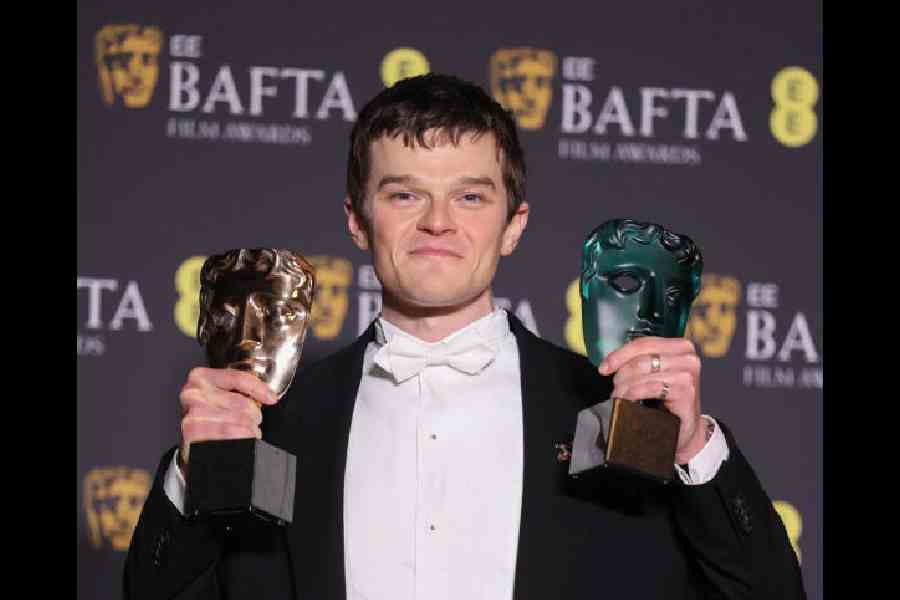
Robert Aramayo with his two BAFTAs for Best Actor for I Swear and EE Rising Star
In her acceptance speech, Devi highlighted the ongoing unrest in Manipur and appealed for peace and hope. She shared a sense of elation and pride at the team’s accomplishment, saying: “To walk up till here felt like the last few steps to reach a summit of a mountain we never knew we were climbing in the first place.”
During her speech, Devi shifted focus to the situation in Manipur, where recent unrest has led to widespread displacement and disruption. She took the opportunity to make a heartfelt appeal, saying: “I just want to use this opportunity to say that we pray for peace to return to Manipur. We pray that all the internally displaced children, including the child actors in the film, regain their joy, their innocence and their dream once again.”
Her speech also highlighted how Manipur is often overlooked in India. She called her film “not only rooted in a place which is very troubled” but “very much ignored and very unrepresented in India, my homeland Manipur”. “It’s a homage to my homeland,” she said.
Concluding her speech, Devi emphasised the importance of resilience and forgiveness, saying: “We pray that no conflict is ever formidable enough to destroy the one superpower that all of us have as human beings, that is forgiveness. So thank you, BAFTA, for giving us not only an award, but this stage to express our hope.”
Boong follows the life of a young boy who sets out in the search of his absent father, with the coming-of-age film also commenting on the larger political and racial tensions within the state and along its international borders.
Namaskar, Alia!
The other notable Indian presence on the BAFTA stage was that of Alia Bhatt. Dressed in a custom-made sequinned Gucci gown — the brand that the actress is the international face for — a radiant Alia, channeling old Hollywood glamour and specifically screen icon Marilyn Monroe, strode on to stage to present the award for Best Film Not in the English Language.
Alia started her speech with a “Namaskar” and added in Hindi: “Agla award ek aise film ke liye hain, jo angrezi me nahin hain”, and followed it up with: “Don’t reach for the subtitles just yet”, and then switched to English, stressing on the fact that while films “speak in countless voices, the true language of cinema is universal”.
Alia’s decision to speak in Hindi won hearts, with the Internet not seeming to have enough of it. “Speaking Hindi on the BAFTAs stage is an iconic move,” wrote a social media user, while another praised the idea of inclusion, saying: “This is beautiful. Great job to all who played a role in carving out a space for true inclusion.” “Eloquence at its finest! Alia’s speech left me speechless, especially that impactful Hindi intro,” wrote another fan.
The late Dharmendra’s prominent inclusion in the ‘In Memoriam’ segment also won the hearts of Indian fans.
Half a dozen for One Battle After Another
One Battle After Another, Paul Thomas Anderson’s counterculture comedy about a down-and-out revolutionary trying to protect his daughter from a ruthless military officer, dominated the 2026 BAFTAs, taking home six awards — including Best Film, Best Director and Best Adapted Screenplay (both for Anderson), Best Cinematography, Best Editing and Best Supporting Actor for Sean Penn.
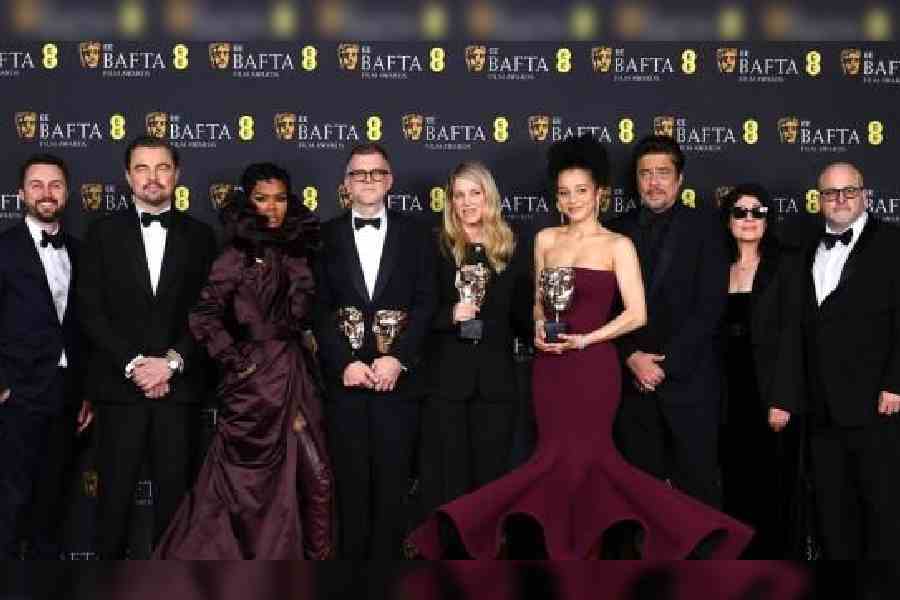
The critically acclaimed film was nominated for 14 awards going into Sunday’s ceremony, the most for any contender — including nods for stars Leonardo DiCaprio, Sean Penn, Benicio del Toro, Chase Infiniti and Teyana Taylor.
Anderson, accepting the gong for Best Film, took up the cause of movies and movie making, saying: “Anybody who says movies aren’t good anymore can piss right off, because this is a great f***ing year. We have a line from Nina Simone we stole in our film. She says: ‘I know what freedom is, it’s no fear.’ Let’s keep making things without fear.”
I Swear stuns
Robert Aramayo, the lead actor of I Swear, in which he plays a man growing up with Tourette Syndrome in 1980s Scotland, pulled off two big wins. The actor — best known for playing Eddard Stark in the sixth and seventh season of Game of Thrones and as Elrond in The Rings of Power — took home the EE Rising Star award as well as the big one, the BAFTA for Best Actor, beating favourites like Leonardo DiCaprio (One Battle After Another) and Timothee Chalamet (Marty Supreme). In addition, I Swear won a BAFTA for Best Casting.
Upon hearing his name for the Best Actor award, Aramayo immediately burst into tears as he struggled to compose himself. The tears kept coming even when he made it to the stage. “I absolutely can’t believe it, I can’t believe that I am looking at people like you, in the same category as you, never mind that I am stood here. I honestly cannot believe that I have won this award. I really, really cannot. Everyone in this category blows me away,” he said.
Sinners success
Sinners made history, becoming the most decorated movie ever by a Black director at the BAFTAs. Ryan Coogler’s hit vampire thriller won three awards, eclipsing the previous record for a film by a Black director, held by Steve McQueen’s 12 Years a Slave, which scooped two awards in 2014.
Wunmi Mosaku won Best Supporting Actor for her performance as Annie, with the film also winning Original Screenplay for Coogler’s script. Ludwig Goransson won Best Original Score.
Buckley as Oscar frontrunner
Hamnet, Chloe Zhao’s adaptation of the Maggie O’Farrell novel about William Shakespeare, his wife Agnes and the tragic death of their son, took home two awards, including Outstanding British Film and Best Actress for Jessie Buckley.
Buckley is the first Irish performer to win a leading actress Bafta. Critics widely praised her raw and intimate performance of a mother grieving the loss of her 11-year-old son. Having dominated the category so far, Buckley is the favourite to take home her first Academy Award next month.
“This is nuts,” she said, luminous in blue, after receiving the award from compatriot Cillian Murphy. “This really does belong to the women past, present and future who taught me and continue to teach me how to do it differently.”
She continued: “I share this with my daughter, who has been with me since she was six weeks old, on the road with this. It’s the best role of my life being your mum and I promise to continue to be disobedient so you can belong to a world in all your complete wildness as a young woman.”
Making a point
The political talk was kept to a minimum at this year’s BAFTA Film Awards. The most notable mention came from Akinola Davies Jr., who won the award for Outstanding British Debut by a writer, director or producer for the Nigeria-set My Father’s Shadow. He thanked his family, co-writer and brother Wale Davies for “nurturing the spark and writing this story”.
Davies Jr. finished his speech with a dedication to “all those whose parents migrated”, as well as to those suffering through “persecution, genocide”. “Your stories matter more than ever,” he said, adding: “Free Palestine.”
Director David Borenstein accepted the award for best documentary for Mr. Nobody Against Putin with a US reference, saying: “No matter how dark things get, whether in Russia or on the streets of Minneapolis, we always face a moral choice.”