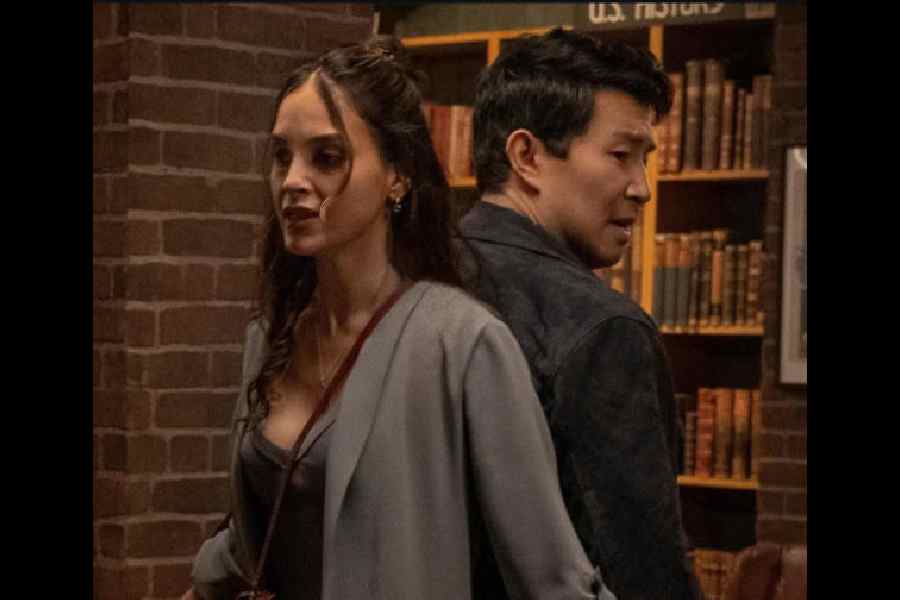
A spy thriller about a man whose own mind becomes the ultimate weapon against him, forcing him to become a double agent within his own life to uncover a conspiracy. The Copenhagen Test stars Barbie and Shang-Chi actor Simu Liu as Alexander Hale, a Chinese-American intelligence analyst for a secret agency called ‘The Orphanage’, whose brain is hacked, giving unknown enemies total access to his senses, forcing him into a deadly game of proving his loyalty while navigating a world where no one can be trusted. With the series now streaming on JioHotstar, t2 chatted with creator and co-showrunner Thomas Brandon and co-showrunner Jennifer Yale to know more.
What was the genesis of The Copenhagen Test?
Thomas Brandon: The show was born from my love of classic spy novels, specifically the John le Carré stuff from the ’60s and ’70s, and even some from the Cold War. It started there — my love of this genre and of this world. I started pushing myself as a writer who likes science fiction and to try and figure what is the next step forward in our society — I was really worried about my laptop and my phone being hacked! What was the next thing I should be worried about, I wondered. I started imagining someone who had their eyes and ears hacked, and married that with my love for the spy genre. I thought of someone who worked in a clandestine agency and had to prove to the people around him that he didn’t know he was hacked. That was a really interesting character for me to focus on. And then I realised: “Oh, I am stepping into a Truman Show world”, which is one of my favourite movies — the idea that he is going to have to perform and they are going to build this fake world around him. He is not going to know what is real and what is not as he is trying to clear his name and figure that how does he survive this....
Jennifer Yale: What is fun about this show is that it is a thrill ride but it is also a puzzle box, and so much of what we really worked hard to do in building this show was making sure that the audience felt like they were along for the ride with Alexander (Simu Liu). There are times when they are ahead of him and there are times when they are behind him, but most of the time, they are with him. We have made sure that it is fun... that it is exhilarating, but not exhausting. There is a scene where the audience takes a deep breath and breathes out before we throw them back into the spiral. So we want the audience to feel like they are with Alexander all the way.
The show, as you mentioned, is like a puzzle box which blends many genres and multiple threads. At any point, did you feel that you were packing in too much? Or did you feel that the demanding and discerning audience of today merited having so much to wrap their heads around?
Thomas: For us, it was always a push and pull of figuring out how you can make sure there is the right amount of mystery but without the confusion. But honestly, in our quest to find answers while making this, it was less about the audience driving us and more about the characters propelling us — what are they interested in, what is driving them, what do they want, what do they need at this moment.... And it took us to some really interesting places that often made us ask: “Is this still the same story?” But then we started to see how they are all connected, how all the characters are drawn back together.
Jennifer: We definitely didn’t set out to create the most complicated weave of all time... we set out to follow these characters and they were doing the weave for us.
Thomas: Sometimes, puzzle boxes get a bad rap because audiences have been treated to a couple of shows where you open the puzzle box and what is inside is another puzzle box. And so what we did was answer some of the questions and mysteries very quickly where one would know who has done it, but not the reason why it was done. So it became less of a whodunit and more of a whydunit. Thematically, we were getting into questions like: where are these deeper allegiances? Where do people’s loyalties lie? Until you know their life story, you don’t know what is driving them and why they are doing what they are doing. That is the scariest, most compelling mystery of all.
From ideation to execution, what was the biggest challenge of bringing this all together? Were the challenges and the creative highs synonymous with each other?
Jennifer: The challenge was always to make sure that it felt different from any other show that is out there now or had been in the past, especially those in the espionage genre. That is why we always thought of The Copenhagen Test as spy-fi (blending classic spy fiction with science fiction elements), and making sure that the science-fiction element added a sort of twist to the espionage part of the show. But we always kept the sci-fi grounded in order to elevate the espionage.
Thomas: I love how you asked whether the greatest challenges and the greatest highs are connected in some way. In a way they are, because as you solve the greatest challenges, that is the best feeling in the world. You hit a roadblock in a story, and then almost without fail, you go back and realise that you already have all the pieces you need. They are already there... you have already planted them in the story, without even knowing. And when those things click together, it makes something that is really rewarding and satisfying. As Jen said, with The Copenhagen Test, we were trying to do something that hasn’t been done before. And so when you feel it starting to work, that is the best feeling.
Which is your favourite watch in the
spy-fi genre?
Tell t2@abp.in