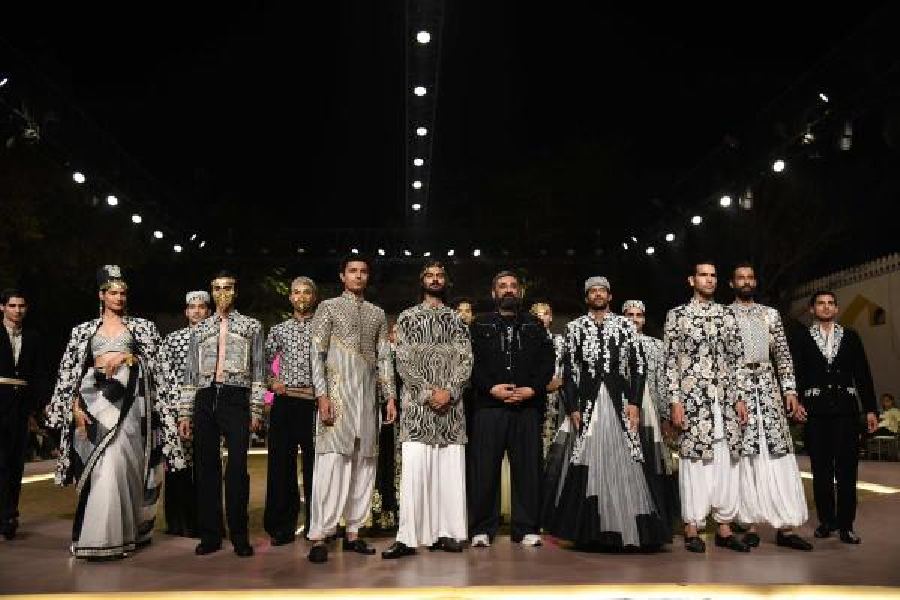
Siddartha Tytler’s Miraas was a marriage of monochrome and heritage craft. Inspired by the exquisite centuries-old Parsi gara threadwork, the designer’s FDCI India Men’s Weekend showcase at Diggi Palace in Jaipur transported us into a sophisticated era of cultural confluence, with designs reflecting the cultural fusion of Persian and Indian (Mughal) themes.
The ceremonial collection, imagined through a lens of contemporary couture, was accessorised with layered jewellery, adorning the face and forehead. A celebration of cultural inheritance and artistry, inspired by regal lineages, the showcase of silhouettes stunned with its balance of structure and fluidity, clean lines and ornate details. A post-show t2 chat with Siddartha.
In most of your collections, craft intersects glamour for a narrative on luxury. What drew you to the century-old Parsi gara technique for your collection Miraas?
As you would see in my past collections, I’m very fond of blacks, ivories and golds. Recently, I was with my friends and having a Parsi meal, and we were talking about their traditions, their clothes and their way of being. It just struck me that it’s such a beautiful culture, and I had to draw inspiration from it.
In what ways does traditional craftsmanship complement your design language?
My brand ethos has always been about taking modern fabric and modern cuts with traditional embroideries or traditional cuts with modern embroideries. This time, with the Parsi gara embroidery, it was just great to mix the contemporary and yesteryear together; it just came out beautifully and seamlessly.
How do you define luxury, and what is your vision of it?
At one time, luxury really meant fashion before comfort, but post-Covid, it’s all about comfort. Luxury is pretty much a statement now. Everyone loves luxury. Everyone loves good clothes, looking good and feeling good about themselves. They also want to be fashion-forward, and luxury is what a person wants for themselves now.
The range of Mughal and Indian motifs you explored was interesting, but what made you opt for the monochrome palette for the collection?
There is nothing more classic and everlasting than ivories and blacks with hints of gold. You can wear this 20 years from now, and it’ll still look fresh and modern for the time.
You explored a seamless blend of fluid and structured silhouettes in your showcase. How do you envision menswear in India in the coming years?
With social media, Instagram and all of it in everyone’s palms all the time, global fashion is accessible to everyone now. It’s all mixed up, but it’s great. Men are ready to explore and experiment. Seeing people abroad, men in India are also now keen on experimenting with fashion. For designers, it only pushes us to experiment along with them. So, I think it’s great that men are ready to play with their clothes and look more fashion-forward.
What’s the future of couture design in India and India’s couture craftsmanship at a global level?
With AI at our fingertips, playing with new silhouettes and new techniques of embroidery and motifs, and India being the leading country in embroidery, I think we’re going to go leaps and bounds in the following years. Take Gaurav Gupta, Rahul Mishra or Dhruv Kapoor into account; they’ve already put India on the map. We’re just getting noticed now, and we’re just going to go further and further. There’s no holding us back.
The accessories in the show were your signatures, of course, but added so much meaning to this showcase as well. Do you believe fashion has the power to transcend style and artistry to make social statements?
I think every designer has a point of view, and at our core, we are all storytellers. Our storytelling doesn’t necessarily have to be a statement or a social statement. We know how to tell a story in our looks and in our shows. So, it’s not about making a statement; it’s more about putting you, the audience, into the fantasy. It is our fantasy that we like to showcase. Hence, yes, it makes a statement but not necessarily a political or social statement.