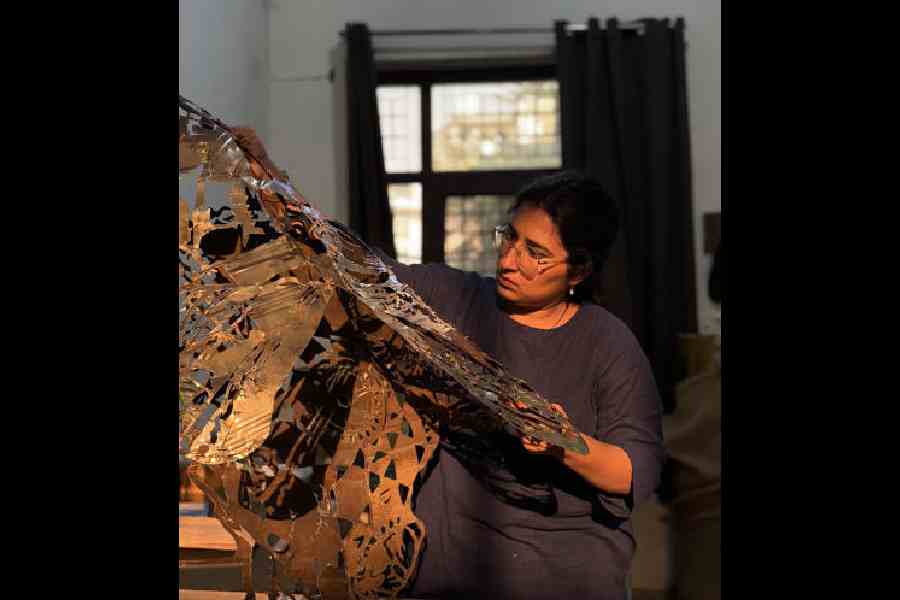
At first glance, a blouse is simply a garment — intimate, familiar, almost invisible in its everydayness. In the hands of Haryana-based sculptor Richa Arya, however, it becomes something far more arresting: a sculptural archive of labour, memory and resistance. Cast in bronze, brass and iron, her blouses do not drape so much as endure — holding within their rigid forms the stories of the women who make, mend and remain unseen.
“For me, the work is mostly social,” Arya says, when asked where her practice sits between fashion, culture and commentary. “The blouse is such a culturally loaded garment in India; a garment deeply embedded in the Indian imagination, carrying connotations of gender, labour, and identity,” she says. It is precisely this familiarity that allows her to subvert it —transforming an object of everyday wear into a site of inquiry.
At 29, Arya has already carved out a distinct visual language. Her now-signature metal blouses — recently exhibited at the India Art Fair, following earlier bodies of work such as The Last Season (2023) and Handmade (2024) — stand at the intersection of sculpture, fashion, and social inquiry. For Richa, the work is not about fashion in any conventional sense, but about the conditions that surround it.
Born into a conservative joint family in Samalkha, Richa’s earliest understanding of making garments was shaped within the home — she watched her mother and grandmother stitch tirelessly, first as a necessity, then as a means of modest financial independence. What might have appeared as routine household labour revealed itself to Richa, even then, as something potent. Stitching was not merely functional; it was agency.
What she witnessed was not only economic disparity, but a generational cycle. Daughters stepping into the same roles as their mothers. Children growing up amidst chemical exposure. Labour that sustains a global industry, yet remains largely undocumented and undervalued.
Richa’s sculptures do not replicate textiles; they translate them. The softness of embroidery is reimagined in metal, not as an aesthetic gesture, but as a conceptual shift. In her hands, metal becomes a narrative device — its hardness echoing the harshness of working conditions, its permanence standing in contrast to the disposability of fast fashion. Each piece carries what she describes as a “hidden story”, shaped not only by her own experiences, but by those of the women she observes and engages with.
“I saw my mother and grandmother stitching all the time,” she recalls. “It wasn’t just work inside the house — it was a powerful tool.” What began as necessity gradually revealed itself as autonomy: her mother earning small amounts through tailoring, repurposing old garments, sustaining both household and self.
That early intimacy with textile traditions now finds an unlikely counterpart in metal. Her pratice reimagines the concept of fabric. “When I make work in metal, it doesn’t become textile,” she explains. “It becomes storytelling — my experience, and other women’s experiences.” The shift from softness to hardness is deliberate. Metal, for her, is not just material — it is metaphor. “There is always a hidden story behind every work,” she says. “Metal is a hard medium, but for me it becomes a way to speak about the situation I am in — and the situations around me.”
Those “situations” are rooted in the industrial textile belts of Panipat and Samalkha — landscapes Richa knows intimately. Returning there as an artist years after her schooling, she encountered a transformed reality. “Panipat has become one of Asia’s largest textile markets now,” she notes. “But with that, pollution has increased, and there are so many female workers.”
Gaining access to these spaces required patience. “You can’t just enter factories or even take photographs,” she says. Instead, she began by building relationships — speaking to women workers, observing their routines, understanding their labour. What emerged was a stark picture of inequality. “The pay scale of male workers is very high, but for female workers it is very low,” she explains. “And the labour they do is intense — they cut cloth, remove buttons, work with sharp tools.”
It is this invisible, often dangerous labour that finds its way into her sculptures. The delicate language of embroidery, traditionally associated with care and craft, is reinterpreted in metal — its fragility replaced by weight and permanence. “Embroidery is also part of my work, but it changes when it comes into metal,” she says. “It carries the story differently.”
Pain, too, becomes part of that translation. Richa speaks candidly about the physical toll of her own process. She recalls injuring her hands when she first began working with metal, an experience that brought her closer, in a visceral sense, to the physical toll endured by the workers she represents. The act of cutting, shaping, and assembling metal mirrors the repetitive, often injurious gestures of textile labour. Protective gear, she notes, is not always practical — dexterity is compromised, and so the body absorbs the cost.
“When I started working with metal, I would wound my hands,” she admits. “And when I spoke to the women workers, they told me when you cut cloth with sharp tools, your hands will bleed. It’s unavoidable.” That shared experience — of injury, repetition, endurance — creates a visceral link between artist and subject. “If I wear gloves, I can’t work properly,” she says. “So the pain becomes part of the process.”
This embodied understanding deepens the ethical framework of her work. She is acutely aware of the delicate balance between representation and appropriation, yet her connection to these spaces is not external. This is her geography, her history. Her practice is less about speaking for, and more about drawing attention to what already exists — quietly, persistently, and often invisibly.
Beyond labour, Richa’s work also interrogates the afterlife of garments in an era of relentless consumption. “Earlier, in our homes, nothing was wasted,” she reflects. “My mother and grandmother would reuse everything — old clothes became something new.” Today, she observes, that cycle has been replaced by a far more opaque system. “We wear something a few times and then discard it, but we don’t know where it goes,” she says. “Recycling is not as simple as it sounds — it takes water, chemicals, energy. Sometimes making something new is easier.”
This critique naturally extends to the anonymity of fast fashion. She questions the opacity of supply chains, asking why garments cannot carry the names, stories, and conditions of those who make them. In an industry where profit margins often eclipse human considerations, her sculptures act as a counterpoint — a demand, however subtle, for transparency and accountability.
“My concern is: who designed the garment, and who made it?” Richa asks. “If we could make that chain clear — from A to Z — workers might be paid better.” She points to the paradox of an industry where intricate handwork is undervalued at the source, yet sold at a premium in the market. “Artisans say there is no money in it, so the next generation leaves. But in the market, those same designs sell for the highest price.”
If her work reads as resistance, it is a quiet, deliberate one. And yet, Richa remains pragmatic about the limits of art. “I don’t think an artist can change everything,” she says. “Art can convey a message. It can show reality in a certain way but changing the situation is different.”
What it can do, however, is shift perception. It can prompt pause, provoke discomfort, and perhaps, initiate conversation — and that shift is palpable in how audiences engage with her work. In gallery spaces, viewers often approach her sculptures with a sense of curiosity that quickly turns inward. “People start recalling their past,” she says. “They say, ‘my grandmother used to recycle clothes like this.’ There is a memory attached.” Her work opens up conversations about labour that many have never considered. “People ask me: how does recycling actually happen? How do workers live? Aren’t you afraid to go to these places?” she says. “So the dialogue begins there.”
For Richa, that dialogue must extend beyond the gallery. She actively seeks platforms that allow her to engage with wider communities, often inviting the very women she speaks about to view her exhibitions. The goal is not simply to display, but to connect — to collapse the distance between subject and spectator.
Looking ahead, her practice continues to evolve. While her current works remain firmly sculptural, she is exploring installations and moving image. “The work will change,” she says. “As research grows, an artist’s work also changes.” One recent concept involves multiple female figures arranged in sequence, reflecting the cyclical nature of factory labour — “one woman joins after another, like a continuous chain”.
Wearable art, for now, remains unlikely. “Metal is very sharp — it’s not possible to wear,” she notes with a faint pragmatism. But the idea of the garment as a carrier of identity persists. “Clothes hold memory,” she says. “They carry relationships, feelings — even across generations.”
In Richa’s hands, that memory is no longer soft or fleeting. It is cast, fixed, and impossible to ignore. A blouse, once ordinary, becomes a monument — to labour, to lineage, and to the stories fashion so often forgets to tell.