At the office of Nandy Movies, Ritwick Chakraborty walks in with a lived-in ease and the kind of presence that never really tries too hard to command attention, yet does. The office on the 14th floor felt untouched by the scorching May sun or the bustling Bypass right outside. Plopped side by side on two massive chairs, the actor speaks the way he performs — casually, thoughtfully, and with sudden flashes of intensity that make you sit up. One moment he is laughing about food on set, the next he is speaking about home, fathers, memory, and the emotional weight of returning. Somewhere between those conversations lies Phera.
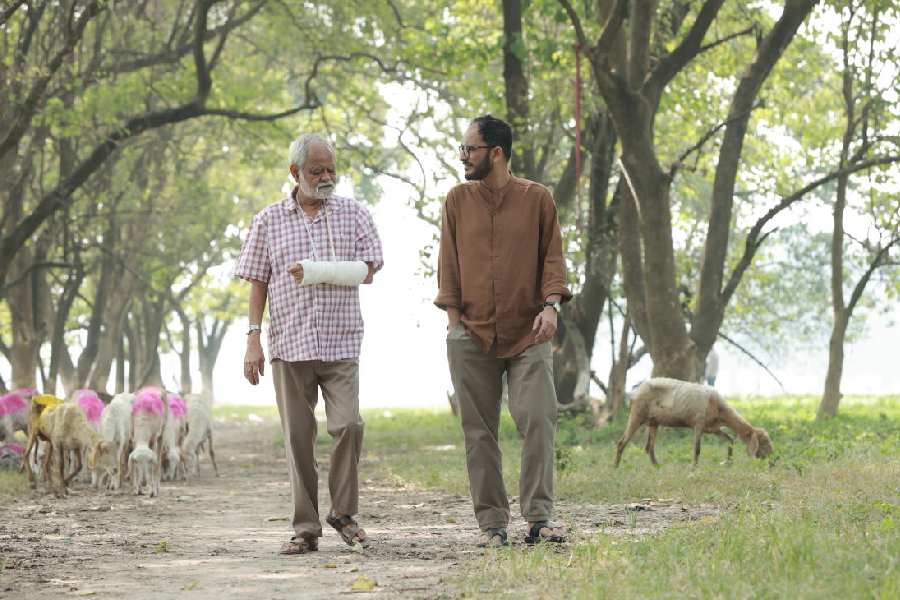
The upcoming film stars Ritwick alongside Sanjay Mishra — in what marks the veteran actor’s first Bengali project — and Sohini Sarkar. In the film, Sanjay plays Ritwick’s father, while Ritwick essays Polash, a man negotiating the complicated terrain of return. Return to home, return to memory, return perhaps even to himself.
Listening to stories
For Ritwick, sharing screen space with Sanjay Mishra was something he had looked forward to for years. Growing up watching him on screen, the excitement was genuine, almost childlike.
“I was extremely enthusiastic about working with him,” Ritwick says, leaning back into the oversized chair. “We’ve all grown up watching Sanjay Mishra. But beyond the actor that everybody admires, what amazed me was the human being. He is such a wonderful co-actor, such a generous colleague. There is absolutely no air about him on set.”
He recalls an outdoor shoot where the celebrated actor spent the day cooking mutton for the entire cast and crew. The memory makes him grin immediately.
“He’s this huge actor, but he never behaves like a ‘big shot’. One day during an outdoor schedule, he cooked mutton for everybody himself. We were all sitting together, eating, listening to his stories. He has endless stories from growing up, from theatre, from life, from travelling… and he shares everything so openly. You end up learning so much without even realising it.”
The warmth between the two actors, one senses, travelled beyond the frame of the film itself. Ritwick repeatedly circles back to the word “fun” while describing the shoot, but there is admiration tucked beneath the humour. “I genuinely had an amazing time,” he says. “Those are the experiences you carry back home from a film.”
About Polash
Ritwick says he agreed to Phera almost instinctively because of how deeply he connected with Polash. The actor had worked with the film’s director once before on another unreleased project, but this script stayed with him for more personal reasons.
“Polash is somebody a lot of people will relate to,” he says. “We all move away from home at some point. Sometimes for work, sometimes for ambition, sometimes because life simply pushes us elsewhere. But the returning part — the phera — is never easy.”
The title itself becomes a point of discussion. Ritwick smiles carefully, almost teasingly, unwilling to reveal too much.
“This film is about return in many ways,” he says. “Polash’s return, maybe somebody else’s return too. But whose return really matters, or whether somebody returns at all… that’s what people will understand when they watch the film.”
There is something quietly philosophical in the way he speaks about the story, never over-explaining it, allowing silences to do some of the work.
Ritwick says that understanding Polash also came from recognising the lives of ordinary working people around him — including a version of himself from years ago. Before acting happened professionally, he spent a couple of years working as a medical representative, navigating prescriptions, doctors’ chambers, targets and the exhausting rhythms of everyday corporate hustle.
“I’ve seen that life closely,” he says. “I’ve done that routine myself before entering films. And even now, so many of my friends are in corporate jobs. So I completely understand that pressure, that distance people slowly develop from home while trying to build a career or survive. I’m not disconnected from that world at all.”
That perhaps explains why Polash never feels like an abstract character in Ritwick’s telling. He speaks about him less like a role and more like somebody he has met repeatedly in trains, offices, tea stalls, old friend circles — people constantly moving forward while quietly wondering what they may have left behind
Familiar Comfort
Phera also reunites Ritwick with Sohini Sarkar, with whom he has shared screen space in several projects over the years. Audiences have long responded warmly to their pairing, irrespective of the nature of the characters they play.
“We’ve worked together many times now,” he says. “So there’s naturally a comfort level. And I think audiences have also accepted us together in very different kinds of roles.”
But Phera shifts that dynamic slightly. Sohini is not cast opposite him romantically. Instead, she plays his landlady.
“That’s what’s interesting,” he says with a laugh. “People may expect one thing from us because of our previous work together, but here the relationship is completely different. She’s not my love interest in the film. And that freshness was exciting for both of us.”
Roots and returns
As the conversation drifts toward the idea of home, Ritwick begins speaking about Barrackpore, where he grew up. His voice softens slightly when he mentions his parents.
“I had a very healthy middle-class childhood,” he says. “There were books everywhere, music everywhere. Conversations happened openly. I think I became who I am because of that environment.”
He speaks of inheriting fragments from both his mother and father before eventually becoming his own person. His relationship with his father, especially, remains something he remembers with warmth.
“We spoke about everything. There was communication. Nothing felt forbidden to discuss,” he says. “Now that I have a son, I try to follow those same ideas. Not replicate it exactly, because every relationship is different, but that openness matters.”
He admits he no longer visits the Barrackpore house very often after the passing of his parents, though his brothers still live there. But for Ritwick, home is no longer tied entirely to a physical place.
When asked where he would most like to return to, he pauses for a moment before answering quietly, “It’s not exactly a place anymore. It’s a space in my head. A zone I can return to whenever I want. I carry it with me because I carry my roots with me. I’m a very grounded person.”
Ritwick has been everywhere recently — film after film, performance after performance, barely slowing down. Mention that to him, and he breaks into an easy smile. “As long as audiences want to see me on screen, why not?” he says simply. There is no performative modesty in the statement, nor arrogance. Just gratitude, perhaps even curiosity. The same curiosity that makes him excited about working with actors he once admired from afar, or stories that ask difficult questions about returning home.
And sitting there at the office, carefree yet deeply articulate, Ritwick Chakraborty feels a little like the characters he often plays — rooted, restless, and always searching for something just beyond the obvious.