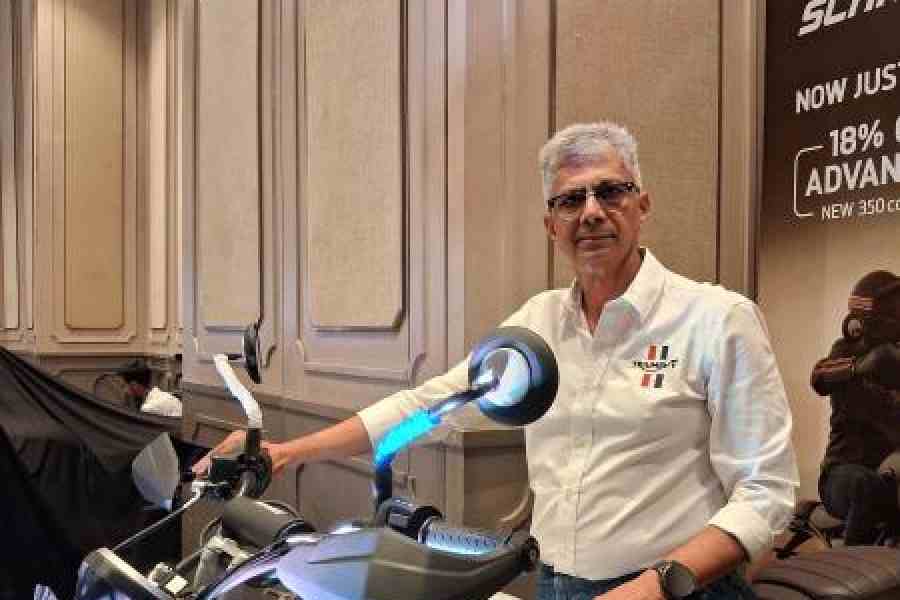
Triumph Motorcycles, which is part of Bajaj Auto’s Probiking division in India, is being given a major push and there are plans to ramp up sales quickly. The bike maker, which sold one lakh motorcycles in its first 33 months in the country, is planning to sell the next one lakh motorcycles in the next 15 months. t2oS spoke with Dinesh Kulkarni, vice president — Probiking, Bajaj Auto, to get an idea of where he wants to take Triumph and the other Probiking brands like KTM. Excerpts.
Triumph has launched 350cc motorcycles to take advantage of the lower GST on two-wheelers with smaller than 350cc engines. Till now, the progress hasn’t been very quick. How are things going to change going forward?
My view on this is the progress has been pretty quick. We are very happy with it. I’ll tell you the reason. Triumph is a very premium brand. And it’s very difficult for us to keep the same premiumness right to the end. So, with great difficulty, we have actually kept the premiumness throughout our network. If you see the network in Delhi or even in Calcutta, everywhere you will see the same values of Triumph. What is important for us is to expand our footprint across the nation. It’s the pangs of growing up. Overnight you can’t just become big. It’s slowly, slowly, slowly...
For example, in March alone we have sold 6,400 vehicles because the network is now getting stabilised. Secondly, it’s a game of the network growth and the demand also. We go there, it’s a new brand, we create demand for that, then again we go to the next network. You can’t just be opening networks and there is no demand there. So, my view on the business is it has taken us 33 months, but we are quite happy because we have expanded very systematically without diluting the values of the brand.
At the front end you have Triumph showrooms. What about the back end in terms of service and so on? Is it exclusive to Triumph?
It is exclusive Triumph only. All the service stations are exclusive Triumph service stations.
So you are not capitalising on the Bajaj background?
No, no, we have not capitalised on any Bajaj background. They are all unique showrooms. It is only in very small towns that we have come up with the concept of KTM plus Triumph showrooms because both are premium. In places which are very small, where such heavy duty showrooms will not work, what we have done is we have created very premium KTM and Triumph showrooms and we have split the showrooms into two parts where one side will be a completely KTM kind of a feeling and one side is completely, with brand ethos and all that, Triumph. You should see those showrooms. They have come out so beautiful and which has helped us expand quite fast.
Probiking includes the Husqvarna brand of motorcycles as well...
Yes, it does include the Husqvarna brand also. It is Husqvarna, KTM and Triumph. But I must honestly say it is the KTM and Triumph brands that have picked up and Husqvarna is a little bit on a back burner because I personally feel Husqvarna model designs are too evolved for the taste of the Indian customers. That’s my own opinion.
So the thrust is basically on Triumph and KTM?
Yes, we did try Husqvarna also. See, when you are going through the product life cycle, it is not necessary that every product becomes a hit or every brand. Fundamentally, they (Husqvarna) are into dirt biking. They have made their attempt into street biking with a very minimalistic design. That probably has not caught the imagination of the Indian customers. But KTM bikes are really doing well.
How do you see the Probiking and, within the Probiking, Triumph and KTM going ahead?
Okay, so how we see this is we call this market the premium sports motorcycling market. And this market has two different characteristics. One is driven by the complete classic look motorcycles. You will have a lot of classic bikes over there. And one is the sports kind of a market. So, how we define them... sports bikes... these are largely defined by the form. If you look at the bikes like Royal Enfield, Jawa, they all come into the classics, and Yamaha, KTM, they come into sports. We have two offerings which are distinct from each other. So we are able to do justice to both because they hardly intertwine with each other though every market is (available) for us. But, still, there’s a very clear line drawn.
When a person makes a decision to buy a motorcycle, he usually decides the form of the motorcycle. If he is evolving into a classic form, he veers towards Triumph and when he wants a sports motorcycle he wants KTM. We have best of both worlds.
This particular market that you’re talking about, which is 350cc upwards and up to maybe 700cc, this market has become quite quite busy in the last couple of years... So, you are there, RE, of course, is there, which has gone into the Himalayan successfully. So they have also straddled both the sides. Then there is Jawa and Yezdi and Norton is coming in. So how do you see this whole market evolving?
See, one good thing is when the market becomes busy, the market also expands. Because it is not just one person playing the game. So there is enough business for everybody in this.
What sort of growth are you seeing in terms of percentage?
Next year we hope to at least grow in the range of 35-40 per cent. Our growth, I don’t know about the market.
And around what rate is the overall market is growing?
So post-GST (new rates announced in September 2025), the first quarter, I think the market has, I mean the classic side of the market because that’s where the real action is, has grown by almost 30 per cent. Q3 was the time when the GST benefit first started. In both these (last two) quarters, the market has grown almost 30 per cent. On the KTM side also, in Q4, we have almost grown 45-50 per cent because our adventure motorcycles have also started doing extremely well.
And in which part of the capacity range are you seeing the maximum growth?
Now, because of the GST benefit, it’s my view is that 200cc to 350cc is the range where there will be a lot of growth.
Coming to Triumph, what kind of growth expectations do you have and what can the motorcycle buyer look forward to?
Next year we are planning aggressive growth. I don’t want to give the exact numbers honestly. But we are very confident of good growth. I have already showed you in my slide. In the next 15 months, one lakh (Triumph motorcycle sales) we would be doing. The numbers are evident from that.
Apart from this 350cc changeover that you have done, do you plan anything else in terms of technology, in terms of new products?
I cannot tell you the future of the new products coming in. But, as of now, we are sticking to 350cc platform.
Are the big bikes having a proper rub off effect on the smaller motorcycles?
Yes, that I very strongly believe that wherever we have a good big bike imagery and all that, our market shares are very strong in those markets.
Can you name a couple of those?
Like if you take the South markets, they respect performance a lot more. In fact, even Calcutta started doing very well for us. Bangalore is doing very well, Chennai, Kochi, all the South markets are doing extremely well. We are slower in northern markets because it takes time for people to appreciate technology.
Is northern market more of a four-wheeler market than a two-wheeler market?
No, no, it’s not like that. It’s a strong two-wheeler market also. But the customers are a little different and we have to take it step by step. For example, even for KTM, the growth started in southern markets. But now we are dominating everywhere. We are very confident. It takes time but the markets evolve.
It’s not much different, honestly, in terms of absolute numbers, but what is different is the type of the motorcycles. The people’s aspiration level in the South is very high. The big bike acceptance is very high. People want to spend more. People are more driven. It’s a pattern, but eventually it comes to the North is my view. Also, it’s just the evolution. Some markets are early adopters, some markets are late adopters, that’s all.
What can customers and riders really expect in this new scheme of things?
Actually, with so much tech and new products coming in, my view is that riders’ expectations from the products will increase very fast. And the manufacturer’s job is to ensure that we meet their aspirations. So that’s all I would say. Because every time a new... like you yourself mentioned a few brands coming in... each brand will differentiate on tech, each brand will differentiate on the ride. And we have to just keep ensuring that we fulfil the aspirations of the customer. The customer is the centre of everything and we have to be very watchful about this.
And you expect that to kind of kick up the volumes?
Yes, we expect that to pick up for a simple reason. The ecosystem is entirely made for 350cc in terms of insurances and all that. So on-road prices almost dropped down by ₹20,000 even after this. So we believe that it will become more accessible to all the people.