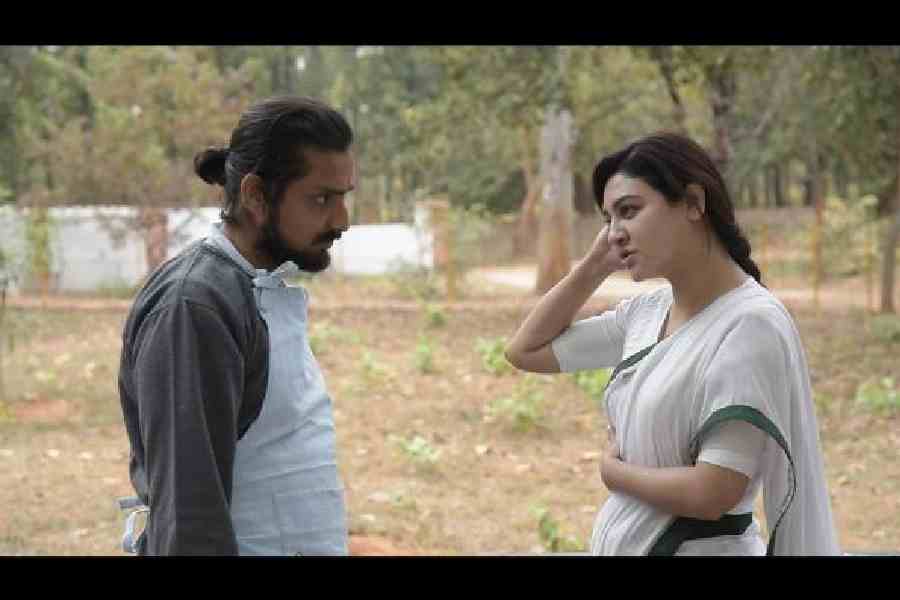
OCD is a psychological thriller that examines how unresolved childhood abuse can echo through a survivor’s adult life. The story follows Shweta, a successful doctor played by Jaya Ahsan, whose disciplined routine masks deep emotional wounds. When her former abuser unexpectedly crosses her path again, Shweta is forced to confront the memories she has long buried. A t2 chat with director Soukarya Ghosal...
What compelled you to tell this story, and why did you choose to frame it through the lens of a psychological thriller rather than a social drama?
The film is not solely about obsessive-compulsive disorder. At its core, it is about the inner journey of the protagonist, Shweta, played by Jaya Ahsan. Throughout the film, she repeatedly questions whether she actually suffers from OCD at all. This uncertainty is central to the narrative. If you look closely at the film’s logo, you’ll notice a prominent question mark embedded in the third letter — this was a deliberate design choice to reflect that ambiguity.
Shweta’s fixation on cleanliness gradually leads her to a deeper realisation: keeping her immediate surroundings clean feels meaningless if the society around her is morally polluted. This internal conflict pushes her to confront realities far beyond her personal condition. Because of this overlap, it becomes difficult to clearly separate what belongs to a psychological thriller and what functions as social drama. Both elements are deeply intertwined, as an individual’s psychology is inevitably shaped by the society they inhabit.
The film’s title directly references obsessive-compulsive disorder. How did you approach portraying a mental health condition without turning it into a cinematic trope?
From the very beginning, I was conscious that I didn’t want OCD to become a label or a cinematic shortcut. While the title references obsessive-compulsive disorder, the film never attempts to clinically define or diagnose Shweta. Instead, OCD is treated as a question rather than a conclusion.
Rather than portraying it as an isolated mental illness, I explored how social environments, moral decay, and everyday hypocrisy influence and intensify an individual’s psychology. This approach allows the audience to engage with Shweta’s experience without reducing her to a stereotype or a medical condition.
The film strongly foregrounds the idea of forced silence imposed on child abuse survivors. Why do you think society still struggles to listen to children, even in so-called progressive spaces?
This is largely a legal and social issue. Even adults fail to address the suffering of animals because they, too, have no political voice. One reason is that abusers are often friends or family members, and people hesitate to accuse them based on a child’s testimony. There is a deep trust deficit when it comes to children — we doubt their memories, their intentions, or assume they will simply forget as they grow older. That assumption is a grave and damaging mistake.
Was it important for you to show how childhood abuse doesn’t end in childhood?
Absolutely. Trauma doesn’t end — it lingers and often intensifies over time. Mira Nair’s Monsoon Wedding portrayed this with remarkable intensity. As you grow older, you begin to fully understand what happened to you as a child and realise that the abuse occurred because you had no power to resist or protest at the time. That realisation can be devastating.
What made Jaya the right choice for Shweta, and how did you work together to build this character’s inner life?
Having worked with Jaya earlier in Bhootpori, I was well aware of her range as an actor. Shweta is a character with extreme emotional shifts — psychological, behavioural, and even gestural. While writing the dialogues, Jaya’s name came to me organically. Once she read the script and immersed herself in the character, her intensity elevated the role far beyond what I had initially imagined.
Shweta is unstable, anxious and morally ambiguous. Did you ever worry about audience discomfort with a protagonist who doesn’t fit the conventional “strong survivor” narrative?
No. Audiences today watch far more uncomfortable films. Discomfort isn’t the issue — engagement is. If a film is engaging, audiences are willing to confront difficult emotions.
The film critiques patriarchal structures and social hypocrisy that protect perpetrators. Were there specific real-world cases or observations that informed this aspect?
Such incidents are unfortunately common. We heard about them from our surroundings when we were minors, and now we see them regularly in the news. There’s no denying their prevalence. While I wouldn’t frame this strictly as a patriarchal issue, social hypocrisy certainly plays a major role. Even matriarchal systems can suppress the truth if hypocrisy becomes ingrained.
The medical profession is central to Shweta’s identity. Was this choice symbolic of society’s expectation that survivors must appear “functional” to be believed?
Yes. Shweta is a dermatologist who believes that cleanliness isn’t merely superficial. Her profession is both ironic and symbolic — because even as a skin doctor, she understands that the deepest problems lie beneath the surface.
The trailer suggests a blurred line between justice and revenge. Do you believe cinema should offer moral clarity, or is it more honest to sit with moral discomfort?
Justice and revenge don’t always align. Morality itself is complex and often situational. Cinema’s primary responsibility is engagement. If a film engages its audience honestly, it’s on the right path.
Is OCD more interested in exposing the emotional cost of unresolved trauma?
The subject may be complex, but the film’s message is simple: it advocates for children and stands firmly against predators.
The film has an unsettling, almost claustrophobic tone. How did sound design and music contribute to Shweta’s psychological world?
Pooja, our creative director, played a crucial role, especially in shaping the female perspective. We used many natural sounds that exist within Shweta’s mind. Pooja shared numerous references, which we refined together. Once we aligned creatively, I worked with music director Megh Banerjee and sound designer Sougata Banerjee to further develop the soundscape with their insights.
What kind of conversation do you hope OCD sparks after audiences leave the theatre?
I hope audiences begin to give children the same importance and attention they give adults in real life.
Looking back, did making OCD change the way you personally think about trauma, memory or justice?
Absolutely. Since I often work with children, I am now far more vigilant on set — not just about their hygiene and comfort, but about how every individual treats them.
If the film unsettles viewers, where do you hope that unease ultimately leads?
The film operates on two levels: an engaging cinematic experience and a lingering post-viewing reflection. I hope viewers begin speaking more openly about issues like child abuse. If that happens, the film will have achieved its true purpose.