Did you know that in certain pockets of Calcutta, for at least three to four months every single year, people’s sleeping hours turn upside down? Night becomes day, day becomes a long stretch of waiting, and the lanes remain awake under the soft glow of tube-lights and borrowed bulbs. And no, you don’t have to travel to the end of the city to witness this strange rhythm. Just cross Park Circus, walk a little further, and you’ll begin entering a world inside a world.
First come the narrow lanes. Then narrower lanes. And then, lanes squeezed so tight that two people can pass side by side only by adjusting their shoulders and offering an apologetic smile. How do you describe these lanes? Words fall short. But ask any local, “Cake bananor jayga ta kothay?” or simply “Where are the bakeries?”— and they’ll point you in the right direction without hesitation. A common clue is “opposite the Seven Sisters’ Church”. Once you reach that zone, look around. The air itself feels seasoned — mixed with sugar, smoke, and the hum of anticipation.
Yellow taxis stop every few minutes. People climb out with bags full in both hands, clutched tightly as if carrying treasure. Their eyes scan the surroundings, half-curious, half-cautious, before they quietly slip into those old, modest houses. You can walk in too — no one will question you. These lanes, these rooms that look like kitchens and workshops combined, are the birthplace of Calcutta’s legendary homemade Christmas cakes.
Inside, you won’t find chefs wearing tall white caps or designer aprons. Instead, you’ll meet men who have worked with batter all their lives. Their hands move with instinct — whipping, folding, mixing, judging the texture by a single glance, a single tap on the bowl. They are not chefs by formal training, yet they are masters. You bring only the ingredients: flour, eggs, sugar, butter, dry fruits, rose essence, wine-soaked raisins, whatever your family recipe calls for. And you must bring them in exact quantities. They’ll turn those ingredients into a cake right in front of your eyes.
But the rules are strict. You must book a slot. You must arrive on time. You must collect the cake exactly when they tell you to. Because inside these cramped rooms, thousands of cakes are being made every day — each with its own recipe, its own story, its own eager family waiting at home.
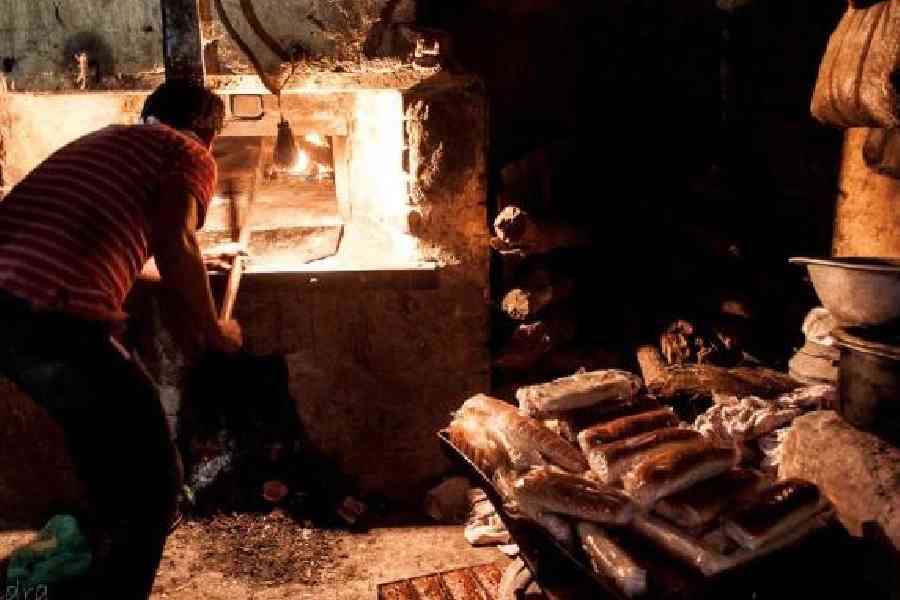
The ovens work non-stop, glowing like quiet furnaces of joy. Some cakes rise tall and golden, some settle dense and rich, some get pricked gently with a wooden skewer to check their doneness. It is nearly impossible to describe the smell inside those rooms — warmth, sweetness, caramelised edges, and the faint aroma of dry fruits blooming in heat. If you stand there long enough, the scent follows you home like a memory.
And once Christmas is over — once the frenzy calms down — the same ovens move into a new rhythm. Bread-making begins. And that bread… oh, that bread is something else. Slice it thick. Spread butter and sugar on top. Or don’t limit yourself — add malai, or homemade orange marmalade, or whatever survived in your kitchen from your last winter stash. If you’ve tasted it, you’ll know why even now, at this age, my eyes sting a little, and my tongue remembers too many things at once.
If you ever want to witness this cake-making ritual, come here 20-30 days before Christmas. First book your slot. Then bring your ingredients. Then wait — and watch — how magic looks when it rises in an oven.
And remember, not all cakes here are the soft, airy kinds we have become used to from fancy bakeries. Many are firm, sturdy, and full-bodied, with a flavour that sits deep on your tongue. Most of the regular customers are from Calcutta’s Anglo-Indian community. And if you’ve ever tasted cake from an Anglo-Indian household, you already know — after that, no other cake quite satisfies the same way.
But among all the cakes I’ve ever eaten, one still sits quietly inside my memory. And that story deserves a little space of its own.
Because this cake wasn’t baked in Park Circus or by a master with seasoned wrists. It wasn’t made with imported ingredients. It wasn’t born out of tradition or community gatherings. It was made at home, in childhood, by a woman who didn’t have degrees in baking but had something that was far more rare: the urge to create joy out of whatever life allowed. My mother used to bake a cake in one of those old-fashioned round ovens — the kind with the glass top cover and a heating coil that glowed like a tiny sun. The oven stood on the floor or on a low stool, and when plugged in, it hummed softly, almost like it was clearing its throat before beginning its work. That glass top was our entertainment. My siblings and I would crouch around it, peeking through the fogging glass, waiting to see when the batter would start rising. First small bubbles, then a swelling dome, then tiny cracks that hinted at the golden brown crust forming inside.
My mother’s hands were not professional hands. She didn’t measure ingredients with weighing scales. Sugar was “ek mug moto”, flour was scooped with the same steel bowl used for rice. Eggs were added with hope rather than precision. Butter was softened in the winter sun or over a small flame if she forgot to keep it out earlier. Ever y step carried uncertainty, but every movement was wrapped in tenderness. Looking back, I realise that her recipe wasn’t consistent. Some years the cake had more raisins, some years it was denser, some years sweeter. But back then, none of it mattered. Because the magic wasn’t in the cake. The magic was in the moment. The thrill of being handed a warm slice straight from the oven — edges slightly crisp, centre still soft, aroma clinging to the fingers. The sheer pride in getting two extra pieces smuggled out for me, hidden behind her sari’s pallu because in a big joint family, everything was shared, counted, monitored. But mothers always found loopholes in the system. And children always knew.
Even today, when I close my eyes, I can hear the sound of that old oven — its soft ticking, like a heartbeat. I can see my mother wiping her forehead with the back of her hand, smiling at our excitement. I can still feel the first bite, the warmth travelling down my throat, the sugar grains not fully dissolved, the raisins sticking to my teeth. No bakery in the world — no matter how refined — has ever been able to replicate that taste. And here is the truth that adulthood quietly delivers: Sometimes, it was never the cake we were tasting. It was love in a shape we could eat.
Today, life looks different. Families have shrunk. Microfamilies, they call them. No one ever promised that every joy would survive time. My mother is no more. The old round oven is long gone. And my wife — who is a wonderful baker — makes perfect cakes in the microwave. Moist, fluffy, beautifully balanced. She follows recipes with precision. Her cakes rise exactly the way they should. But somewhere inside me… maybe I’m still searching for that old taste. The taste that had a mother’s exhaustion mixed with affection. The taste that made childhood feel safe. The heart remembers what it remembers. It stores flavours like photographs and plays them back when you least expect it.
All I silently hope is this: Someday, my son too will miss his mother’s cake the way I miss mine. Not because the cake was perfect, but because childhood tasted like it.
Pictures by the writer