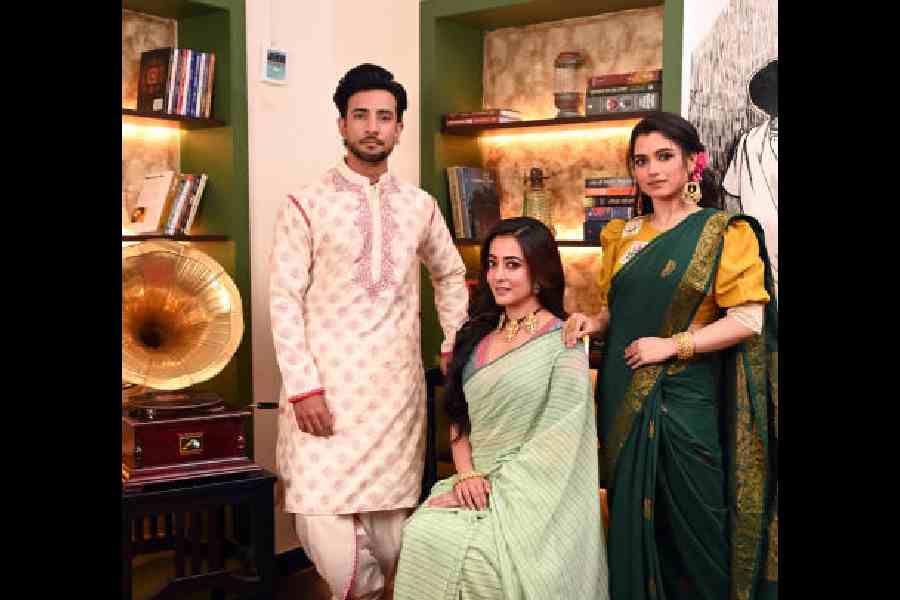
To celebrate Poila Baisakh, Raima Sen, Shyamoupti Mudly, and Rishav Basu recently came together for a special shoot at Chaudhury & Company. The setting was warm and steeped in tradition, perfectly complementing the essence of the Bengali New Year. Dressed in elegant traditional attire, the trio looked absolutely resplendent. Raima Sen exuded timeless grace in classic saris, paired with understated yet striking jewellery, while Shyamoupti brought a fresh, youthful vibrance to the frame with her look. Rishav, in his traditional ensemble, added a touch of effortless charm to the group.
The atmosphere was lively and filled with laughter. Between shots, the three were seen chatting animatedly, sharing light-hearted moments, and posing with ease and chemistry that reflected their off-screen camaraderie. Their natural rapport added a candid, joyful energy to the shoot, making it as engaging behind the scenes as it was in front of the camera. Amid the celebrations, conversations often drifted toward their upcoming film Phool Pishi O Edward, set to release in theatres in May.
The blend of festive spirit, traditional aesthetics, and the actors’ infectious enthusiasm made the shoot a delightful tribute to Poila Baisakh — capturing not just the look of the occasion, but its heart and warmth as well. Directed by Nandita Roy and Shiboprosad Mukherjee, Phool Pishi O Edward revolves around a zamindar household in Bengal. A watchful aunt becomes the quiet witness to a mystery that slowly exposes years of quietly buried truths within the family. When Manindra Chandra Nandy, in desperate need of a kidney transplant, fails to persuade his wife, Aditi, to become a donor, he makes a calculated decision — to marry her sister, Binita.
Raima Sen What does Poila Baisakh mean to you?
For me, it’s less about grand celebrations and more about being with family. If we’re at home, my mother makes sure that we either order something special from outside or make something nice. It’s really about spending time together. Beyond that, it’s not something we celebrate in a very elaborate or ritualistic way.
So it’s more low-key at home rather than a big celebration?
Exactly. It’s quite simple. Like most people, we acknowledge the day, but we don’t go out of our way to do anything extraordinary. If it happens to be a holiday and friends are free, we might step out, but otherwise it’s just a relaxed day at home.
Do you have any childhood memories associated with Poila Baisakh?
Yes, those are actually very special. When we were young, my grandmother made every festival feel grand. Not just Poila Baisakh, but Durga Puja, Kali Puja — everything. We would all gather at her house. My sister and I would often go there straight after school, have lunch, and spend the entire day. Our parents would join us later in the evening for dinner.
She had this beautiful bungalow, and all the celebrations happened there. Relatives would be invited, everyone would sit together, eat, talk, laugh —it was always a big, lively affair. It felt very traditional and very warm.
Do you miss those kinds of celebrations now?
Of course, I do. Those were very special times, but we try to recreate that feeling in our own way. It’s not the same, but the essence of being together is still there.
Were there any particular traditions your grandmother followed?
Yes, very much so. We would always wear something new, exchange gifts, and have a proper traditional meal. Sitting on the floor and eating on banana leaves was a big part of it. It wasn’t just about the festival — it was about the whole experience. Even birthdays were celebrated in a similar way. It was a very rooted, Bengali style of celebration.
Coming to your personal style — what are your thoughts on traditional outfits, especially during shoots or festive occasions?
These days, I’ve started wearing my mother’s saris quite a lot. She has an incredible collection — some of them even belonged to my grandmother. She keeps telling me, “I have so many saris, you should wear them.” And I think it’s a lovely idea because they’re unique pieces that no one else has seen. Even in films sometimes, I’ve worn my mother’s saris. It feels special and personal.
You star in the film, Phool Pishi O Edward, directed by Nandita Roy and Shiboprosad Mukherjee. It’s surprising that this is your first collaboration with them. How did that happen?
I know, it’s quite surprising! It’s been about 25 years, and this is the first time I’ve worked with them. When I got the call for this film, I was genuinely excited. I’ve worked with most of the prominent directors in Bengal, but this was one collaboration that hadn’t happened yet.
What drew you to the film eventually?
The idea of doing something new. At this stage in my career, if I’m working in Bengali cinema, I want roles that show me in a different light. Of course, I liked the script too. The primary motivation was the collaboration itself.
How was the shooting experience?
I had a fantastic time! We had long shooting hours, but it never felt tiring because the atmosphere was so relaxed and fun. I became good friends with the cast.
Did you form any close friendships during the shoot?
Yes, definitely. I got along really well with Anamikadi and Shyamoupti. She’s a wonderful actor and very sweet. We were playing sisters, so we made sure to spend time together and build that connection.
How was it working with the directors as a team?
They complement each other beautifully. Shibu is more expressive — he’ll show you exactly what he wants. Nanditadi, on the other hand, explains things very gently and gives you the reasoning behind a scene. Both approaches together worked really well.
Finally, would you like to work with this team again?
Definitely. It was one of the most relaxed and enjoyable shoots I’ve been part of. There was no stress, no shouting — just a very positive environment. I would absolutely love to collaborate with them again.
Shyamoupti Mudly and Rishav Basu
What drew you to Phool Pishi O Edward, and what made this role stand out for you?
Shyamoupti: First of all, the script was written by Zinia Sen, and of course, the production house is Windows, and getting the opportunity to work under the direction of Nandita Roy and Shiboprosad Mukherjee was a huge thing. The way my character has been crafted in this film definitely felt very unique to me.Rishav: A call from Shibuda drew me to Phool Pishi O Edward, and the narration he gave me made the role stand out.
Did you relate to your character in any personal way?
Shyamoupti: Yes, of course, there are some similarities. Like the character, I can also distinguish my relationships in life, and in my life too, the word “love” holds a lot of importance.Rishav: Absolutely. I think that’s what Shibuda and Nanditadi’s narration did. It tickled my own emotional memory. I had a lot of angst when I was younger. I have always been a hopeless romantic, and above all, my love for my mother is paramount.
What were the most challenging and most rewarding aspects of playing this role?
Shyamoupti: The most challenging part for me was learning Kathak. It’s not really possible to learn a dance form in such a short time, but I still tried my best to give it my all.Rishav: I think working with the cast is the common answer here. It was challenging to be in the same frame with such an exceptional pool of actors. And it was so rewarding because I could learn so much from them.
Any memorable moments from the shoot that stayed with you?
Shyamoupti: There was a scene with Rajatava Dutta, and after that scene, Didi came and kissed me on the forehead. That moment is very memorable to me.Rishav: There was a song sequence with Shyamoupti and me, where we were dancing through a village road. And I remember the whole crew and the local people also started dancing with us.
What does Poila Baisakh mean to you?
Shyamoupti: Poila Baisakh, to me, means a fresh start, positivity, Bengali food, dressing up, and celebrating Bengali culture.Rishav: A celebration of who we are. The Bengalis. Our rich culture, heritage, inclusiveness, and pride.
How do you usually celebrate the Bengali New Year?
Shyamoupti: At home, I cook some of my favourite dishes, decorate the house beautifully, and go out for dinner with my family. Since I love cooking, I prepare something special like makha sandesh or haula, some kind of chicken dish, and since I love prawns, I make a prawn item too. Along with that, I try to decorate the entire house, like using flowers, putting on a new bedcover, and hanging new curtains. Going out for dinner with family is a must, and of course, wearing a sari is non-negotiable.Rishav: I generally don’t have a fixed plan, but I hang out with friends if I’m not working.
Are there any childhood memories of Poila Baisakh that you still cherish?
Shyamoupti: Going for halkhata with my Dadu used to be so much fun. A new calendar would arrive at home, and I would count how many calendars we had collected over time. Many people would visit our house, bringing lots of boxes of sweets, and my job was to organise them all. Everyone at home would eat together. Those small, sweet moments are unforgettable. Although I read Bengali books regularly, on this day, I make it a point to read a poetry book with extra attention and emotion.Rishav: I was a very young theatre actor in Bohurupee and I used to play the main character in a play called Nero. We had a show in the Academy of Fine Arts on Poila Baisakh, and Sankha Ghosh and Samik Bandopadhyay came to watch it. They praised my performance. That’s a cherished memory.
What are your must-have traditions — food, rituals, or outfits — on this day?
Shyamoupti: On this day, Bengali food is a must, decorating the house, reading a Bengali book, and of course, wearing a sari is a must for me.Rishav: I try to wear a dhuti punjabi at any occasion possible, but Bengali home-cooked food is a must on Poila Baisakh.
Do you prefer a traditional celebration or a more modern one now?
Shyamoupti: I definitely prefer traditional celebrations more.Rishav: Anything as long as people are enjoying themselves. A little bit of both is always fun.
What are your thoughts on the t2 shoot?
Shyamoupti: Generally, I don’t get to dress up like this often, so when I do such traditional looks for a shoot, I really enjoy it. It gives me a chance to truly embrace and live that authentic Bengali essence.Rishav: Absolutely loved it. I really felt handsome in the attire, all thanks to my dear friend Anupam Chatterjee (costume designer and stylist for Phool Pishi O Edward).
Pictures: Pabitra Das
Raima Sen’s make-up: Sayanta Dhali
Raima Sen’s hair: Gargi Roy
Shyamoupti Mudly & Rishav Basu’s make-up: Pritam Das
Shyamoupti Mudly & Rishav Basu’s hair: Sujit Das
Look design and stylist: Anupam Chatterjee
Sari: ParamaBlouse: Parama
Rishav Basu’s costume: Anupam Chatterjee
Jewellery: Gahane Jewellery
Location courtesy: Chaudhury & Company