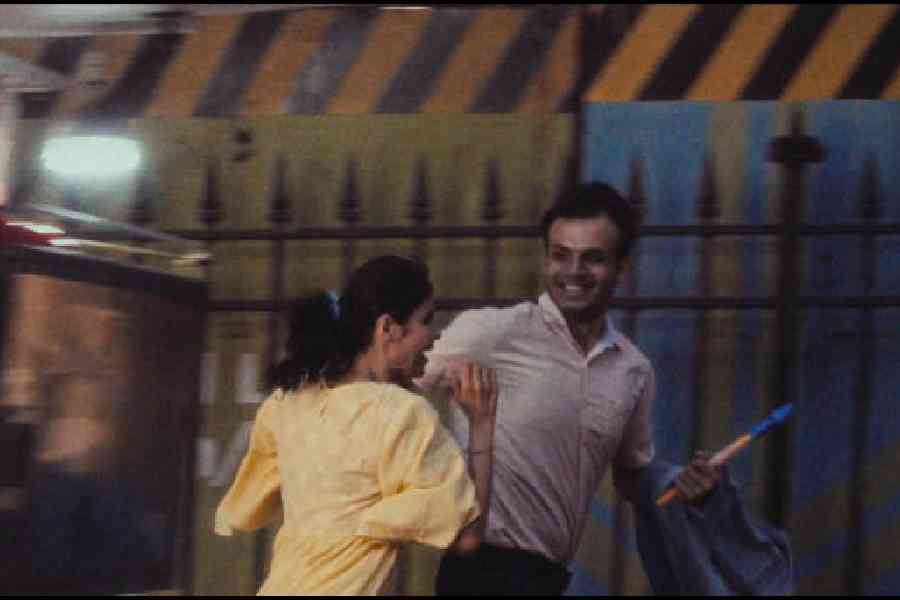
The Red Sea International Film Festival 2025 has selected Early Days, directed by Priyankar Patra, for its New Visions Competition section. Produced by For Films (India) in association with Hazelnut Media (Singapore), Early Days is executive-produced by filmmaker Aditya Vikram Sengupta. Set in Mumbai, Early Days captures the fragile balance between love, ambition, and self-invention in a hyper-connected world. Through the story of a young couple suddenly thrust into digital visibility, the film explores how modern intimacy is shaped and sometimes fractured by the gaze of others. Visually blending cinematic realism with the immediacy of social media, it reflects the rhythms of a generation that lives both online and off. Starring Manasi Kaushik and Sarthak Sharma, Early Days premieres at the film fest in Jeddah, Saudi Arabia, on December 10. A t2 chat with director Priyankar Patra...
What does being selected for the Red Sea International Film Festival’s New Visions Competition mean for you?
I’m humbled and truly grateful. I have always made films for the love and fun of cinema. However, a selection in one of the most exciting festivals in the world today is truly validating, especially when the programmers are industry veterans. The self-doubt has taken a back seat for now and has been taken over by sheer excitement. As a debutant, I always believed in myself, but now it feels like maybe I can make the world believe in me too.
What was the first spark or idea that led to Early Days?
My younger cousin — who was also involved in the making of the film — was my first inspiration. He was interested in content creation while I, like an out-of-touch older sibling, expected him to be interested in French New Wave. For the longest time, I failed to understand him or support him. I realised just because our tools are the same, doesn’t mean our profession, or the format, has to be the same.
I can express through films, while he can choose to express through short-form content or vlogs. And that’s completely valid. When this realisation hit me, I started to grow more curious about content creators, and by extension, influencers. Having that personal connection as the spark helped me look at them with a more empathetic lens. A young generation trusting themselves with a profession which is still in its teething stage. This outlook helped me to dig deeper into not what goes on when they press record, but in the moments leading up to that.
The film is set in Mumbai — why was Mumbai the right backdrop for this story?
I tend to look at my stories through an economic lens. I love Mumbai but the city comes with contradictions and challenges. It promises you fame and wealth but mere survival in Mumbai is costly, especially if you have to afford a lifestyle which demands visibility. So how do you grow your wealth if you’re always spending, and spending more than your means? Paying exorbitant rents, wearing branded clothes, going to high-end restaurants to show a certain lifestyle have all become very normalised in Mumbai. It’s true for people in my life and it’s true for the characters in my film too. My film just aims to show this without any judgement.
The story deals with love and digital visibility. What interests you most about the tension between intimacy and exposure today?
Love has become very standardised in today’s day and age. We all love differently. No two relationships are the same, but our forms of expression have become very binary now because we compare our personal relationships to everyone else’s on social media. By overexposing relationships on social media, we are also welcoming everyone’s generalised public opinion about a private dynamic, stripped away from context. And with that, our relationship stops being ours anymore — it’s everyone else’s. That’s when it becomes a performance. And we become puppets to that unknowingly. This tug-of-war between the private and the public in today’s voyueristic society really intrigues me.
In what ways do you think technology reshapes not just relationships, but identity itself?
Technology is important and is ever-evolving. So I would never say that technology is bad. It’s great! But we’re still very early in our relationship with technology, especially social media. We’re figuring this out. But as of today, technology has definitely killed curiosity. There’s so much information thrown at us every single minute that it’s hard to absorb these anymore.
Depending on your algorithm, you’re expected to like one thing over another. Individuality and our own little quirks are fading away. We’ve completely aestheticised our lives. We’d like to believe it’s for ourselves, but it’s really for an unknown audience who we believe is always watching us.
Do you see the couple’s journey as a cautionary tale or as a realistic portrayal of love in the digital age?
I didn’t want to make a cautionary tale. And I’d never want to preach. I don’t think that works. I sincerely followed my characters as they navigated their lives together. The phone, and by extension the thousands following them on social media, is part of their lives too. So I tried to remain as grounded as possible in exploring a love story which is burdened by the pressure of today’s accepted voyeurism.
Was there a specific moment or lived experience that helped you understand the characters better?
I once overheard an acquaintance request her now ex-boyfriend to break up after a month, so that they could both benefit from a brand deal during Christmas they were expected to do as a couple. I was initially shocked and amazed but I quickly understood why: living in Mumbai is costly; so if your source of income becomes your private relationship, that means anything that derails your personal life also derails your professional life. So you must protect your personal life at any cost to be able to pay rent. That’s some insane amount of pressure and it really made me feel for the characters. As a writer, I stopped being a puppeteer and started becoming an observer.
Did social media aesthetics, surveillance culture, or smartphone storytelling influence the cinematography or framing choices?
One hundred per cent. The cinematography uses a lot of close-ups and zooms. It’s very voyueristic and suffocating — almost as if we aren’t giving the characters space to live a carefree life even when the phone recording is off. There’s also the use of vertical frames, which is essentially just the perspective of the reels and what the audiences are officially exposed to. I’ve used two very distinct cinematography styles here. The very clean 4K high resolution vertical cinematography for the public persona and a ‘dirtier’, closer and documentary-esque style for the private lives.
As an India–Singapore co-production, how did the collaboration shape the film’s identity?
The film evolved a lot during its making. It started as a weekend experiment between four friends and slowly grew into a full-fledged production. When Singapore’s Hazelnut Media came on board as co-producers and with their extensive prior experience in distribution of films, they gave me the confidence that the story is urgent and relatable to a younger generation, not just in India but across the globe, as the impacts of social media are not geography-bound.
It also helped me put my voice in perspective — that I am able to tell a story that works in layers: you can watch the entire film just as a love story, or watch it as a case study on the over-exposure to social media in today’s day and age.
How has your working relationship with Aditya Vikram Sengupta developed over the years?
I’ve known Aditya for over a decade now. I first met him when he had just made Asha Jaoar Majhe, months before it released in India. Since then, I was always in touch with him, sharing thoughts on films or my early experiments in filmmaking. Over the years, our dynamic also evolved. We act as each other’s sounding board, creative producers. And in an unfiltered manner. He was involved with Early Days since day zero, when the film was just a concept. He has been a sounding board at every step of the way, looking at things very objectively and sharing his perspective. And that’s a great marker for a collaborator.
What do you hope global audiences take away from a story rooted in a very specific urban and digital reality?
That we should celebrate our individualities and be mindful of our socio-economic realities. It’s important to not exhaust yourself in an attempt to live a cookie-cutter life that’s predetermined by algorithms.