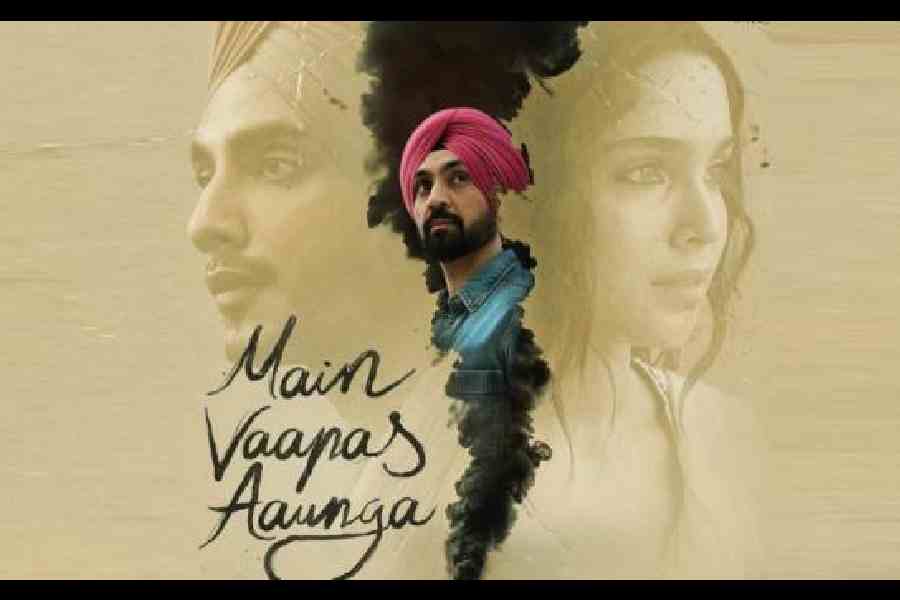
Imtiaz Ali returns with a story of unfulfilled love and explores the poetry of longing in Main Vaapas Aaunga. Set across multiple eras, the film touches upon themes of memory and migration, brought to life by a stellar cast comprising Naseeruddin Shah, Diljit Dosanjh, Vedang Raina and Sharvari. t2 chatted with the maker of films like Jab We Met, Rockstar and Tamasha, about his latest film that hits theatres worldwide on June 12.
You have already shown Main Vaapas Aaunga to quite a few people, including industry insiders. What kind of feelers have you got so far?
I like showing my films to friends and colleagues before release. In the case of Main Vaapas Aaunga, I have shown the film to many more than usual… some people have even seen the rough cut. Everyone is saying positive things, but if I start praising my film now, you will say har dukaandar toh apne saamaan ke baare mein achha hee kehta hain (laughs)!
Main Vaapas Aaunga is inspired by real-life events. The Partition has endless stories, many remarkable and mostly tragic, that we have grown up hearing and discover even today. Was there a specific trigger that made you want to make this film?
This is a story that was repeated to me several times when I was making (Amar Singh) Chamkila in Punjab. Even otherwise, every time I came across someone who had seen the Partition and spoke to me about it, I would want to make a film on it. I met many of these people — it was initially out of personal interest — and then a story started forming in my mind for a film.
Specifically, I met an elderly gentleman who had travelled to the border and wanted to go to his ancestral home on the other side of the border. But the tragedy was that he had memory issues and couldn’t recall that the Partition had happened. So that is what really triggered the idea of this film for me. Almost everything that is featured in the screenplay of Main Vaapas Aaunga is borrowed from events that have taken place in real life.
What does the Partition story mean to you, both personally and as a filmmaker?
When you switch on the TV today, you see displacement. When you read the newspaper, you see displacement. I think displacement and migration is the story of the century. When I see displacement and migration happening now, I am reminded of the Partition and of all those stories that I have heard about the division of Punjab and Bengal and the forced migration that happened then. I feel that there has not been a more dynamic, a more influential event in the history of the subcontinent than this. The Partition continues to affect the politics of the subcontinent.
Such a tragic incident has created many stories of love, longing, loss and victory. And ultimately, what I was most fascinated about, and the reason why I went on to make the movie is the angle with which most of the veterans of Partition look back at that period in their lives — it is of love, of art, of beauty.... They don’t think of hatred or destruction. I think it is these stories of love that have enabled them to survive such a tragic event in their lives.
Many in today’s generation are aware of the Partition superficially. When you cast Gen-Z actors like Vedang Raina and Sharvari in parts that set them in the turmoil of Partition, was it imperative for you that they come in with an informed feel of what happened then? What did they bring to the table in terms of both emotions and knowledge?
The great thing about the younger generation is that they are a very Internet-savvy, Google-savvy generation. It is true that the present generation does not know much about the Partition. And that is all the more reason for us to remind them of the recent history of this country.
But when Vedang and Sharvari came in, they had a fair amount of knowledge of undivided and divided India and what happened in terms of the events that caused Partition. What they didn’t know, they researched and found out. It takes five minutes for this generation to dig out things and this is what I admire about them. If they are interested in something, they will make it a point to find out about it.
Many of them, of course, have heard stories of it in their families, they are aware of their socio-political roots.... Unfortunately, almost all communities in this country have gone through some kind of migration or the other. Vedang, for instance, is Kashmiri and he understands the story of migration from his family’s point of view... the fact that the previous generations of his family were forced to leave Kashmir and settle in other cities. He was very emotionally informed about it. Things like that made a lot of difference while making this film.
Diljit Dosanjh is the only actor you have worked with in successive films, while you are working with Naseeruddin Shah for the first time in your career. What was that experience like?
I love the scenes with the two of them together. They bring in a certain ease to difficult conversations in the film, which, at the same time, are idiosyncratically funny. We have Naseer’s character, afflicted with dementia, talking about Martians, his “visits” to the moon and other improbable events, and we have Diljit’s character reacting to it without making fun of it, but also enjoying the funniness of it. There is a certain balance that comes from just being available in that moment.
They also have tremendous respect for each other. Like most people in this country, Diljit is a great admirer of Naseeruddin Shah. Naseer is also an admirer of Diljit’s acting ability... he has seen Chamkila and some of his other films. When I told Naseer that Diljit would be playing this part, he was very happy. They had a very nice working relationship and they brought a certain reality to their scenes together.
Most of your films tend to be characterised as ones that portray love, loss, yearning, longing.... Do you feel these descriptors are reductive for the cinema that you make?
I don’t have any problem with anybody looking at my films in the way they want to. That is because there is not just one person’s view that is imposing upon what the truth is. There are varied views about my cinema, and that always feels nice. Yes, the words you mentioned are used liberally for the films I make, but since there are so many people and so many different opinions, I don’t find them reductive.
Also, I would like to say that I have not made Main Vaapas Aaunga as a historical, I have made this film because it feels valid even today, and more than ever. It is a story that the young generation must know about. They must also know about the kind of love that existed then, something that many of them aspire to have today.
Your films have changed lives and world views in many ways. Many look at relationships differently now, while a film like Tamasha has been known to make some even leave their jobs and follow their passion. While that must be a high, does it also put pressure on you?
The only pressure is that I should not fake this or misuse this opportunity that I have. It is a job of responsibility. The only pressure that I take is that I should not lie, that I should not have a short-term goal in my filmmaking. Whatever I put into my films should be with positive intention. I shouldn’t be mean, I shouldn’t mislead. That is because people do follow films emotionally, almost illogically.
I am looking forward to Main Vaapas Aaunga because...
Tell t2@abp.in