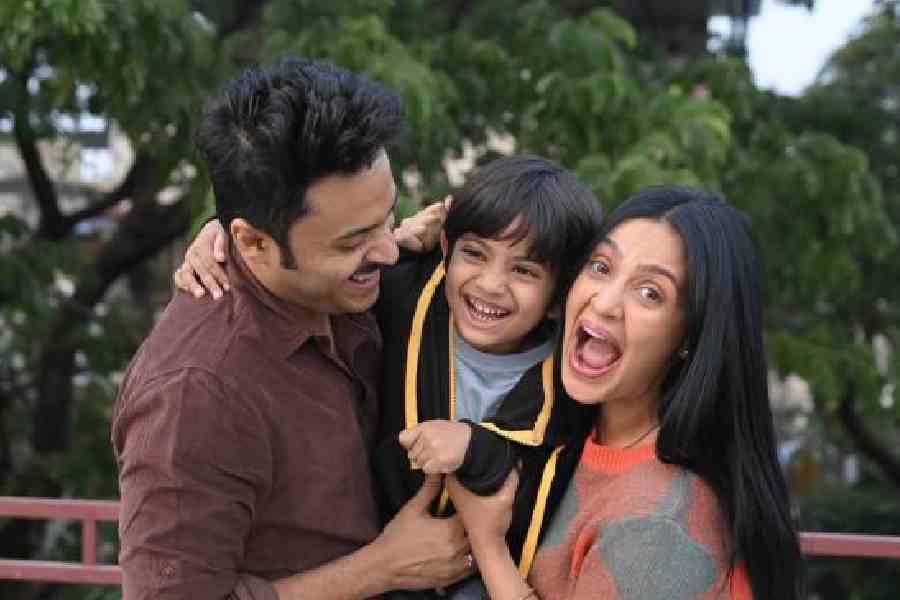
Maya Satya Bhram has been officially selected for the New York Indian Film Festival and will be screened on May 31, with director Samik Roy Choudhury attending the festival for the special showcase. Reflecting on the recognition, Samik describes the moment as both emotional and rewarding. Starring Priyanka Sarkar, Soham Majumdar, Sanat Chattopadhyay, Alexandra Taylor, Sankhadeep Banerjee, Subhrajit Dutta, Paran Bandopadhyay, and Sreya Bhattacharyya, Maya Satya Bhram promises a rich blend of spirituality and psychological drama, with a pinch of sci-fi. A t2 chat with Samik...
How did you react when you learned that Maya Satya Bhram had been officially selected for the New York Indian Film Festival?
Naturally, I was extremely excited and grateful. As filmmakers, we spend years nurturing an idea through writing, production, and post-production, often under challenging circumstances. So when a film receives recognition from an international platform like NYIFF, it becomes deeply emotional.
It is always a pleasure to present our regional stories and hard work to a global audience. Bengali cinema has a rich literary and philosophical tradition, and it feels rewarding when stories rooted in our culture travel beyond geographical boundaries and connect with viewers internationally.
After Mushroom was screened at NYIFF in 2023, what does returning to the same festival with Maya Satya Bhram mean to you personally and professionally?
Returning to the same festival with a stronger and more ambitious film gives me immense confidence as a filmmaker. In many ways, it feels like an evolving relationship with the festival and its audience. Honestly, one more selection and NYIFF may begin to feel like a homecoming.
The audience I encountered in 2023 during Mushroom was phenomenal. They were deeply attentive to the storytelling and filmmaking details. What moved me most was their openness; they engaged with the film sincerely and reviewed it with genuine curiosity and emotion. That kind of audience interaction stays with a filmmaker for a long time. Professionally, it also reassures me that stories emerging from Bengal can resonate universally when told with honesty and conviction.
Do you think international festivals like NYIFF are becoming more receptive to regional Indian storytelling, especially Bengali cinema?
I sincerely hope so, and I believe we are already seeing signs of that change. At least at NYIFF, there has been a visible increase in Bengali films in recent years, including this year’s selections such as Bakshobondi, Adamya, and Maya Satya Bhram. Regional cinema often carries a very distinct cultural texture, language, rhythm, and philosophy. International audiences today seem increasingly interested in authenticity rather than homogenised storytelling. Bengali cinema, historically, has always explored human psychology, politics, spirituality, and social structures in a nuanced way. Festivals like NYIFF are perhaps recognising that these stories, while deeply local, are emotionally universal.
What aspect of Maya Satya Bhram do you think will resonate most strongly with audiences in New York?
Though it is difficult to predict audience reactions, I believe the film’s emotional and philosophical layers may resonate deeply. At its core, Maya Satya Bhram is about grief, belief, guilt, and the human tendency to search for answers beyond logic. Those emotions are universal.
The journey of Trilokadarshi Baba — from a marginalised and traumatised child to becoming the most discussed spiritual figure in the town — also reflects larger questions about society, power, faith, and perception.
The film further explores a philosophy that I personally find very important: not becoming imprisoned by the past and not obsessively trying to predict the future. Sometimes the burden of both can destroy the present.
I also feel fortunate to have actors like Soham Majumdar, Priyanka Sarkar, Sanat Chattopadhyay, Devesh Roy Chowdhury, and Paran Bandopadhyay and others bringing emotional depth and sincerity to these ideas. Many aspects of the film may linger in the minds of audiences long after the screening.
NYIFF is known for showcasing independent and thought-provoking Indian cinema. How do you think your film fits into that space?
Maya Satya Bhram is fundamentally an independent film in spirit and execution. My producers, Sanat Chattopadhyay and Indrani Chattopadhyay, believed in the dream of making a film that was uncompromising in its voice.
From the very first script reading, the story provoked strong reactions and discussions among the actors and crew. Everyone involved invested emotionally and intellectually in the process. That is often the beauty of independent filmmaking; people come together because they believe in the soul of the story rather than merely its commercial potential.
I believe NYIFF celebrates precisely this kind of cinema — films that challenge, provoke thought, and remain emotionally honest.
Has your experience with Mushroom at NYIFF in 2023 helped you approach this year’s festival differently?
The experience of NYIFF 2023 certainly gave me confidence and perspective, but my emotional approach toward Maya Satya Bhram remains similar to what I felt during Mushroom. Every film has its own journey, vulnerability, and identity.
Of course, this time there is familiarity. The organisers and perhaps even some audiences may recognise us as the same filmmakers from Mushroom. But creatively, the filmmaking language of Mushroom and Maya Satya Bhram is completely different from one another. As filmmakers, we do not want to repeat ourselves stylistically. Each film should discover its own cinematic grammar.
What kind of conversations are you hoping Maya Satya Bhram will spark among international viewers?
I hope the film encourages audiences to question perception and morality rather than simply search for concrete answers. The film presents a different point of view and, in some ways, carries a satirical undertone about society’s relationship with spirituality, fear, and power.
One unusual aspect is that the narrative does not treat the shamanic figure as a simplistic villain or miracle-maker. Instead, it attempts to humanise and justify him within a larger philosophical framework.
At the same time, the emotions in the film — loss, parental fear, guilt, loneliness, and social alienation — are globally relatable. I believe international viewers may arrive at very different interpretations of the story, and those differing interpretations themselves can create meaningful conversations.
Do you see festivals like NYIFF as a gateway to wider international distribution opportunities?
Absolutely. Festivals often become the starting point for larger conversations about distribution, collaborations, and future projects. Two of my previous films have already been acquired by leading OTT platforms, and naturally, I hope Maya Satya Bhram also finds a meaningful international distribution journey.
Festivals bring together filmmakers, distributors, programmers, critics, and producers in one ecosystem. Many festivals also host film markets, networking sessions, and curated industry interactions that can open important doors for independent cinema.
After NYIFF, Maya Satya Bhram will also travel to the Bishkek International Film Festival, so I remain hopeful and excited about the possibilities ahead.
How important is interacting directly with international audiences for you?
For me, interacting directly with international audiences is one of the most valuable parts of the festival experience. Beyond the excitement and pleasure, those conversations give you perspectives you may never have considered while making the film. Audiences often interpret moments differently based on their own cultural and emotional experiences.
Those discussions make you rethink your own work more deeply. In many ways, a film continues evolving even after it is completed, through the eyes of its viewers.
If you had to describe Maya Satya Bhram to NYIFF audiences, what would you say?
Maya Satya Bhram blurs truth and illusion, weaving dark fantasy with human frailty while holding a mirror to a society where belief, guilt, and power intertwine in shadows beyond reason. At its heart, it is a philosophical mystery about the human need to seek meaning in a world where reality itself often feels uncertain.