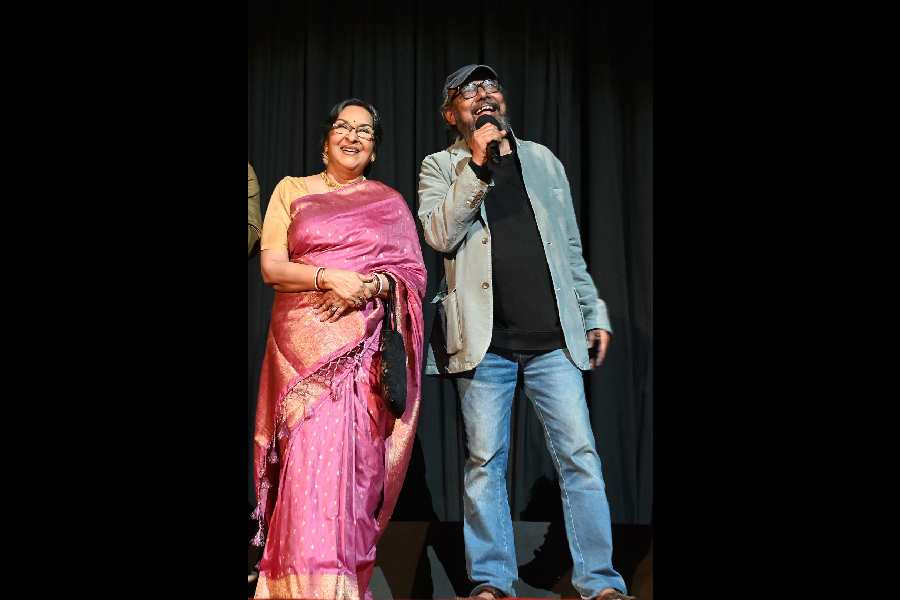
The winter air outside Priya Cinema on Friday evening felt unusually tender — the kind that settles softly on the skin and carries with it the hum of anticipation. The premiere of Deri Hoye Geche (directed by Saptaswa Basu) unfolded in an intimate whirl of warmth and familiar faces. The theatre lights glowed against a gathering that felt both cosy and star-laden, led by Anjan Dutt and Mamata Shankar, joined by Rituparna Sengupta, Shiboprosad Mukherjee, Nandita Roy, and an elegant stream of filmmakers, actors and friends of the industry who arrived without spectacle, yet with unmistakable affection for the film and its makers.
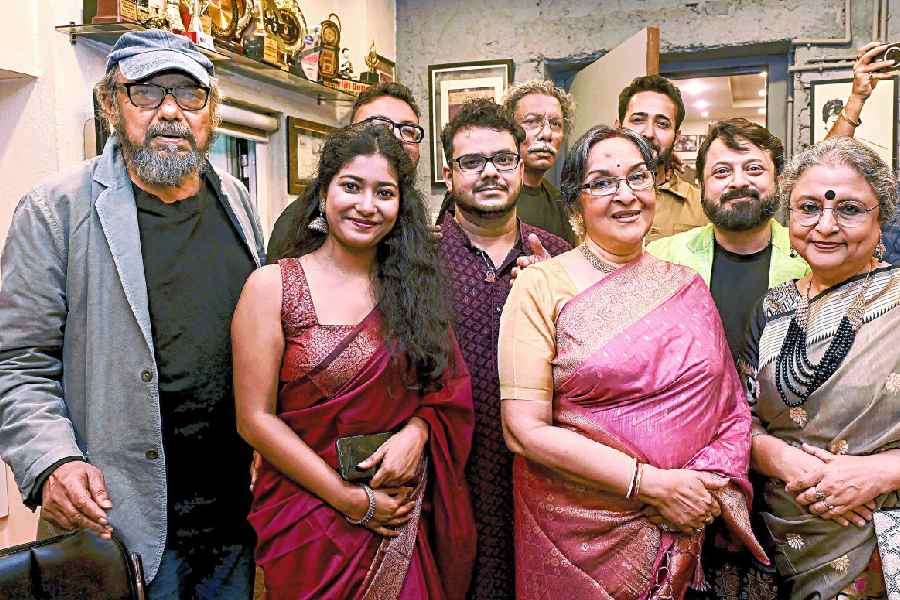
Anjan Dutt, Apala Chowdhury, Saptaswa Basu, Arijit Dutta, Mamata Shankar, Shiboprosad Mukherjee and Nandita Roy
“This film has a lot of our hard work and is not just another project. I don’t do films that are commercial or simple — it is not me. It is a layered story. Mamata and I go back a long way... we are friends and working with her feels like one long adda because of the warmth. People will like it… but it does require a certain palette to enjoy. It is special to me,” said Anjan Dutt.
The film carries its audience to Bolpur, where the quiet rustle of sonajhuri trees and the stillness of long-forgotten railway tracks fold into a story of time, wound and love that refused to die. Anjan Dutt’s Rishi Chatterjee, a retired police officer haunted by the ghosts of past encounters and crumbling under the weight of PTSD, returns to the world of Mamata Shankar’s Sanghamitra Guha Thakurta, the woman he once loved deeply but left waiting — abandoned at a railway platform while duty swallowed him whole.
Decades later, prompted by his perceptive superior played with gentle wit and restraint by Arijit Dutta, Rishi arrives unannounced at her homestay under the false name Niranjan Sengupta, posing as a history professor, certain she will not recognise him after all these years. The instant charge between them is palpable — visible in Mamata Shankar’s delicate urgency, her soft hesitation, her hands that move almost too quickly as if trying to outrun memory. He settles into a quiet room haunted by bottles of alcohol, his only escape from the relentless roar of trauma.
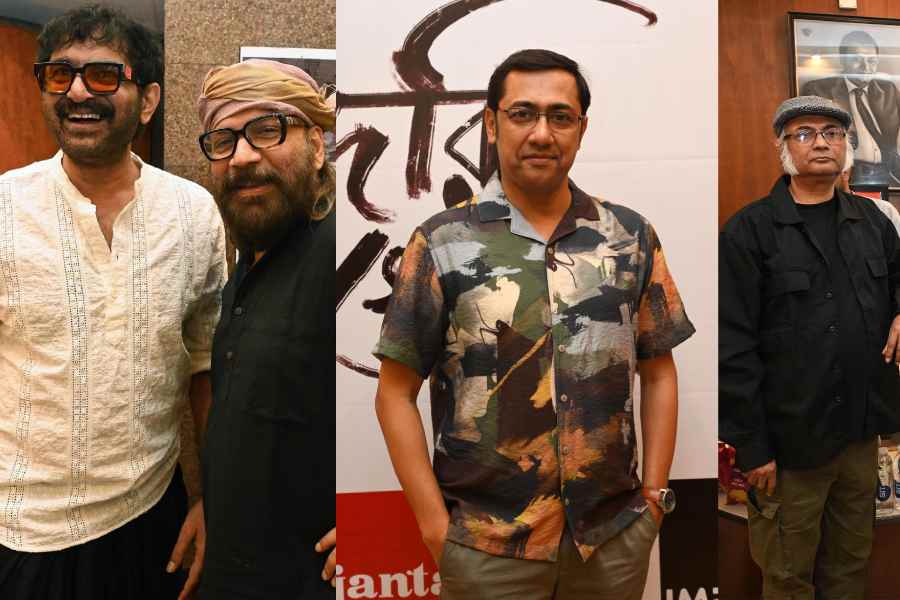
Silajit and Debojyoti Mishra, Subhrajit Dutta and Arghyakamal Mitra
Recognition comes unexpectedly, and when it does, it tears open years of silence. The pair stand before a riverbank fire — a scene carved with aching symbolism, and speak of the grief neither ever healed: the abandonment she endured, the pressures he drowned in, the impossible weight of lives interrupted. Rishi collapses soon after, and when the doctor notices old wounds on his back, he lies, and everyone knows he is lying — including Sayanti, played by Apala Chowdhury, a young woman who helps at the homestay and whose own story of love and loss echoes the film’s sorrowful heart. Only later do we learn she was once in love with Sanghamitra’s son, a social activist whose sudden death remains shadowed by mystery.
What follows is tender, inevitable and devastating. The ending walks exactly where the audience knows it will, yet leaves them shattered in their seats, holding the weight of what could have been. Saptaswa Basu crafts a film soaked in the ache of ageing, of mental illness left untreated, of promises broken by circumstance and time. It lingers long after the screen cuts to black — a soft, bruised whisper reminding us that sometimes love comes too late.

Rituparna Sengupta
Anjan Dutt is magnetic — humorous, sharp, wounded — his signature dialogue delivery cutting through the quiet in ways that draw laughter even through tears. His obliviousness to the history of Biswa Bharati and sonajhuri as a supposed history teacher is a moment of sharply written irony. Mamata Shankar, at once fragile and resilient, performs with grace that feels almost sacred — steady, luminous, profoundly felt.
"The audience reaction to Deri Hoye Geche has been overwhelmingly positive. I expected appreciation from the middle-aged to older generation primarily, but a section of the young audience also liked the film to a great extent. The performances of Anjan Dutt and Mamata Shankar are highly appreciated and the climax has been reviewed as unexpected and unpredictable. The breezy love story has a sense of innocence and humour. The dark shade of the encounter specialist adds a layer to the film. People have actually said that I could have increased the run time a bit more as they were enjoying watching the film. So I feel blessed with the journey so far," said Saptaswa Basu.
Deri Hoye Geche is not loud cinema. It is a slow-burning wound — intimate, truthful and heartbreakingly human. A film that asks, with trembling hands: What happens when love finds its way back — when everything that once stood in its way has already been lost?