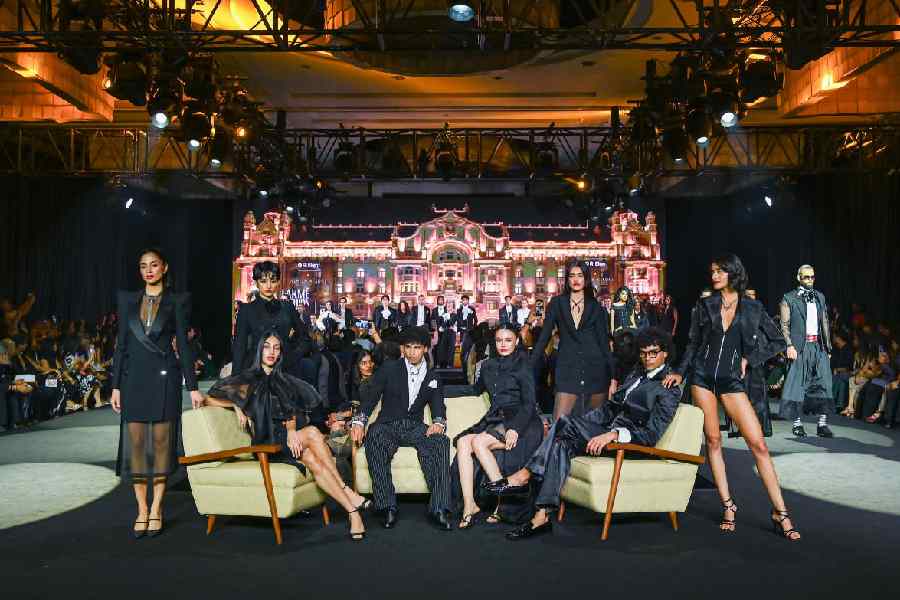
Ashish N Soni’s The Soirée at the Grand Budapest Hotel was a masterclass in tailoring. Chic, sophisticated, with an element of vintage glam, the designer made his favourite black the hero of the pieces. And mixed it up with various moods. The menswear was suave. The womenswear was a winner with sharp styles and power play of sheer and structure. Post-show, Ashish chatted with t2 on the new challenges he explored with the collection and how the lines may blur in menswear and womenswear.
Is The Grand Budapest Hotel one of your favourite films?
Yes, it’s definitely one of my favourite films, and also, I mean his (Wes Anderson) craft is just unbelievable. I felt that it was an interesting way to borrow ideation from, without sort of you know, delving into his space and making it too literal. I thought it would set the vibe and the atmosphere perfectly.
How much of a challenge was it making garments out of R|ElanTM fabrics?
I spent a couple of months just on R&D in terms of their product range. Also, you know what they had done till now was either they delved into the printed space or in the Indian pret space, but more sort of basically focusing only on fluidity and that kind of weight of fabric. So when they said we want to do something different, in the formal space, I thought it was first important to see and explore their range and therefore I travelled with their team to a few cities where they produce and in fact went to the mills and chose fabrics myself including the Reliance mills where I actually saw some blends which had all incorporated their EcoGold and GreenGold yarns but the fabrics were superior in quality. A lot of it was in that selection process only. So, half of what you were liking is because of the eye that I’ve developed over 30 years of experience. And because we had to start from the fabric stage rather than a sketch and then trying to figure out what we are doing, I wanted to ensure that the garments look superior in terms of tailoring, therefore the raw material will be perceived as luxurious.
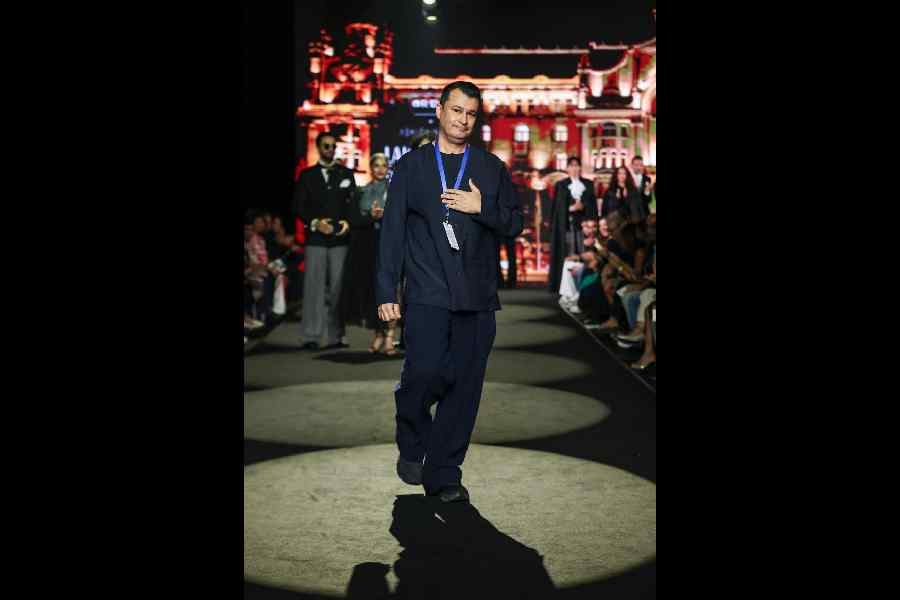
Designer Ashish N Soni walks the ramp during a Relan X Ashish N Soni show part of Lakmé Fashion Week 2025, held on October 11th at The Grand New Delhi, India. Photo : FS Media Pro / FDCI x Lakme Fashion Week / RISE Worldwide
Otherwise, for example, if I take a bad fabric, no matter how much tailoring I put into it, you will still be able to see those flaws and those defects. So, one half of the battle was the selection, and the next step was what to do with it, and my approach was to put all my tailoring prowess into ensuring that this looks like something that’s not been seen in India before.
Your womenswear was amazing…
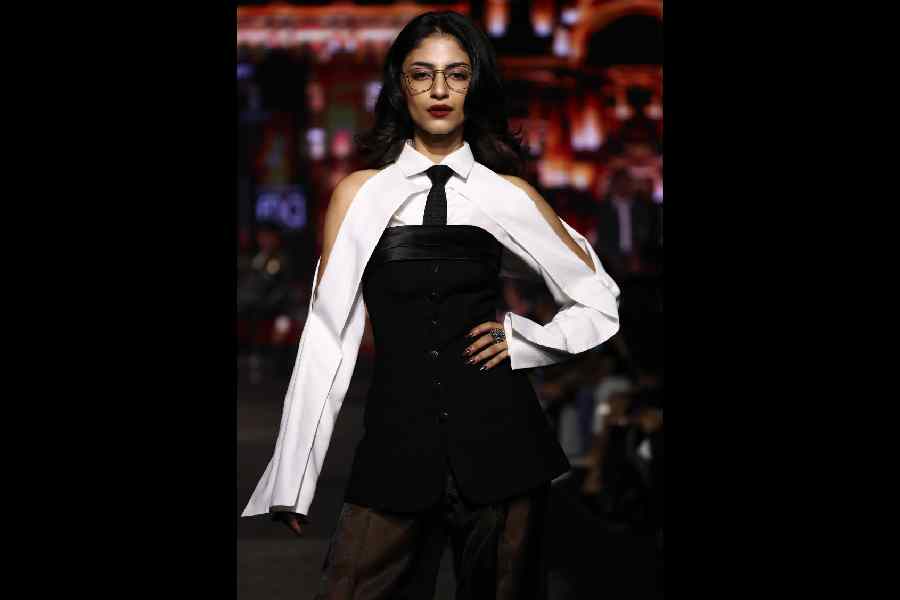
They in fact thought that I’d go into a very men’s-heavy collection, and I said to them that, you know, that’s again something that would be expected of me, and therefore it would be more obvious. So, I’m going to do a 50-50 collection. Also, the perception of eveningwear when you do it for women makes it more glamorous. Then I chose to play with sheer and opaque together. It was also something that was internationally relevant right now.
I incorporated a lot of tailoring even in the sheer because sheer is also very difficult to tailor. Otherwise, every stitch defect shows, and the way you finished it shows, and every element shows. Whereas in an opaque or thick wool, I can hide those things, but here I said, no, I’m going to pair them together so that it’s an interesting look, and the beauty of the fabrics gets very easily highlighted in terms of comparison.
The collection was versatile too…
So, that was the second thing that you didn’t have to buy them the way I had styled them. You can buy whatever pieces you think work in your wardrobe. For example, one particular jacket can be worn with a sari. It can be worn with trousers if you want it to be less elaborate. And then of course, if you want to, for that evening vibe that we were creating, we put it with a sheer skirt, you know, you can wear it with a lehnga. So that was a thought that they should work as extremely elegant pieces in your wardrobe, which remain classics for people to wear.
Did you use a tough kind of lace for some of the sheer pants?
That’s right. They were all recycled polyester with laces. A lot of people have talked to me about them. There were a lot of firsts that I had done here for myself. With R|ElanTM, I travelled to a lot of their mills and their partners in Surat, which is where they supply a lot of the recycled polyester. And that’s where I found a lot of these very interesting sheer fabrics, including those machine-made laces.
And, but again, they’re not perceived to be luxury. And I said, okay, how does one incorporate something or cut a garment in a way that it looks very interesting to wear? Second thing, when you don’t line those things, it also shows the quality of the fabric because otherwise it would irritate the wearer, if it were inferior. I’ve used certain tricks to ensure that both in terms of fashion, as well as in terms of product relevance are visible on the stage.
I told these guys, I’m going to go very deep into using your fabrics because, since I’m playing with just one colour, I need to ensure that there is so much on display that people forget that it was a singular colour collection.
Black is something that you love…
I think I think in black!
What were the new things you tried in menswear?
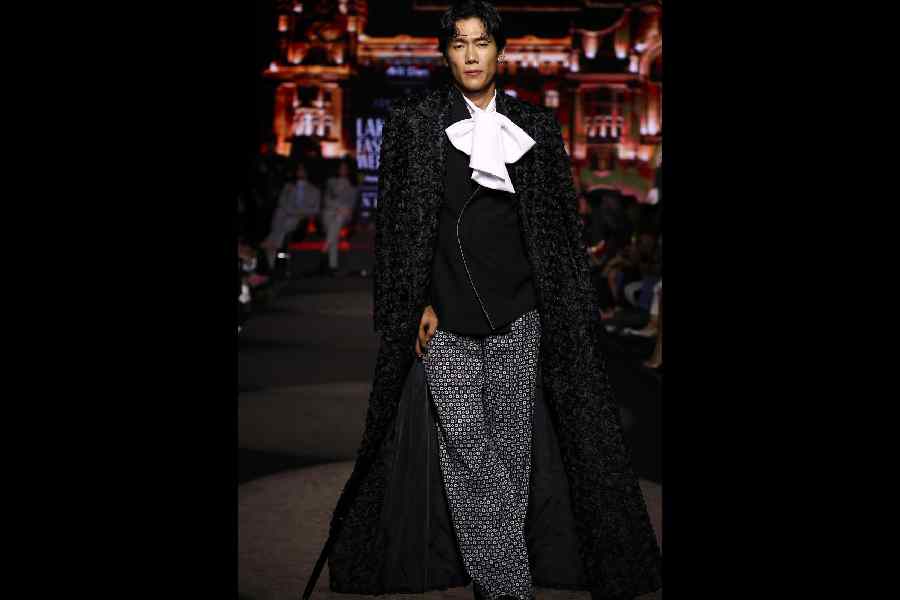
I think one interesting thing to do is try and mix up, you know, the obvious, which would be that a soiree at the Grand Budapest Hotel would incorporate people who respect only classic tuxedos and tailcoats and that kind of vibe. I said, how does one make this more interesting? I did two things. One was to put skirts on men. And, second was to bring in the bomber jacket on top of a formal tuxedo. So, I did a tailored bomber jacket instead of sporty bomber jackets and use them on top of formal suits and jackets.
Those were the two new things in terms of presentation that I feel worked well for the show. The uniforms were also more inspired by the actual movie, and I’ve just taken it a little further in terms of the militarisation of it, depicting the grandness of the hotel.
Do you see menswear and womenswear merging somewhere?
There’s this whole talk internationally about, in any case, not just within fashion, as you know, over everything from corporate life to everything where, you know, what we used to discuss as women’s empowerment, it’s almost like now everyone’s talking about gender equality, right? And when you specifically talk about it in terms of fashion, I’ve even had conversations with a few friends of mine in the business in the West where they predict that 10 years from now, you might not even have, you know, how you have a men’s floor and a women’s floor in those in the big departmental stores, all that will also merge into genderless shopping.
There will be a range in sizes. For instance, if now women have five options and men, three to four, you could have a product that has eight to 10 size options, but it’s genderless. Like you would buy a small and I would buy a large. It doesn’t say it’s men’s or women’s. Let’s see if it could come true.
I think more than just fashion, if you look at, especially with the Gen Z’s as they age, this might be a natural progression, you know, where they don’t feel the difference between men’s fashion and women’s fashion or anything like that.