The red clay courts of Roland Garros are perhaps gearing up for a new champion in nearly two decades, when the French Open begins on Sunday.
Since 2005, the second grand slam of the year has been undoubtedly ruled by Rafael Nadal (14 titles) while his compatriot Carlos Alcaraz won it the last two times.
In between, Novak Djokovic emerged champion thrice and in 2015 Stan Wawrinka had surprised the Serb in the final for his lone triumph at the Paris grand slam. The Swiss former world No.3 is currently ranked 119 and though he is competing, there is really a very very slim chance of him making it to the deep end of the draw.
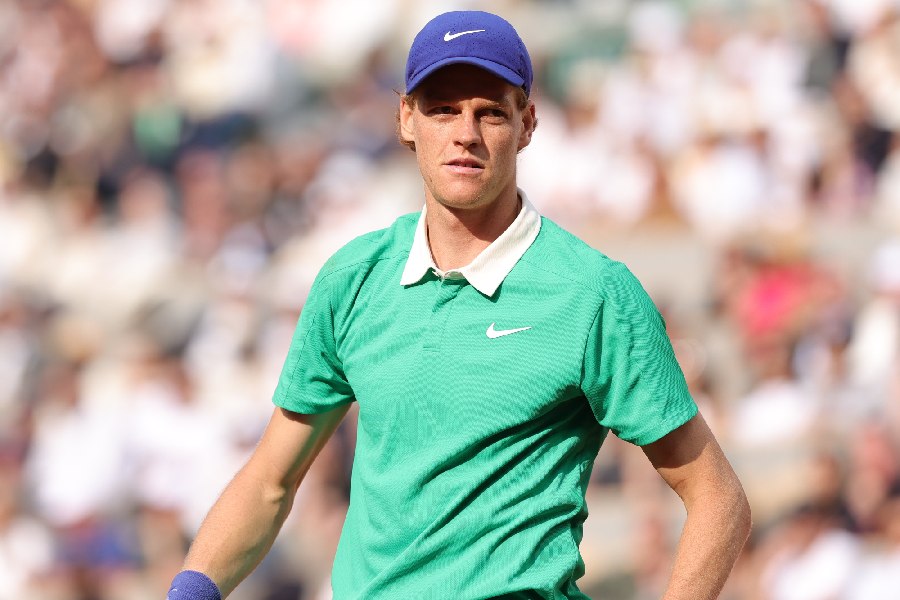
So, in the absence of Alcaraz who withdrew with an injured wrist, the path to glory seems to be rather smooth for the top seed and world No. 1 Jannik Sinner who has yet to open his account at this grand slam. And a title here will complete his career grand slam.
Will it be a cakewalk for Sinner? If a poll is taken now, the chances of that being a resounding ‘yes’ is possible. But, when Djokovic is around, then one really cannot be certain. Because, no matter the difference in age and fitness, he has the uncanny ability to play with a steely resolve, specially when the chips are down.
They are placed in opposite halves of the draw and the possibility of a final showdown is on the cards.
Sinner arrives with a 29-match winning streak and will open his campaign against French wild card Clement Tabur. Djokovic begins his latest bid for a 25th major trophy against Giovanni Mpetshi Perricard and could face Joao Fonseca in the third round.
Last year, the Sinner and Alcaraz match had produced one of the greatest French Open finals in history. But this time, the show should belong to Sinner — unless Djokovic comes up with another plan.
Sinner’s recent form is almost frightening. He has swept through the ATP Masters circuit, winning Monte Carlo, Madrid and Rome.
What makes Sinner especially dangerous this year is that there appears to be no obvious challenger capable of matching his relentless baseline precision over five sets on clay. His movement has improved enormously, his serve has become a major weapon and, perhaps most importantly, he now carries the aura of being unbeatable.
However, the 39-year-old Djokovic remains a looming presence. The Serbian has openly admitted in recent months that his body no longer recovers as it once did, but grand slams remain his priority. The runner-up finish at this year’s Australian Open shows his hunger is very much alive.
And if there is one player who understands how to survive the emotional and physical demands of a grand slam, it has to be Djokovic.
Beyond the two names, the men’s field has a transitional feel. Alexander Zverev, seeded second, remains a threat on clay, while younger names such as Joao Fonseca and Jakub Mensik represent the next wave trying to break through. But without Alcaraz, the emotional charge of the tournament has take a hit.
The women’s competition looks far more open and unpredictable. Top seed Aryna Sabalenka enters Paris as arguably the most dominant player on tour right now, armed with explosive power and improved movement on clay.
Coco Gauff, the defending champion and fourth seed, has matured tactically and mentally, and her athleticism makes her exceptionally dangerous on slow courts.
Then there is Iga Swiątek, who had won four of her six grand slam titles at the French Open. Seeded third, she however had been inconsistent recently. But Paris remains her happy hunting ground.
Elena Rybakina, the second seed, also enters the tournament with confidence, after her Australian Open triumph.
Teen sensation Mirra Andreeva continues to gather attention as a potential future major champion.
The women’s field may ultimately provide the more compelling drama because there are at least five or six legitimate contenders capable of lifting the trophy.
Last hurrah
French veteran Gael Monfils was drawn against compatriot Hugo Gaston for what is expected to be his final appearance at Roland Garros. Another farewell storyline will see 17th seed Arthur Fils take on 2015 champion Wawrinka, who is also preparing for his final campaign on the Paris clay.
Off the court
The build-up to this year’s tournament saw an increasingly bitter dispute between players and grand slam authorities over prize money and revenue sharing.
Leading stars including Djokovic, Sinner, Sabalenka and Gauff had been vocal about what they see as an unfair distribution of tournament revenues.
Players reportedly receive only around 15 per cent of grand slam revenues and are pushing for a far larger share, alongside better pension and welfare structures.