 |
| UFO or spy satellite? |
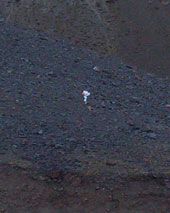
The mystery posed by the unidentified flying object spotted last month by Indian scientists in the Himalayas may remain embroiled in deadlock ? unless its makers come forth, or it reappears. A team of geologists, on an expedition to study the Samundri Tapu glacier in Himachal Pradesh, about 15,000 feet above sea level, saw and photographed an object that resembled a cluster of balloons tied together and displayed ?strange movements?.
The geologists from the Space Applications Centre (SAC), Ahmedabad, and Himachal Pradesh, who saw the object, assert that it didn?t behave anything like a balloon. But aerospace experts who have seen a photograph of the object argue that wind currents over the mountainous terrain and human perceptions of objects in a vast open space may explain whatever the geologists had observed. They also say that technology exists today to build small unmanned flying vehicles.
The SAC scientist who led the expedition says the most striking thing about the object was its movement. ?It manoeuvred itself in what appeared to be finely-controlled motion. Free-floating balloons don?t do that,? said Dr Anil Kulkarni, a senior geologist at SAC. ?It appeared to have the ability to manoeuvre itself around small boulders, elevations and depressions on the ridge,? he said.
A little past seven on the morning of September 27, the geologists who had set up camp at the base of a steep ridge saw the object approaching them, soundlessly moving along a diagonal path down the ridge. The vertically-upright object appeared to have three white balloons and a single red balloon at its top and other structures underneath. As the expedition members started walking towards the object, their porters shouted.
The geologists claim that the object stopped its descent at the sound of the shouting porters. ?It was almost as if it sensed the sound,? said Professor Sunil Dhar, a geologist in a postgraduate college in Dharmashala, and an expedition member. Both Kulkarni and Dhar refuse to speculate on what the object may have been, but say the observations indicate ?controlled movements?.
However, aerospace experts at the Indian Institute of Technology, Bombay, say wind could also explain such movements. ?Imagine a balloon carried by wind towards a tall building. As it approaches the obstacle, the wind flow will carry the balloon right over the building ? to a distant observer, it appears as if the balloon ?sensed? and avoided the building,? said Dr K. Sudhakar, professor at the IIT, Bombay, who?s worked on unmanned aerial vehicles.
The object has also triggered speculations whether it was a device for covert surveillance. At IIT, Bombay, Dr Hemandra Arya says cutting- edge technology today makes it possible to build small electric-powered autonomous unmanned aerial vehicles. A simple explanation is that it was a runaway balloon cluster; a sophisticated one is that it was an unmanned aerial vehicle powered by electric motors which would also explain the lack of sound, said Arya. ?We certainly don?t need to invoke ET for this,? he said.