 |
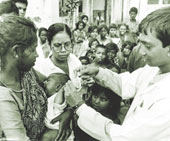
| MASS CAMPAIGNS: A proper implementation of such Central initiatives as the mass drug administration of DEC is needed to curb the menace of lymphatic filariasis |
It’s a common belief that when a woman contracts an infection during her pregnancy, she can shield her child against it, at least temporarily. How is this possible? Well, it is believed that the foetus receives from the infected mother antibodies that can protect it. However, this theory doesn’t work when the foetus catches the infection directly from the mother. It also doesn’t hold true in case of an infectious disease like lymphatic filariasis, or filaria, caused by a type of parasite and vectored by mosquitoes.
A recent study by researchers at University of Connecticut and Case Western Reserve University, Cleveland, suggests that if a woman contracts the parasitic infection of filaria during pregnancy, the foetus isn’t immune to it. As a result, the child after he or she is born remains vulnerable to lymphatic filariasis.
Millions affected
The study, yet to be published in journals, is significant from the Indian perspective because our country accounts for 74 per cent of the endemic filaria population. “To prevent the mother-to-child spread of filariasis, a proper strategy should be taken up so that pregnant women infected with the filaria parasite can receive immediate treatment and children born of filaria-infected mothers can get proper screening,” says Dr Sudip Saha, a professor of obstetrics and gynaecology at Calcutta Medical College and Hospital.
“One should not neglect filaria just because it’s a disease common among the poor and because it doesn’t lead to fatality. The disease affects about 10 million people in developing nations. It disfigures the legs, thanks to the swelling of the limbs and the hardening of the skin. It’s a condition known as elephantiasis,” he adds.
The issue of mother-to-child spread of filariasis may be new to Indian researchers, who’re working to eliminate the disease from the country. According to medical surveys, India has 21 million clinical cases and 28 millions carriers of filariasis.
The mother-to-child link to the occurrence of this disease may add to the problems. Says Dr Bikram Kumar Saha, former assistant professor of medicine at RG Kar Medical College Hospital, “Filaria is a neglected disease. If you see journals, you won’t find much Indian research focused on the elimination of the disease.”
He then goes on to add, “The disease is really debilitating, it affects poor people and causes incapacitation, stigmatisation and quite a colossal waste of money. Poor people, particularly in the rural areas, are often treated by quacks.”
A statement (http://namp.gov.in/filariasis.html) on the disease issued by the Government of India’s National Vector Born Disease Control Programme says, “Filariasis is caused by several round, coiled and thread-like parasitic worms belonging to the family, filaridea.
These parasites, after getting deposited on the skin, penetrate on their own or through the opening created by mosquito bites to reach the lymphatic system. The disease is caused by the nematode worm, either Wuchereria bancrofti or Brugia malayi, and transmitted by ubiquitous mosquito species Culex quinquefasciatus and Mansonia annulifera/M.uniformis, respectively.”
Bizarre symptoms
“The disease,” the statement continues, “manifests itself often in bizarre swelling of legs and hydrocele and is the cause of a great deal of social stigma.” It adds, “Filariasis has been a major public health problem in India next only to malaria. The disease was recorded in India as early as sixth century BC by the famous Indian physician Susruta in his book Susruta Samhita.”
It further notes, “In seventh century AD, Madhavakara described signs and symptoms of the disease in his treatise, Madhava Nidhana, which hold good even today. In 1709, Clarke called elephantoid legs in Cochin as ‘Malabar legs’. The discovery of microfilariae (mf) in the peripheral blood was made first by Lewis in 1872 in Calcutta.”
The problem with filariasis is that the parasite causing the disease can remain in the body undetected for a substantially long period of time ? maybe 10 years or so ? and it can be found in the blood only at night. Elephantiasis or the swelling of the limbs takes a long time to make its presence felt. Since there is no manifestation of the condition, victims of filariasis in most cases get to know about the disease at an advanced stage. All these hamper treatment.
The Indian government has been undertaking successive filaria control programmes since 1956, but they have done little to curb the menace.
In 1996-97, an annual mass drug administration with a single dose of diethylcarbamazepine (DEC) was taken up as a pilot project covering 41 million people.
It went on to cover 77 million people by 2002. About 400 million people were brought under the mass drug administration strategy during 2004.
Currently, India’s National Health Policy 2002 aims to wipe out lymphatic filariasis by 2015. The target can be achieved by carrying out “the annual mass drug administration of DEC for five years or more” and extending it to the whole of the population, “excluding children below two years, pregnant women and seriously ill persons in affected areas”, according to the National Vector Born Disease Control Programme’s statement.
Experts say that along with the proper implementation of the current strategy, medical researchers in India should be concentrating on combating the infection in pregnant women and children.