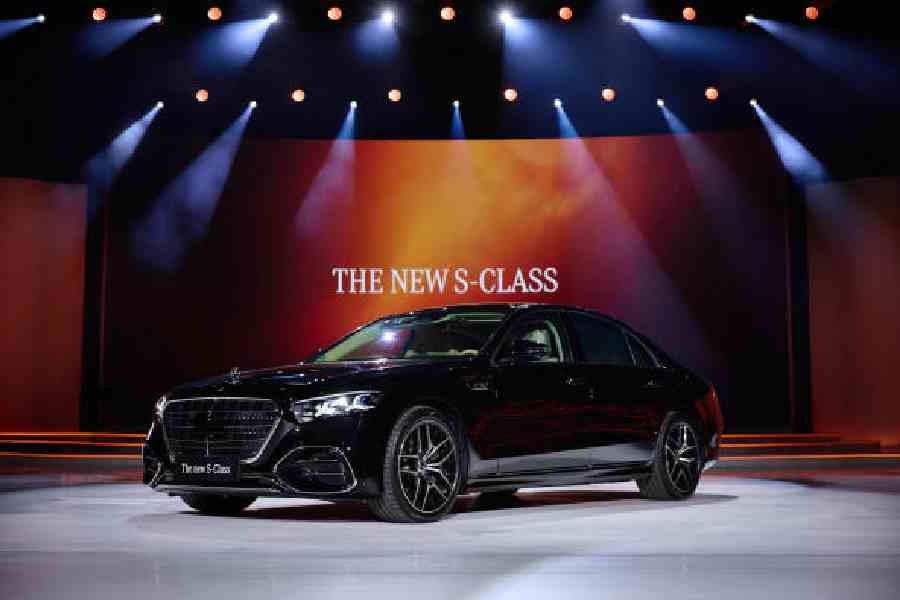
Mercedes-Benz has just rolled out the latest version of its flagship model, the S-Class, in India. The specific model in question is called the S450e. On the face of it, this latest rollout is a mid-life update of the S-Class limousine. And while the structural underpinnings of the car remain the same, the manufacturer says, “More than 50 per cent of the S-Class, comprising over 2,700 components, has been newly developed, updated or refined — the most comprehensive update within a single S-Class generation.” What is most significant, however, is the change in the powertrain. For, now it is a plug-in hybrid electric vehicle, or PHEV. That is essentially a strong self-charging hybrid vehicle with the addition of a facility to charge it with an external charger. The S-Class retails for ₹2.20 crore upwards at the showroom.
Just a little while before that, the world’s largest maker of PHEVs and battery electric vehicles (BEVs), BYD of China, which sells a bunch of pure BEVs in India, showcased a platform called the DM-i, denoting ‘dual mode’ technology. This is again a PHEV platform and the first vehicle that BYD is expected to roll out based on that sometime later this year is the BYD Seal U DM-i at somewhere around ₹50 lakh. And while it is not in the same segment as the Mercedes-Benz S450e, the powertrain that will drive the car will use the same underlying principle.
Further down the price scale, Honda Cars India recently updated its City e:HEV, which, while it does not have a plug-in charging facility, still offers a self-charging strong hybrid option to buyers. It sells for around ₹21 lakh. And Honda’s upcoming ZR-V SUV, which is supposed to be the company’s top offering in India and expected to cost upwards of ₹40 lakh, will again use the same technology, except that it will be using a bigger petrol engine than the City coupled with the electric system to deliver the propulsion power.
Then, towards the end of this year, JSW, which is a partner of MG Motors in India as of now, is supposed to independently launch its own line of vehicles. And the first among them would be the Jetour T2 small SUV. Now this is a very square piece of kit with looks inspired by the Land Rover. What is significant is that it is likely to come in with a PHEV powertrain.
Suddenly, there is a flurry of activity in the strong hybrid vehicle space, with manufacturers looking at it as a kind of halfway house between internal combustion power and electric vehicles with the upsides of both but the downsides of neither. To be fair, strong HEVs are not a new phenomenon in the Indian automotive market. Toyota has been selling the Camry as a hybrid for many years now and it has been four years since Honda introduced the first version of the City e:HEV.
In fact, a handful of strong hybrids rolled out in the last few years. India’s largest carmaker Maruti Suzuki brought out the Grand Vitara and Toyota its sibling the Toyota Urban Cruiser Hyryder. Similarly, there was the Innova Hycross from Toyota and its Maruti Suzuki version, the Invicto. The last two were offered only with strong hybrid powertrains as opposed to the Grand Vitara/ Urban Cruiser Hyryder, which came with other engines as well.
So, what is a strong hybrid and why should one even be bothered with it? A car qualifies to be called a strong hybrid if it can be driven on electric power only without the internal combustion engine (ICE) providing any power directly to the wheels. Typically, strong hybrids operate as electric-first powertrains with a system of clutches that allow just the electric motor to be used to get the car rolling. Their batteries and motors are bigger than those in mild hybrids. In the latter, the electric motor works as a complementary power source and a generator to store brake energy in the battery, while the ICE works all the time to power the wheels.
After getting the car rolling, a strong hybrid continues to be driven by the electric motor and, if the charge in the battery runs down, then the ICE kicks in only as a generator to charge the battery. This is usually what happens in city conditions, where the high torque of the electric motor moves the car easily. It is only when high performance is needed that the ICE engine syncs with the electric motor to together send power directly to the wheels. The ICE is usually an Atkinson cycle or Miller cycle engine (they are super fuel efficient but a little thin on power output) that, when paired with the electric motor, has its weak points nicely covered. The result is pretty phenomenal fuel efficiency. So, more than 25kmpl, or 1,000km-plus on a single tank of fuel is common for cars that aren’t too small.
Plus, even though the car behaves like a BEV most of the time, particularly in city traffic, there is no worry about running out of charge, or range anxiety, since these cars are self-charging. Even the plug-in hybrids, which can be charged externally, can also charge the battery from the ICE on the go. So, it looks like win-win all the way, but that isn’t entirely the case. There is a price to pay for this convenience and that is in the sticker prices of these vehicles.
Compared with either an ICE vehicle or a BEV, which use just one powertrain, the strong HEV uses two, ICE and electric motor and battery. And the cost of equipping cars with both gets built into their prices. So, these tend to be somewhat more expensive. In India, the minimum price of the Mercedes-Benz S-Class (ICE vehicle) before the 2026 update was ₹1.85 crore. That is now up to ₹2.20 crore with the PHEV and other updates. The Maruti Suzuki Grand Vitara strong hybrids cost significantly more than their petrol counterparts for the same trim levels. The story is the same for the Honda City with the e:HEV being its most expensive variant.
Does the saving on fuel offset the price difference? That would depend on how much the car is driven. For example, the Honda City e:HEV has a fuel efficiency of 27.13kmpl as certified by ARAI compared with the CVT petrol, which is certified at 18.4kmpl, so a difference of about 9kmpl.
But there is also another factor to consider, and that is the ease of use. Particularly for city driving, given the mappings of strong EVs to run as pure electrics, they work wonders to lower stress levels. And that is an intangible that needs to be factored in as well. And there is no range anxiety to boot. There seems to be enough reason to warm up to strong hybrids after all.