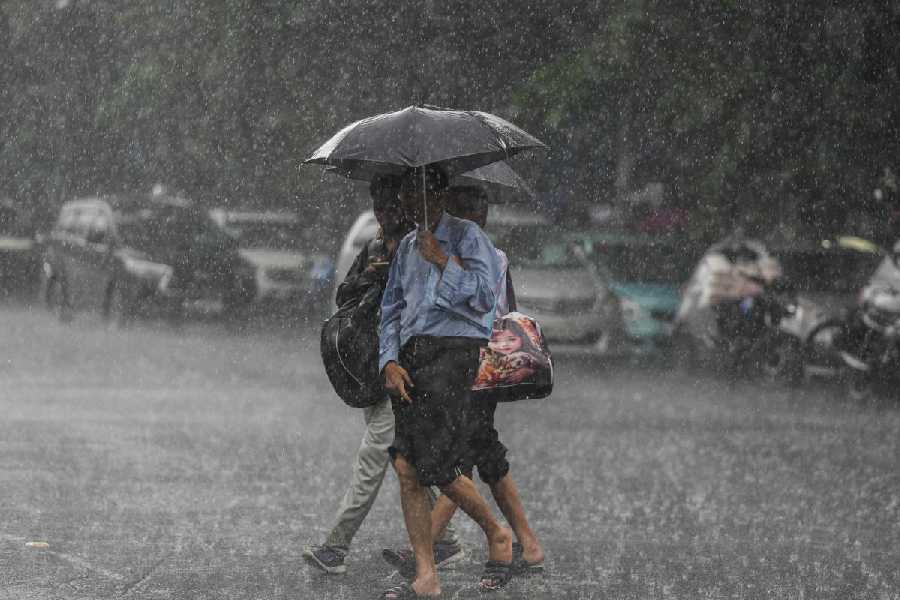
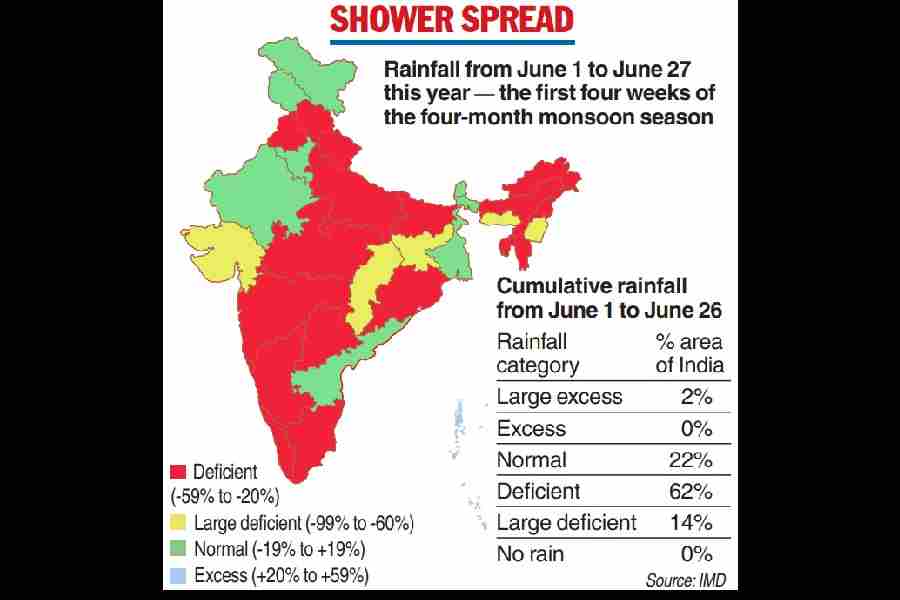
Rainfall across India in June has been 42 per cent below normal, the weakest start to the summer monsoon in more than a decade and a half, leaving 76 per cent of the country “deficient” or “large deficient” in rainfall. Forecasters expect July, too, to be drier than usual.
The country’s 166 major reservoirs, monitored for irrigation and drinking water, held 26 per cent of their combined storage capacity on June 25. The water levels were down to 14 per cent at Indira Sagar, 5 per cent at Nagarjuna Sagar and 2 per cent at Tehri.
Weather scientists expect the rising sea surface temperatures in the Pacific — a phenomenon called El Nino — to keep the monsoon rainfall below normal through much of July, even after a possible revival during the month.
The weak Indian monsoon comes as Europe endures its most severe heat wave on record, with temperatures across parts of France, Germany, Italy, Spain and southern England running 5 to 12 degrees Celsius above seasonal averages. (See Page 2)
The World Weather Attribution, a multi-country research group, said on Friday that the heat wave, driven by a persistent high-pressure system drawing hot air from North Africa, had been intensified by human-caused climate change.
Scientists say that while El Nino has only a limited influence on Europe’s summer weather, it is expected to be the dominant driver of India’s monsoon this year.
Some economists argue that El Nino does not always translate into macroeconomic impacts because other climate patterns, including conditions in the Indian Ocean, can partly offset its effects.
But monsoon specialists say the current season increasingly resembles 2009, when June rainfall was 47 per cent below normal and India suffered one of its worst droughts in decades. Over the full 2009 monsoon season, rainfall was 22 per cent below normal.
“Weak June rainfall in an El Nino year is not a good sign,” Madhavan Rajeevan, a senior atmospheric physicist and former Union earth sciences secretary, told The Telegraph. “El Nino is the dominant influence on India’s monsoon, so any revival in July is likely to be limited.”
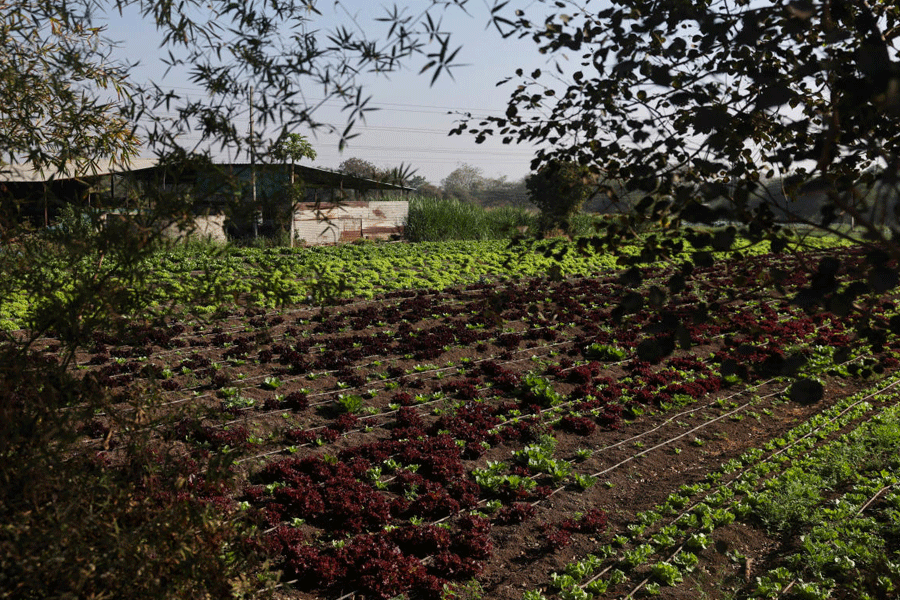
India’s four-month summer monsoon delivers three-quarters of the country’s annual rainfall, replenishing reservoirs and groundwater and sustaining the farm economy. Nearly half of India’s farmland depends on rainfall, making the rains critical for crop yields, food prices and rural incomes.
Scientists say the absence of any low-pressure systems over the Bay of Bengal through June this year, while not entirely unexpected, is an ominous sign.
Low-pressure systems serve as triggers for bursts of widespread rainfall across central and northern India.
A 110-year analysis of low-pressure systems in the Bay of Bengal, from 1891 to 2000, had found that the total number of such systems ranged from 9 to 18 through the four-month monsoon season.
“In June, we would expect at least one to have formed by now, but there is no sign of one yet,” Rajeevan said.
Weather scientists say that while the El Nino effect will dominate this year, a short-term rainfall revival could occur under the so-called Madden Julian Oscillation, a slow-moving band of tropical storm activity that circles the tropics every 30 to 60 days and can temporarily strengthen India’s monsoon when conditions are favourable.
The Union agriculture ministry, while acknowledging the risks posed by a weak monsoon, said earlier this week that buffer stocks of rice and wheat “remain comfortable” and that there was no immediate threat to food security.
The Indian Council of Agricultural Research and the agriculture ministry have identified 315 districts as vulnerable to deficient rainfall and inadequate irrigation, including 111 high-priority districts with irrigation coverage levels below 25 per cent.
Most of these are spread across Andhra Pradesh, Bihar, Gujarat, Jharkhand, Karnataka, Madhya Pradesh, Maharashtra, Odisha, Rajasthan, Telangana and Uttar Pradesh — among 27 states that have received deficient or large-deficient rainfall this month.
The ministry has urged state governments to promote short-duration and less water-intensive crop varieties, encourage crop diversification and mixed farming, and prioritise drinking water supplies in vulnerable districts. It has also reported reservoir deficits of 20 to 60 per cent in several river basins.
The Central Water Commission said the country’s 166 major reservoirs held about 48 billion cubic metres of live storage on June 25, or 26 per cent of their combined capacity at full reservoir level.
But crop weather specialists say it is too early to make any predictions about the country’s overall agricultural output.
“Rainfall activity during July and August is crucial for sowing — far more important than June rainfall,” M.H. Manjunatha, an agronomist at the University of Agricultural Sciences, Bangalore, told this newspaper.
“Farmers have the option of (turning to) short-duration varieties of various crops. We’ll be in a better position to predict the impacts of El Nino after July and August.”