 |
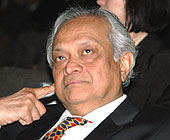
| VECC and SINP director Bikash Sinha (Picture by Sanat Sinha) |
To guess what happened 13.7 billion years ago is by no means an easy job. Add to the problem the fact this Universe was born then in a cataclysmic burst of energy called the Big Bang. How did matter take shape from that sea of pure energy? Physicists all over the world are trying hard to understand that process, by smashing particles and mimicking the condition that prevailed a split-second after it all began. But how to know for sure that they are actually re-creating those conditions? Among the band of theorists trying answer the question is Dr Bikash Sinha, director of the Variable Energy Cyclotron Centre (VECC) and Saha Institute of Nuclear Physics (SINP), who turned 60 last week. To mark this occasion, Sinha?s colleagues from India and abroad organised a Fest Colloquium at the new auditorium of the VECC and SINP on February 7.
?Sinha was born in a royal family which patronised scientists, painters, poets, writers and musicians,? said Dr Dinesh Srivastava of the VECC, who spoke on ?Bikash Sinha: A Life for Physics?. ?This was evident from Sinha?s childhood which was peppered with magical moments spent in the presence of luminaries like S.N. Bose, Bade Gulam Ali Khan, Vilayat Khan, Nandalal Bose and Jamini Roy.?
?In 1973, 28-year-old Sinha wrote a seminal paper in the Physical Review Letters and this marked a new era in nuclear physics,? said Dr Larry McLerran of the Brookhaven National Laboratory (BNL) at Long Island, US, in his speech on ?Searching for the Quark-Gluon Plasma with Bikash Sinha?. ?In that paper, he mused on the microscopic turmoil that shows up when two heavy atomic nuclei come close to each other.?
In 1975, Sinha wrote a review article describing a method that helps unravel how atomic nuclei behave during scattering and radioactive decay. This article, published in the Physics Reports, has been enshrined in textbooks and remains an authoritative one till date.
These papers caught the attention of Dr Raja Ramanna, then chairman of India?s Atomic Energy Commission, who invited Sinha to came back to India from the UK and join the Bhaba Atomic Research Centre (BARC), Bombay, in 1976.
In 1983, Sinha joined the VECC in Calcutta. It was during this time that he got obsessed with unravelling the mystery of quarks, the tiniest components of matter. ?Sinha?s interest in quarks culminated in a seminal paper on ?Universal Signals of Quark-Gluon Plasma?,? Mclerran said.
Biplab Das